For Doctors in a Hurry
- Clinicians lack evidence regarding the benefit of adjunctive intra-arterial alteplase after successful endovascular thrombectomy for posterior circulation stroke.
- This multicenter randomized trial enrolled 246 patients with acute basilar artery occlusion across 37 comprehensive stroke centers.
- Functional independence at 90 days occurred in 41.9 percent of the treatment group versus 46.7 percent of controls (P=0.55).
- The researchers concluded that intra-arterial alteplase did not improve functional outcomes compared to endovascular thrombectomy alone.
- These findings suggest that routine use of intra-arterial alteplase after successful recanalization provides no additional clinical benefit.
Refining Reperfusion Strategies in Basilar Artery Occlusion
Mechanical thrombectomy (a procedure using a catheter to physically remove a clot from a blood vessel) has established a high standard of care for acute ischemic stroke, offering significant survival and functional benefits for patients with large-vessel occlusions [1, 2, 3, 4]. While its efficacy is well-documented in the anterior circulation, its application in the posterior circulation, specifically for basilar artery occlusion (a blockage of the primary artery supplying the brainstem), has required rigorous investigation to confirm similar advantages [5, 6]. Despite achieving high rates of successful recanalization (the restoration of blood flow through a previously blocked vessel), many patients still experience poor functional outcomes, prompting clinicians to investigate adjunctive therapies like intra-arterial thrombolysis (the targeted delivery of clot-dissolving medication directly into the affected artery) to resolve residual microvascular obstructions [7, 8, 9]. Current guidelines continue to evolve as researchers determine if combining pharmacological and mechanical approaches can improve clinical recovery [10, 11]. The IAT-TOP trial, a randomized clinical trial involving 246 patients, now provides evidence regarding the utility of this adjunctive approach in the high-stakes setting of posterior circulation stroke [9].
Trial Design and Patient Characteristics
The researchers utilized a multicenter, prospective, randomized, open-label, blinded–end point clinical trial design, commonly referred to as a PROBE design (a methodology where the treating physician and patient are aware of the assignment, but the primary outcome is evaluated by an independent assessor who is masked to the treatment group). This study was conducted across 37 comprehensive stroke centers in China between September 5, 2023, and November 29, 2024, with the final 3-month follow-up assessments completed on February 18, 2025. The trial focused on adults who presented with acute basilar artery occlusion within 24 hours of the time they were last known to be well. To be eligible, participants were required to have achieved successful recanalization (the restoration of blood flow through the previously blocked vessel) following endovascular thrombectomy. A total of 247 patients were initially enrolled, though one patient was excluded from the full analysis set because the basilar artery reoccluded before the administration of the intra-arterial alteplase. The remaining 246 patients were randomized into two cohorts: 124 patients (50.4%) were assigned to the treatment group to receive adjunctive intra-arterial thrombolysis, while 122 patients (49.6%) were assigned to the control group, which received no additional intra-arterial thrombolysis after the initial procedure. The final analysis set had a median age of 65.0 years (interquartile range, 56.0 to 72.0 years), and 176 participants (71.5%) were male.
Intra-arterial Thrombolysis Protocol
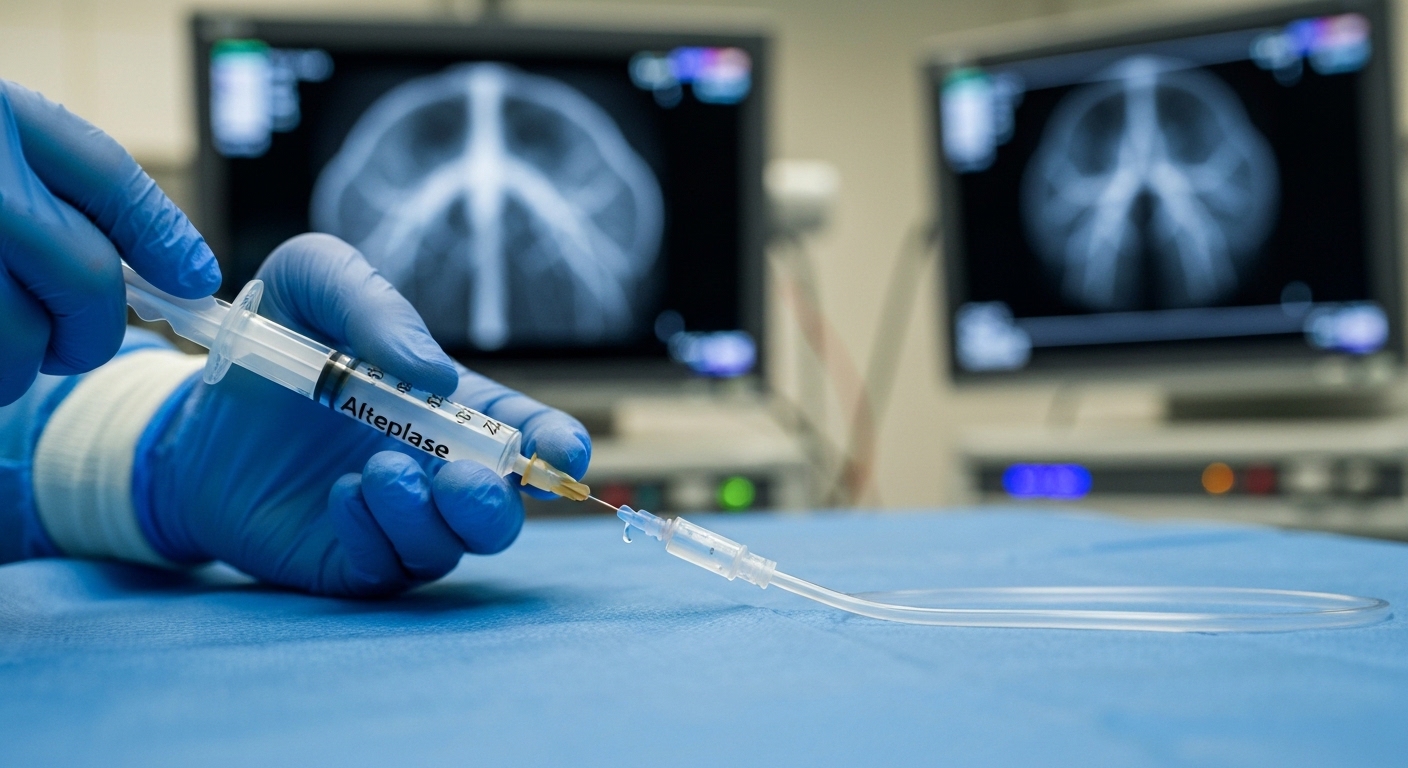
The intervention protocol focused on the delivery of a thrombolytic agent directly into the cerebral vasculature following the mechanical removal of the primary occlusion. Patients randomized to the treatment group received intra-arterial alteplase at a weight-based dose of 0.225 mg/kg, with the total dosage strictly capped at a maximum limit of 22.5 mg. This pharmacological adjunct was intended to address distal emboli or microvascular thrombi that might remain after the large-vessel clot is extracted, potentially improving the capillary-level perfusion that mechanical thrombectomy alone may not fully restore. The administration technique required precise anatomical targeting and a controlled rate of delivery; the researchers infused the alteplase at a concentration of 1.0 mg/mL over a period of 15 minutes. This infusion was performed distal to the origin of the posterior inferior cerebellar artery (the largest branch of the vertebral artery that supplies the cerebellum and medulla). By contrast, the control group followed a standard post-procedural course and received no intra-arterial thrombolysis after successful recanalization was achieved. This clear distinction between the two cohorts allowed the investigators to isolate the specific clinical impact of the adjunctive thrombolytic therapy on long-term functional recovery.
Efficacy and Safety Outcomes
The primary efficacy outcome was the proportion of patients achieving functional independence at 90 days, defined as a score of 0 to 2 on the modified Rankin Scale (a seven-point scale used to measure the degree of disability or dependence in the daily activities of stroke survivors). Among the 246 patients, functional independence at 90 days was achieved in 52 patients (41.9%) in the intra-arterial alteplase group compared with 57 patients (46.7%) in the control group. This difference was not statistically significant, yielding an adjusted risk ratio of 0.93 (95% CI, 0.73-1.18; P = .55). These data suggest that the addition of a thrombolytic agent directly into the posterior circulation following successful mechanical clot removal does not translate into superior clinical recovery for patients with basilar artery occlusion. The researchers also evaluated primary safety outcomes, which included mortality at 90 days and the incidence of symptomatic intracranial hemorrhage (a life-threatening complication involving bleeding within the skull that results in a measurable decline in neurological function) within 48 hours of the procedure. Mortality at 90 days occurred in 29.6% of the treatment group and 27.0% of the control group (adjusted hazard ratio, 1.07; 95% CI, 0.71-1.61; P = .75). Furthermore, the incidence of symptomatic intracranial hemorrhage was nearly identical between the two cohorts, occurring in 2.4% of the treatment group and 2.5% of the control group (unadjusted risk ratio, 0.98; 95% CI, 0.20-4.74; P = .97). While the intervention proved to be safe and did not increase the risk of hemorrhagic transformation or death, it failed to provide the anticipated therapeutic benefit in this patient population, suggesting that routine use of adjunctive intra-arterial alteplase after successful recanalization of the basilar artery is not supported by current evidence.
References
1. Berkhemer OA, Fransen P, Beumer D, et al. A Randomized Trial of Intraarterial Treatment for Acute Ischemic Stroke. New England Journal of Medicine. 2014. doi:10.1056/nejmoa1411587
2. Saver JL, Goyal M, Bonafé A, et al. Stent-Retriever Thrombectomy after Intravenous t-PA vs. t-PA Alone in Stroke. New England Journal of Medicine. 2015. doi:10.1056/nejmoa1415061
3. Campbell B, Mitchell P, Kleinig T, et al. Endovascular Therapy for Ischemic Stroke with Perfusion-Imaging Selection. New England Journal of Medicine. 2015. doi:10.1056/nejmoa1414792
4. Bush C, Kurimella D, Cross LJS, et al. Endovascular Treatment with Stent-Retriever Devices for Acute Ischemic Stroke: A Meta-Analysis of Randomized Controlled Trials. PLoS ONE. 2016. doi:10.1371/journal.pone.0147287
5. Abdalkader M, Finitsis S, Li C, et al. Endovascular versus Medical Management of Acute Basilar Artery Occlusion: A Systematic Review and Meta-Analysis of the Randomized Controlled Trials. Journal of Stroke. 2023. doi:10.5853/jos.2022.03755
6. Jovin TG, Li C, Wu L, et al. Trial of Thrombectomy 6 to 24 Hours after Stroke Due to Basilar-Artery Occlusion. New England Journal of Medicine. 2022. doi:10.1056/nejmoa2207576
7. Guo Y, Yang G, Ding Y, et al. Efficacy and safety of intra-arterial thrombolysis after endovascular reperfusion for acute ischemic stroke: a systematic review and meta-analysis of randomized trials. International Journal of Surgery. 2025. doi:10.1097/JS9.0000000000002404
8. Frechiani LEC, Louzada HL. Dose-Specific Intra-Arterial Thrombolysis After Endovascular Thrombectomy for Large-Vessel Occlusion Stroke: A Network Meta-Analysis of Randomized Trials. 2026. doi:10.1161/svin.125.002292
9. Chen W, Yang B, Bai X, et al. Intra-arterial Alteplase Thrombolysis After Successful Thrombectomy for AIS in the Posterior Circulation: The IAT-TOP Randomized Clinical Trial.. JAMA neurology. 2026. doi:10.1001/jamaneurol.2026.1074
10. Mead G, Sposato LA, Silva GS, et al. A systematic review and synthesis of global stroke guidelines on behalf of the World Stroke Organization. International Journal of Stroke. 2023. doi:10.1177/17474930231156753
11. Xiang Y, Siddiqui A, Yang S, et al. Abstract WP253: A Multicenter, Prospective, Randomized Controlled Trial of Endovascular Treatment with or without Intravenous ThromBolysis in Acute Ischemic Stroke of Basilar Artery Occlusion (BEST-BAO): Study Protocol. Stroke. 2025. doi:10.1161/str.56.suppl_1.wp253