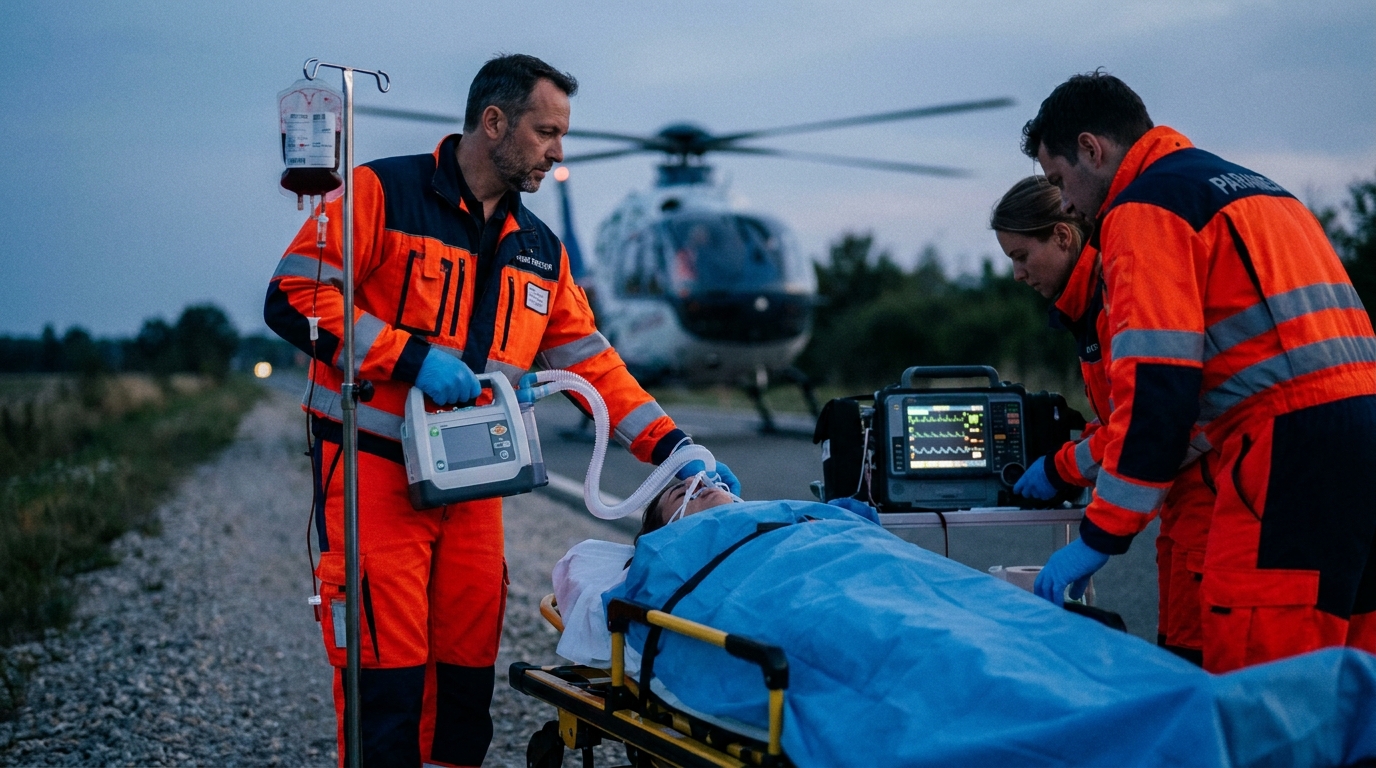
For Doctors in a Hurry
- Researchers investigated whether expanding pre-hospital capabilities and advanced interventions have increased scene times for trauma patients over two decades.
- This retrospective study analyzed 1,357 patients treated by a physician-led air ambulance service between 2005 and 2021.
- Each additional advanced intervention increased scene time by 41 percent (p < 0.001), though overall median scene times remained stable.
- Stable scene times reflect a balance between increased intervention frequency and a higher proportion of rapidly transported penetrating trauma.
- Clinicians must balance procedural benefits against time costs to ensure efficient transfer to definitive care in time-critical trauma cases.
The Temporal Cost of Pre-hospital Stabilization
Trauma remains a leading cause of global mortality, with hemorrhage accounting for approximately 40 percent of these deaths [1]. In the management of hemorrhagic shock, clinical strategies have increasingly focused on early correction of coagulopathy and rapid hemorrhage control [1]. While the immediate initiation of resuscitation is a recognized best practice in emergency medicine, the complexity of modern interventions can complicate the logistics of the initial encounter [2]. Clinicians must frequently balance the perceived benefits of field stabilization against the known risks of delayed definitive care, especially in time-sensitive conditions like aortic disease or major vascular injury [3]. Despite decades of research into various clinical interventions, improving overall survival in trauma patients remains a significant challenge for the global medical community [1]. To better understand this balance, researchers recently examined how the evolution of advanced pre-hospital capabilities has influenced scene times over the last two decades.
Evolution of Field Capability and Patient Demographics
The researchers conducted a retrospective, observational analysis of 1,357 injured patients treated by a physician-led air ambulance service. To evaluate how pre-hospital care has changed over two decades, the study compared two distinct cohorts. Group 1 included data from July of each year between 2005 and 2010, while Group 2 covered July of each year from 2017 to 2021. This longitudinal comparison allowed the authors to track the integration of several advanced clinical procedures into field practice and assess their impact on operational timelines.
Between these two study periods, the service introduced several complex interventions, including pre-hospital blood transfusion, arterial and central venous cannulation, and Resuscitative Endovascular Balloon Occlusion of the Aorta (REBOA, a procedure where a balloon catheter is deployed in the aorta to temporarily halt life-threatening torso bleeding). The data showed that the uptake of these advanced interventions increased significantly over time, rising from 24 percent in Group 1 to 29 percent in Group 2 (p = 0.02). Across the entire study population, 26 percent of patients received at least one advanced intervention during their pre-hospital care.
Alongside the shift in clinical capabilities, the researchers noted a significant change in the nature of the injuries treated by the service. The proportion of patients presenting with penetrating trauma increased from 24 percent in Group 1 to 34 percent in Group 2 (p < 0.001). This demographic shift is clinically relevant because patients with penetrating injuries, such as gunshot or stab wounds, typically require immediate surgical exploration compared to those with blunt trauma. The study suggests that the rising prevalence of penetrating trauma, which inherently demands shorter scene times, effectively masked the temporal impact of the more frequent and time-intensive advanced procedures.
Quantifying the Procedural Time Burden
To determine which elements most significantly influenced the duration of pre-hospital care, the researchers utilized a multivariable analysis, a statistical method that isolates the effect of a single variable while controlling for confounding factors. This analysis identified age, mechanism of injury, and the total number of advanced interventions performed as independent factors associated with scene time. The data revealed a direct, linear relationship between procedural volume and delay. Specifically, each additional advanced intervention increased scene time by 41 percent (p < 0.001). This finding indicates that scene time increases in direct proportion to the number of interventions performed, a trend that remains consistent regardless of temporal, operational, patient, or injury factors.
The study also highlighted a stark contrast in scene times based on the nature of the trauma. Patients with penetrating trauma had consistently shorter scene times than those with blunt trauma, with a median of 10 minutes (interquartile range 6 to 17 minutes) compared to 25 minutes (interquartile range 17 to 36 minutes) for blunt injuries (p < 0.001). Despite the increasing complexity of field care, the median scene time remained similar between the two study periods. The researchers concluded that this stability of scene times over two decades reflects opposing trends of increasing intervention frequency and a higher proportion of penetrating trauma cases. The rapid processing required for penetrating injuries effectively offset the procedural delays introduced by advanced field stabilization.
Clinical Implications for Non-Compressible Hemorrhage
The integration of advanced pre-hospital interventions into trauma care presents a complex clinical trade-off for emergency physicians and trauma surgeons. While procedures such as blood transfusion, REBOA, and central venous cannulation may offer immediate physiological benefit, they simultaneously prolong pre-hospital times. This delay is particularly critical in patients with non-compressible hemorrhage, defined as internal bleeding within the torso or pelvis that cannot be controlled with direct pressure or tourniquets. In these cases, the time elapsed before definitive surgical or radiological intervention is a primary determinant of survival. The study emphasizes that because each additional intervention increases scene time by 41 percent (p < 0.001), the cumulative delay can significantly postpone the transition to an operating room where definitive hemorrhage control is possible.
To mitigate these risks, the researchers advocate for a balanced approach that weighs the potential stabilization provided by field interventions against the inherent time cost of performing them. The findings highlight the necessity of judicious patient selection and a high degree of procedural efficiency among pre-hospital teams. For clinicians directing emergency medical services or receiving trauma transfers, these data underscore that the ultimate goal must remain the timely transfer to definitive care in time-critical trauma. Ensuring that advanced field capabilities do not inadvertently compromise patient outcomes requires a rigorous focus on minimizing scene time while selecting only those interventions most likely to improve the patient's immediate clinical trajectory.
References
1. Curry N, Hopewell S, Dorée C, Hyde C, Brohi K, Stanworth S. The acute management of trauma hemorrhage: a systematic review of randomized controlled trials. Critical Care. 2011. doi:10.1186/cc10096
2. Evans L, Rhodes A, Alhazzani W, et al. Surviving Sepsis Campaign: International Guidelines for Management of Sepsis and Septic Shock 2021. Critical Care Medicine. 2021. doi:10.1097/ccm.0000000000005337
3. Erbel R, Aboyans V, Boileau C, et al. 2014 ESC Guidelines on the diagnosis and treatment of aortic diseases. European Heart Journal. 2014. doi:10.1093/eurheartj/ehu281