
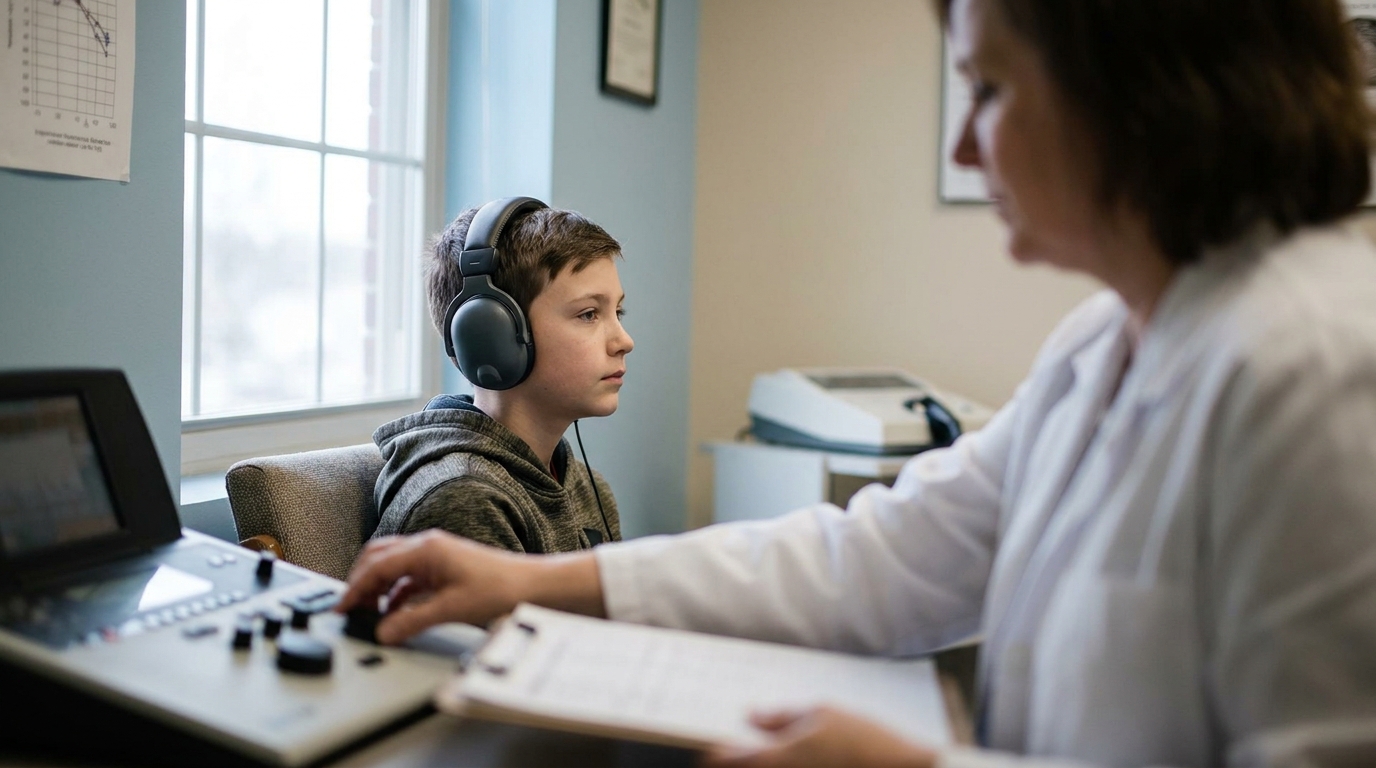
- Clinicians lack clarity on how specific auditory processing deficits contribute to communication challenges in children with autism spectrum disorder.
- The study evaluated 97 autistic participants and 44 neurotypical peers using standardized auditory processing, language, and nonverbal communication assessments.
- Researchers found that time-compressed sentence and gap detection scores significantly correlated with expressive language, receptive vocabulary, and emotional cue recognition.
- The authors conclude that temporal auditory processing components likely influence broader verbal and nonverbal communication development in these children.
- Future interventions should target specific auditory processing deficits to potentially improve clinical outcomes in verbal and nonverbal communication skills.
Decoding the Auditory Architecture of Autistic Communication
Clinicians have long recognized that sensory processing alterations are a core feature of autism spectrum disorder, often manifesting as hyper-reactivity or hypo-reactivity to environmental stimuli [1]. While much research has focused on visual processing, atypical auditory perception is increasingly viewed as a potential early neurophysiological marker for the condition [2]. These auditory differences are not merely peripheral but involve complex central mechanisms, including altered local pitch processing and atypical neural responses to sound changes [3, 4]. Because efficient communication relies on the brain's ability to rapidly extract signals from noise, these sensory variations likely underpin the diverse language challenges seen in pediatric populations [5]. A new study now examines how specific dimensions of auditory processing correlate with distinct verbal and non-verbal communication skills in children on the spectrum.
Mapping Auditory and Linguistic Assessment Parameters
The researchers recruited a cohort of 97 English-speaking autistic participants ranging in age from 7.9 to 17.4 years (mean age 12.3). To provide a comparative baseline, the study also enrolled 44 neurotypical peers between the ages of 8.4 and 16.8 years, maintaining an identical mean age of 12.3 years. This age parity allowed the investigators to isolate developmental differences in auditory processing from general maturation. The primary objective was to determine how specific sensory deficits might correlate with the heterogeneous communication profiles observed in clinical practice, moving beyond simple diagnostic labels to identify the underlying physiological drivers of language impairment.
Temporal Processing as a Driver of Language and Emotion Recognition
To evaluate central auditory function, the researchers utilized the SCAN-3 Tests for Auditory Processing Disorders. This battery included several specialized subtests designed to challenge the auditory system under varying conditions. These included time-compressed sentences, which measure the ability to process rapid speech by electronically accelerating the signal, and auditory figure-ground at +8dB, a test of the patient's ability to identify speech signals against a background of competing noise. Additionally, the team employed gap detection, a measure of temporal resolution (the brain's ability to perceive the smallest possible silent intervals between sounds), and competing words-free recall, which evaluates dichotic listening by requiring the patient to repeat different words presented to each ear simultaneously. This comprehensive approach allowed the team to distinguish between the timing of sounds and the clarity of sound frequencies.
Spectral Processing and Articulation Accuracy
The study then mapped these auditory findings to standardized measures of verbal and non-verbal communication. Language proficiency was quantified using the Clinical Evaluation of Language Fundamentals-Fifth Edition (CELF-5), specifically focusing on the expressive and receptive language indices to capture both the production and comprehension of linguistic structures. For a more granular look at speech production, the researchers used the Goldman-Fristoe Test of Articulation-3rd Edition (GFTA-3) Sounds-In-Words subtest to assess articulation accuracy. Finally, non-verbal vocal communication was evaluated through the Diagnostic Analysis of Nonverbal Accuracy-2nd Edition (DANVA-2) paralanguage subtests, which measure a child's ability to interpret paralanguage (the vocal cues such as tone, pitch, and rhythm that convey emotional meaning independent of literal word choice). By combining these metrics, the researchers could pinpoint whether a child's communication struggle was rooted in grammar, vocabulary, or the social-emotional nuances of speech.
References
1. Gonçalves AM, Monteiro P. Autism Spectrum Disorder and auditory sensory alterations: a systematic review on the integrity of cognitive and neuronal functions related to auditory processing.. Journal of neural transmission (Vienna, Austria : 1996). 2023. doi:10.1007/s00702-023-02595-9
2. Benz F, Hanna S, Harvey NC, et al. Early neurophysiological markers of aberrant auditory processing associated with increased risk of autism spectrum disorder: A systematic review.. Pediatric investigation. 2025. doi:10.1002/ped4.12460
3. Zhu M, Chen F, Zhang Y, Zhang Z, Guo C. Auditory Global-Local Processing in Autism Spectrum Disorder: A Systematic Review and Meta-Analysis.. Journal of autism and developmental disorders. 2025. doi:10.1007/s10803-025-06901-0
4. Sapey-Triomphe L, Bouet R, Mattout J, Sonié S, Schmitz C, Lecaignard F. Systematic Review and Meta-Analysis of Mismatch Negativity in Autism: Insights Into Predictive Mechanisms.. Autism research : official journal of the International Society for Autism Research. 2025. doi:10.1002/aur.70131
5. Callejo DR, Boets B. A Systematic Review on Speech-in-noise Perception in Autism.. Neuroscience and Biobehavioral Reviews. 2023. doi:10.1016/j.neubiorev.2023.105406