For Doctors in a Hurry
- Anesthetists face time and skill constraints when performing point-of-care echocardiography to guide peri-operative management decisions for surgical patients.
- This prospective multicenter observational study evaluated 202 adult patients to compare automated artificial intelligence analysis against manual clinician measurements.
- The software correctly identified 91 percent of systolic function cases and all six patients with severe aortic stenosis (p < 0.001).
- Correlation for left ventricular ejection fraction was strong at r equals 0.845, showing a mean difference of negative 1.9 percent.
- Integrating automated analysis into peri-operative workflows may streamline cardiac assessments, though further research must evaluate the impact on clinical outcomes.
Automating Hemodynamic Assessment in the Peri-operative Setting
Cardiovascular diseases remain a leading cause of global mortality, necessitating efficient diagnostic tools to detect conditions like heart failure and arrhythmias before they lead to adverse outcomes [1, 2]. While point-of-care tools like the electrocardiogram are ubiquitous, traditional interpretations often lack the sensitivity required to identify subclinical structural heart disease or predict acute decompensation [2, 3]. Integrating artificial intelligence into cardiovascular diagnostics has shown potential in enhancing the detection of left ventricular dysfunction and valvular issues through automated analysis of physiological signals [4, 5]. However, the clinical utility of these tools depends on their performance across diverse patient populations and their ability to integrate into existing workflows [6, 7]. To address this gap, a new multicenter study evaluates whether an automated platform can support clinicians in interpreting bedside echocardiographic data during the critical peri-operative period, potentially streamlining pre-surgical cardiac risk assessment.
Validating AI Interpretation Against Clinical Standards
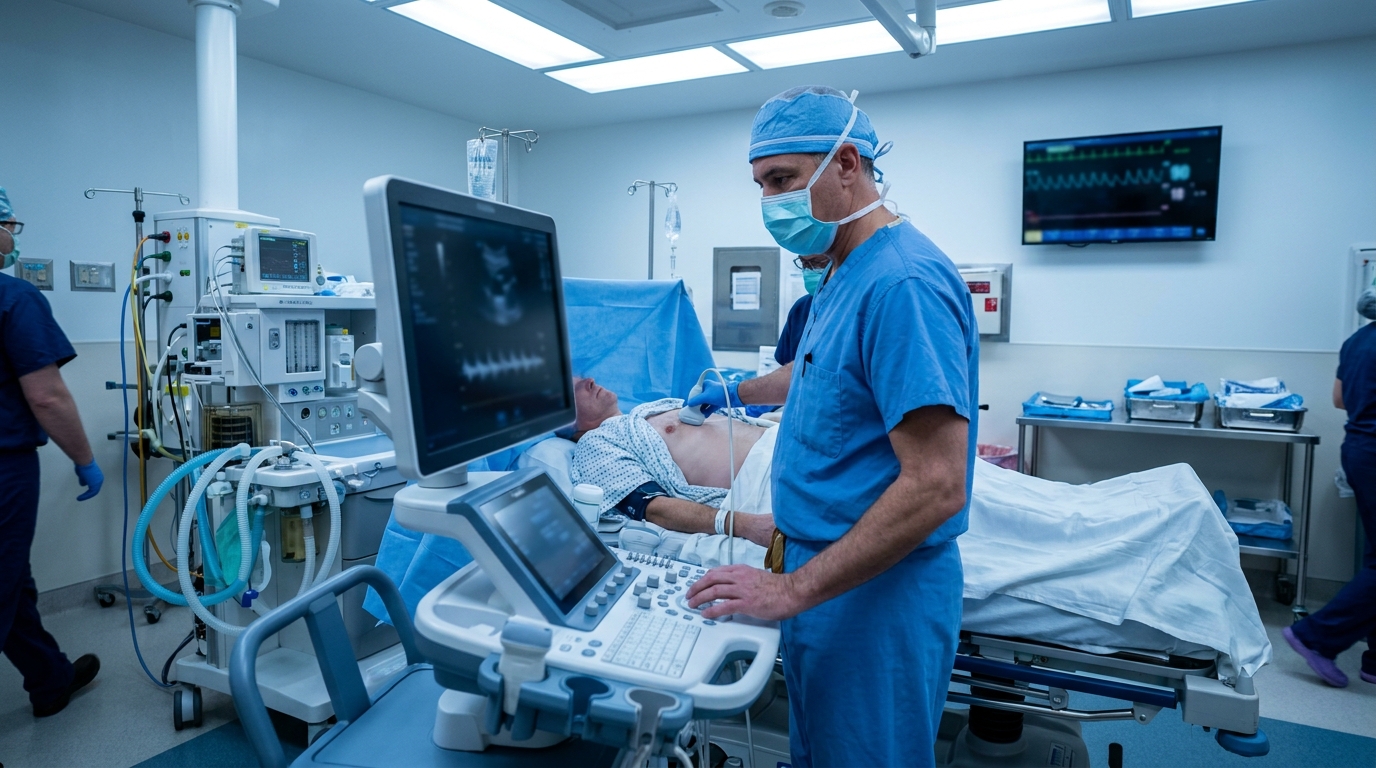
The researchers conducted a prospective multicenter observational study to evaluate the diagnostic utility of automated software in the peri-operative environment. The study enrolled adult patients referred for pre-operative echocardiography to assess cardiac function before surgery. Of the 206 patients initially enrolled, the researchers successfully analyzed data from 202 individuals (98%) who maintained adequate image quality for the software to process. This high rate of image adequacy suggests that the automated system can handle the vast majority of scans obtained in a typical clinical setting, where image clarity can sometimes be compromised by patient factors or technical constraints. To ensure high-quality data collection, anesthesiologists certified in echocardiography followed a predefined 12-view protocol to capture the necessary cardiac images. These studies were then uploaded to the US2.AI cloud platform, an automated system designed to generate measurements and categorical classifications for 10 key echocardiographic parameters, including ventricular function and valvular structure. To validate the accuracy of the software, the researchers used manual measurements performed by expert clinicians as the reference standard. This comparison allowed the team to calculate the intraclass correlation coefficient, a statistical measure of how closely two different sets of measurements agree, to determine if the automated analysis could reliably mirror expert clinical judgment in a fast-paced surgical environment.
High Correlation in Left Ventricular and Valvular Assessment
The analysis of left ventricular ejection fraction demonstrated that the automated software strongly correlated with clinician measurements (r = 0.845, p < 0.001). The researchers reported a mean difference of -1.9% for left ventricular ejection fraction between the software and the expert clinicians, suggesting that the automated measurements are closely aligned with manual calculations. Furthermore, the US2.AI software correctly classified left ventricular systolic function in 180 out of 201 patients (91%). The system also showed high accuracy in evaluating more complex filling patterns, as it correctly classified left ventricular diastolic dysfunction, a condition characterized by impaired relaxation of the heart muscle, in 193 out of 201 patients (96%). Identifying diastolic dysfunction is particularly relevant for anesthesiologists, as it directly impacts fluid management and the choice of vasoactive medications during surgery. The software also demonstrated high sensitivity in detecting critical structural and hemodynamic abnormalities that significantly influence peri-operative risk stratification. Specifically, the US2.AI software identified all 10 patients with pulmonary hypertension, or high blood pressure in the lung arteries, correctly. In addition, the software identified all 6 patients with severe aortic stenosis, a critical narrowing of the aortic valve, correctly. For the clinician, these findings indicate that the automated tool can reliably flag high-risk pathologies that require immediate attention or modification of the anesthetic plan, thereby assisting in the rapid identification of patients at the highest risk for cardiovascular instability.
The study also evaluated the ability of the software to assess the right side of the heart, which is essential for identifying patients at risk of right ventricular failure or pulmonary complications during the peri-operative period. The researchers found that correlations for right ventricular size and function were strong (r = 0.860 and r = 0.743 respectively, p < 0.001). Similarly, the correlation for right atrial size was strong (r = 0.842, p < 0.001). These high correlation coefficients indicate that the automated measurements closely mirror those obtained by expert anesthesiologists. Furthermore, the mean differences for right-sided heart measurements were small, suggesting that the artificial intelligence-driven analysis provides consistent data that can be integrated into clinical decision-making without significant deviation from standard manual assessments. Beyond static structural measurements, the researchers examined dynamic hemodynamic parameters that guide fluid resuscitation and vasopressor use. The agreement for inferior vena cava collapsibility, a key measure of fluid status, was moderate (r = 0.641). This parameter tracks the change in the diameter of the inferior vena cava during the respiratory cycle to help predict fluid responsiveness, showing more variability than chamber dimensions but remaining statistically significant. Additionally, the agreement for cardiac output, the volume of blood pumped by the heart per minute, was moderate (r = 0.675) with low mean bias. While these correlations for dynamic measures were lower than those for structural dimensions, the low mean bias suggests that the software remains a viable tool for monitoring a patient's hemodynamic profile during the surgical period.
Implications for Anesthesia Workflow Integration
The statistical reliability of the US2.AI platform suggests it can function as a dependable adjunct to clinical judgment in the high-pressure peri-operative environment. The agreement between artificial intelligence and clinician-derived continuous measurements was good to excellent for most parameters, with intraclass correlation coefficient values between 0.605 and 0.956 (p < 0.001). This high level of consistency across a broad range of metrics indicates that the software provides stable data points that clinicians can trust for longitudinal patient monitoring. Furthermore, Cohen's κ, a statistical measure of inter-rater agreement for categorical items, was statistically significant for all parameters (p < 0.001). This confirms that the artificial intelligence and the anesthesiologists reached a high degree of consensus when classifying patients into specific diagnostic categories. For the practicing clinician, these results demonstrate that anesthesiologists can obtain essential peri-operative information using a limited predefined image sequence, rather than requiring a comprehensive, time-consuming diagnostic exam. By utilizing a streamlined 12-view protocol, the software can rapidly generate the hemodynamic and structural data necessary for immediate surgical decision-making. Consequently, the findings support integrating US2.AI into peri-operative echocardiography workflows to reduce the cognitive and technical burden on the physician. While further studies are required to determine if this automated integration directly improves patient outcomes, the current data establishes a robust foundation for using artificial intelligence to standardize and accelerate cardiac assessments in the operating room.
References
1. Khaja S, Baijoo K, Aziz R. Artificial intelligence-powered advancements in atrial fibrillation diagnostics: a systematic review. Egyptian Heart Journal. 2025. doi:10.1186/s43044-025-00670-y
2. Velandia H, Pardo A, Vera MI, Vera M. Systematic Review of Artificial Intelligence and Electrocardiography for Cardiovascular Disease Diagnosis.. Bioengineering (Basel, Switzerland). 2025. doi:10.3390/bioengineering12111248
3. Li X, Gao X, Tse G, et al. Electrocardiogram-based artificial intelligence for the diagnosis of heart failure: a systematic review and meta-analysis.. Journal of geriatric cardiology : JGC. 2022. doi:10.11909/j.issn.1671-5411.2022.12.002
4. Shirvani D, Shokravi A, Nasibi N, Nelson P, Mueller A. Abstract 4370574: Artificial Intelligence-Enabled Electrocardiography Demonstrates Strong Diagnostic Performance for Diastolic Dysfunction, Heart Failure with Preserved Ejection Fraction, and Left Atrial Enlargement: A Meta-Analysis. Circulation. 2025. doi:10.1161/circ.152.suppl_3.4370574
5. Ferreira ACC, Antunes V, Guida C, et al. Abstract 4144205: Diagnostic accuracy of artificial intelligence-based electrocardiogram algorithm to predict heart failure with reduced ejection fraction: a systematic review and meta-analysis. Circulation. 2024. doi:10.1161/circ.150.suppl_1.4144205
6. Laws E, Charalambides M, Vadera S, et al. Diversity and Inclusion Within Datasets in Heart Failure: A Systematic Review.. JACC. Advances. 2025. doi:10.1016/j.jacadv.2025.101610
7. Zepeda-Lugo C, Sanchez-Lizarraga M, Insfran-Rivarola A, Arévalos A. Effectiveness of AI Models for Cardiovascular Disease Diagnosis: A Systematic Review and Meta-analysis. Revista de Investigación e Innovación en Ciencias de la Salud. 2025. doi:10.46634/riics.504