
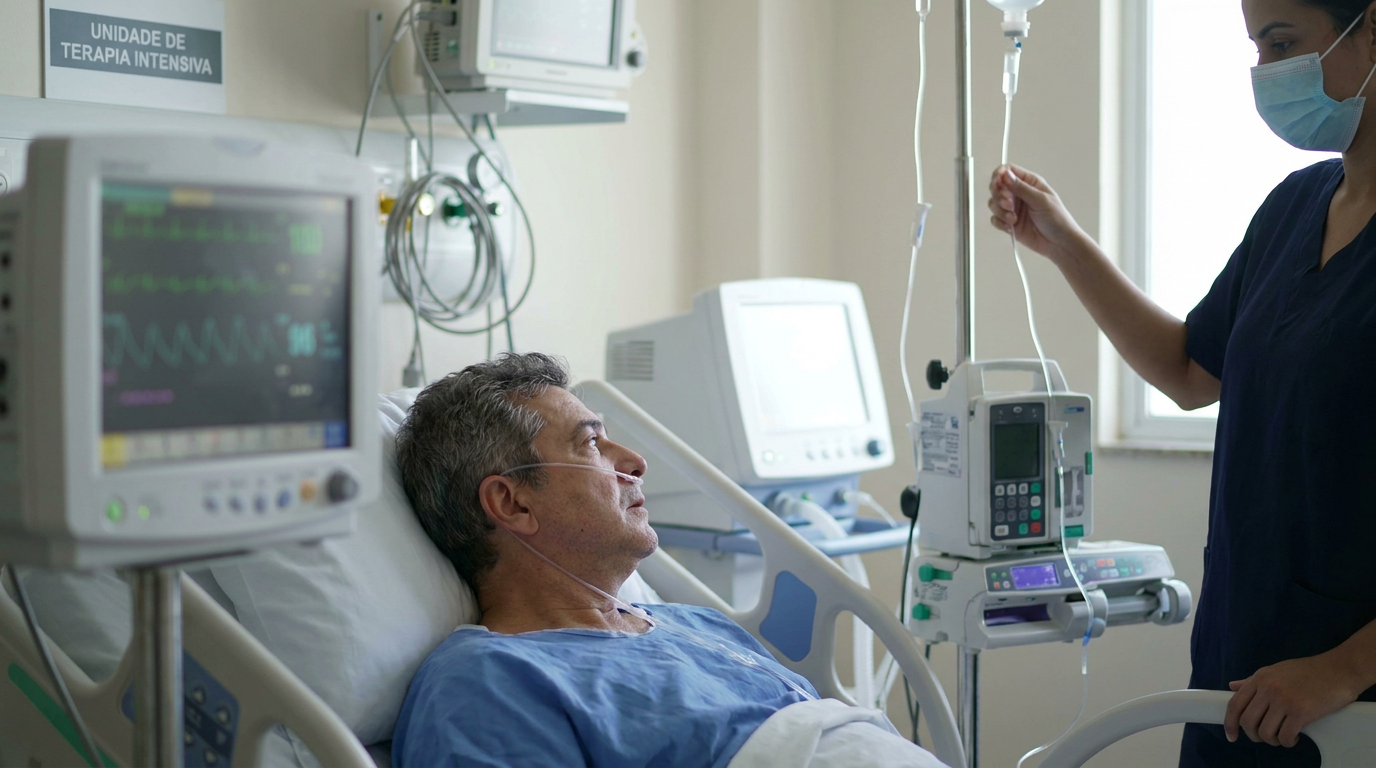
- The study aimed to define the transition point to persistent critical illness (PerCI) and characterize its impact in Brazilian intensive care units.
- This multicenter cohort study included 75,475 adult intensive care unit patients from 56 Brazilian hospitals between 2019 and 2023.
- The researchers found that the predictive performance of acute illness severity declined and crossed antecedent characteristics on intensive care unit day 15, defining PerCI.
- The authors concluded that PerCI occurs at 15 days in Brazilian intensive care units, affecting 10.5% of patients but consuming 44.2% of bed-days.
- Further research is needed to identify modifiable factors contributing to prolonged critical illness and optimize resource allocation for these patients.
Defining the Onset of Prolonged Critical Illness
The primary focus in the intensive care unit (ICU) is the stabilization of acute, life-threatening conditions such as severe sepsis or organ failure [1, 2, 3]. While many patients recover, a distinct subgroup transitions into persistent critical illness (PerCI), a state defined by prolonged ICU dependency and complex medical needs. These patients often exhibit sustained physiological dysfunction, including severe protein catabolism and gut microbiome alterations, which can hinder recovery and lead to significant long-term morbidity [4, 5]. Pinpointing the moment acute illness becomes a persistent state is essential for accurate prognostication, care planning, and the allocation of ICU resources [6]. A large cohort study from Brazil now provides a data-driven definition for this critical transition point.
Methodology for Identifying Persistent Critical Illness
To define the transition to PerCI, researchers conducted a multicenter cohort study involving 56 adult ICUs across Brazil, part of the national IMPACTO-MR platform. The analysis included adult patients admitted between September 2019 and December 2023, after excluding pediatric cases, ICU readmissions, and patients from units with incomplete data. The core of the methodology was a statistical horse race between two predictive models. The first model used only antecedent characteristics, meaning pre-existing patient factors like comorbidities and age. The second model used only acute illness severity, reflecting the immediate physiological state upon admission. The researchers then tracked how well each model predicted in-hospital mortality for every day a patient remained in the ICU, up to day 28. The transition to PerCI was defined as the specific day when the predictive power of the acute illness model weakened to the point that it matched or fell below that of the antecedent characteristics model, signaling a fundamental shift in what drives a patient's outcome.
Key Findings: Timing and Patient Characteristics
The analysis included a large cohort of 75,475 adult ICU patients. At the time of admission, the model based on acute illness severity was a substantially better predictor of in-hospital mortality, achieving an area under the receiver operating characteristic curve (AUROC) of 0.828. An AUROC value measures a model's ability to distinguish between two outcomes, where 1.0 is perfect prediction and 0.5 is no better than chance. In contrast, the model using only pre-existing patient factors had a much lower initial predictive power, with an AUROC of 0.638. This confirmed that in the early phase of an ICU stay, the acute condition is the dominant determinant of survival. However, as the ICU stay lengthened, the predictive accuracy of the acute illness model steadily declined. The study identified a critical crossover point on ICU day 15, when the influence of pre-existing conditions on mortality risk became equal to or greater than that of the acute illness. The authors therefore defined day 15 as the onset of PerCI in this population. This 15-day threshold is notably later than transition points reported in most prior studies from other countries.
Resource Utilization and Outcomes in Persistent Critical Illness
The clinical and operational impact of patients who develop PerCI was substantial. Based on the 15-day threshold, 7,960 patients (10.5% of the cohort) were classified as having PerCI. Although this group represented only about one in ten ICU admissions, they consumed a disproportionately large volume of resources, accounting for 44.2% of all ICU bed-days. This finding highlights a major challenge for capacity management, where a minority of patients drives nearly half of the total ICU occupancy. The clinical outcomes for this group were poor. Patients with PerCI had an ICU mortality rate of 38.2%. For those who survived the ICU, the prognosis remained guarded, with a cumulative in-hospital mortality of 51.2%. These figures underscore the profound clinical burden of PerCI, where prolonged ICU stays are associated with a high likelihood of death and immense resource consumption.
Clinical Implications and Future Directions
This study provides a clinically relevant benchmark for physicians managing patients with extended ICU stays. The identification of day 15 as the transition point to PerCI in this large Brazilian cohort offers a concrete marker to help frame prognostic discussions with patients and their families. It signals the point at which a patient's underlying health status, rather than the initial acute insult, becomes the primary driver of their long-term outcome. This knowledge can inform decisions about goals of care and the potential utility of further aggressive interventions. The finding that this transition occurs later in Brazil compared to other regions may reflect differences in patient populations or ICU care practices, warranting further investigation. From a systems perspective, the data showing that 10.5% of patients consume 44.2% of ICU bed-days provides a clear mandate for hospital administrators to develop strategies for this high-resource population. As the authors conclude, future research and policy should focus on identifying and mitigating modifiable factors that contribute to prolonged critical illness, which could improve patient outcomes and optimize the use of finite healthcare resources.
References
1. Dellinger RP, Levy MM, Carlet J, et al. Surviving Sepsis Campaign: International guidelines for management of severe sepsis and septic shock: 2008. Intensive Care Medicine. 2007. doi:10.1007/s00134-007-0934-2
2. Bellomo R, Ronco C, Kellum JA, Mehta RL, Palevsky PM, workgroup TA. Acute renal failure – definition, outcome measures, animal models, fluid therapy and information technology needs: the Second International Consensus Conference of the Acute Dialysis Quality Initiative (ADQI) Group. Critical Care. 2004. doi:10.1186/cc2872
3. Rhodes A, Evans L, Alhazzani W, et al. Surviving Sepsis Campaign: International Guidelines for Management of Sepsis and Septic Shock: 2016. Critical Care Medicine. 2017. doi:10.1097/ccm.0000000000002255
4. Paulus MC, Melchers M, Es AV, Kouw IWK, Zanten ARHV. The urea-to-creatinine ratio as an emerging biomarker in critical care: a scoping review and meta-analysis.. Critical care (London, England). 2025. doi:10.1186/s13054-025-05396-6
5. Tang E, Doan N, Evans T, Litton E. Lower gastrointestinal tract dysbiosis in persistent critical illness: a systematic review.. Journal of medical microbiology. 2024. doi:10.1099/jmm.0.001888
6. McClave SA, Taylor B, Martindale RG, et al. Guidelines for the Provision and Assessment of Nutrition Support Therapy in the Adult Critically Ill Patient. Journal of Parenteral and Enteral Nutrition. 2016. doi:10.1177/0148607115621863