For Doctors in a Hurry
- Clinicians lack a clear understanding of the neural mechanisms that differentiate cooperative from competitive decision-making strategies during risky tasks.
- The researchers analyzed 60 female dyads performing a modified Iowa Gambling Task while monitoring brain activity via functional near-infrared spectroscopy.
- Competitive pairs earned significantly more than cooperative pairs, who showed a maladaptive bias toward frequent but suboptimal reward outcomes.
- The study concludes that competition engages distinct neural pathways for goal-directed control and opponent monitoring to improve overall performance.
- These findings identify specific neural markers in the prefrontal cortex that may eventually help clinicians assess adaptive social decision-making behaviors.
The Neuro-Computational Mechanics of Social Risk
Clinical assessment of decision-making often focuses on individual cognitive deficits, yet most high-stakes choices occur within complex social frameworks. Risky decision-making is a multi-dimensional construct influenced by various neurophysiological factors, including mental workload and reward processing [1, 2]. In psychiatric conditions such as obsessive-compulsive disorder or behavioral addictions, these processes are frequently disrupted, leading to maladaptive choices and impaired social functioning [3, 4, 5]. While functional near-infrared spectroscopy (a non-invasive imaging method that measures brain activity by detecting changes in blood oxygenation) has emerged as a tool for monitoring cortical activation, the specific neural signatures that distinguish different social strategies remain poorly defined [6, 7, 8]. A new study now offers insights into the neural and computational mechanisms that drive dyadic choice (decisions made by pairs of individuals) in competitive and cooperative environments [9].
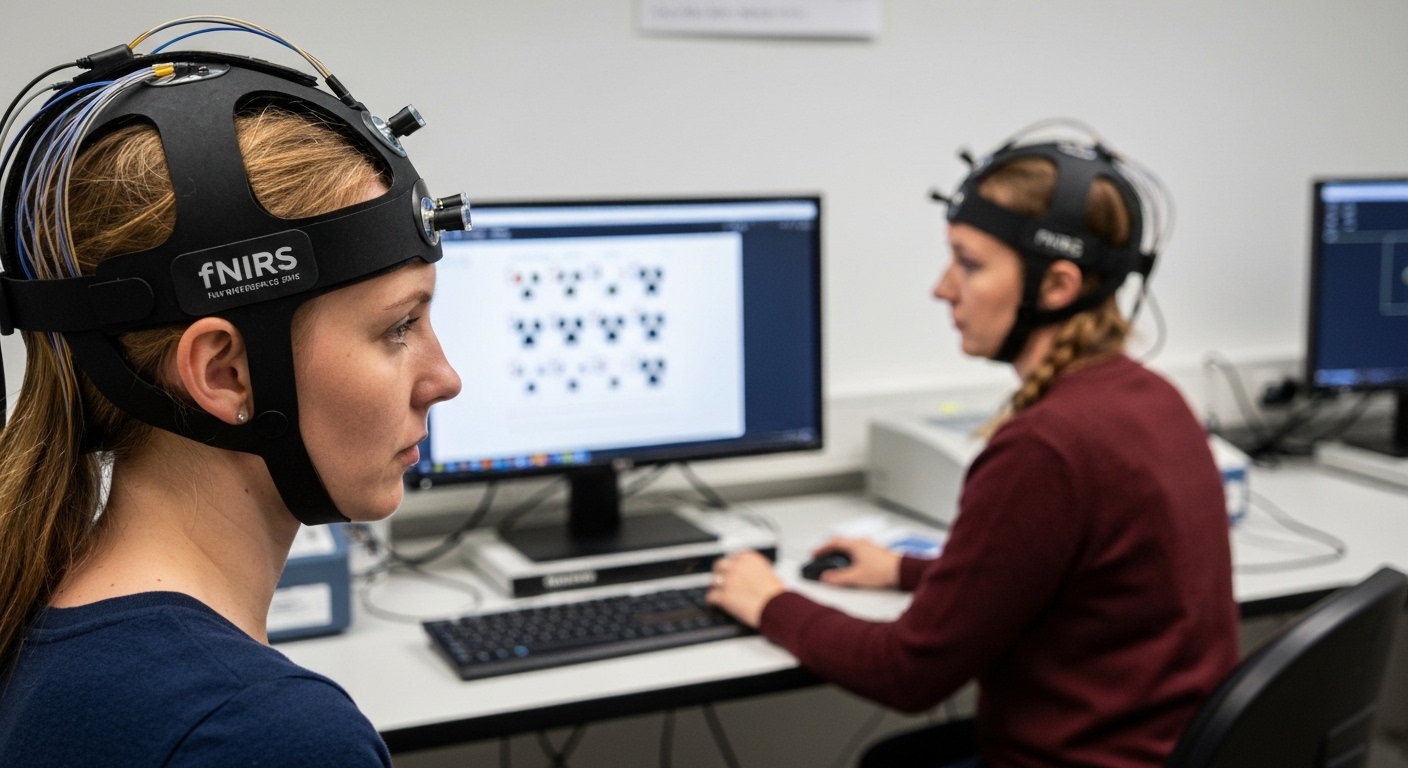
To investigate the behavioral dynamics of social decision-making, the researchers recruited 60 female dyads to participate in a controlled experimental environment. These pairs performed either cooperative or competitive variants of a modified Iowa Gambling Task, a standardized neuropsychological paradigm designed to simulate real-world decision-making under uncertainty by requiring participants to choose between decks of cards with varying reward and penalty structures. In the cooperative condition, participants were instructed to work together to maximize collective outcomes, whereas the competitive condition required individuals to vie for superior personal results against their partner. The behavioral results demonstrated that social context fundamentally altered the financial outcomes of the task. Competitive pairs achieved significantly higher cumulative earnings than cooperative pairs, suggesting that the competitive framework may mitigate certain cognitive biases that typically impair performance in risky environments. To identify the specific cognitive mechanisms driving these differences, the authors utilized reinforcement learning analyses (mathematical frameworks used to quantify how individuals update their choices based on prior experience). These analyses indicated that the Outcome Representation Learning model provided the best account of participant behavior, surpassing other computational frameworks in its ability to predict dyadic choice patterns.
Socially Shaped Learning Biases and Suboptimal Gains
The computational analysis of the decision-making process revealed that the social environment significantly altered how participants weighed rewards. Specifically, the researchers found that cooperative dyads demonstrated increased sensitivity to win frequency (βfre), a parameter within the Outcome Representation Learning model that measures the influence of reward regularity on choice. This increased sensitivity to win frequency in cooperative dyads suggested a tendency to favor frequent but suboptimal gains, where participants were more likely to select options that provided small, consistent rewards even if those choices were mathematically inferior over the duration of the task. This behavior indicates a shift in cognitive priority, where the immediate reinforcement of a win outweighs the objective calculation of long-term value. By comparison, the study found that competitive dyads adopted more flexible strategies that were less dependent on reward frequency, allowing them to prioritize the total magnitude of earnings over the psychological comfort of frequent small successes. For the practicing clinician, these findings are relevant when evaluating patient decision-making in group or family contexts, as they suggest that a cooperative social framework can paradoxically reinforce heuristic biases (mental shortcuts that lead to systematic errors) that result in poorer objective outcomes. The data indicate that social context does not merely influence motivation but fundamentally reconfigures the learning mechanisms used to navigate risky environments, suggesting that cooperation may incur performance costs through socially shaped learning biases.
To identify the biological drivers of decision-making performance, the researchers utilized functional near-infrared spectroscopy hyperscanning, a neuroimaging technique that measures changes in blood oxygenation to track brain activity in multiple interacting subjects simultaneously. This method allowed the team to quantify frequency-specific prefrontal inter-brain synchrony (IBS), which refers to the coordinated neural activity between two individuals. By combining these neuroimaging data with reinforcement learning modeling, the study examined the neural and computational mechanisms that distinguish cooperative from competitive strategies. The neuroimaging results revealed dissociable frequency-related patterns in brain coupling that were linked to specific cognitive functions. A primary finding was the identification of ultra-low frequency coupling in the dorsolateral prefrontal cortex (DLPFC) within the range of 0.015 to 0.017 Hz. This specific frequency of neural synchronization in the dorsolateral prefrontal cortex (a region critical for executive function, working memory, and top-down regulation) was associated with goal-directed control and higher earnings. For the clinician, these data suggest that the superior performance observed in competitive contexts is rooted in a specific neural signature of synchronized prefrontal activity, which may serve as a biological marker for adaptive, high-stakes decision-making.
The Frontopolar Cortex and the Cost of Cooperation
While the dorsolateral prefrontal cortex manages executive control, the researchers identified a distinct neural signature in the frontopolar cortex (FPC), a region involved in high-level cognitive integration and the evaluation of social outcomes. Specifically, higher frequency coupling in the frontopolar cortex was identified within the range of 0.340 to 0.381 Hz. This synchronization between partners at the 0.340 to 0.381 Hz frequency was associated with opponent monitoring and sustained competitive engagement, suggesting that the competitive context necessitates a high degree of vigilance regarding the actions and potential strategies of others. In contrast to the heightened activity seen in competitive dyads, the study found that FPC coupling at 0.340 to 0.381 Hz was reduced during cooperation. This physiological decline in inter-brain synchrony suggests a significant shift in cognitive engagement when individuals work toward a shared goal. The researchers observed that this reduced FPC coupling during cooperation was consistent with reduced individual responsibility, a psychological state where the perceived necessity for rigorous monitoring diminishes because the burden of the decision is shared. Ultimately, these findings support a dual pathway account in which competition engages both control and monitoring processes to facilitate performance. By simultaneously activating the dorsolateral prefrontal cortex for goal-directed regulation and the frontopolar cortex for social monitoring, competition creates a robust neural framework for optimizing risky choices. Conversely, cooperation may inadvertently suppress these monitoring pathways, leading to the learning biases and suboptimal gains identified in the behavioral analysis. These results identify candidate neural markers for adaptive behavior, suggesting that the frontopolar cortex plays a critical role in maintaining the cognitive tension required for high-stakes interactive decision-making.
References
1. Wang P, Houghton R, Majumdar A. Detecting and Predicting Pilot Mental Workload Using Heart Rate Variability: A Systematic Review. Sensors. 2024. doi:10.3390/s24123723
2. Palaus M, Marrón EM, Viejo-Sobera R, Redolar D. Neural Basis of Video Gaming: A Systematic Review. Frontiers in Human Neuroscience. 2017. doi:10.3389/fnhum.2017.00248
3. Perera MPN, Gotsis ES, Bailey NW, Fitzgibbon BM, Fitzgerald PB. Exploring functional connectivity in large-scale brain networks in obsessive-compulsive disorder: a systematic review of EEG and fMRI studies. Cerebral Cortex. 2024. doi:10.1093/cercor/bhae327
4. Zhang S, Li S. How short video addiction affects risk decision-making behavior in college students based on fNIRS technology.. Frontiers in human neuroscience. 2025. doi:10.3389/fnhum.2025.1542271
5. Zeng X, Sun Y, Gao F, Hua L, Tan W, Yuan Z. Concurrent behavioral modelling and multimodal neuroimaging reveals how feedback affects the performance of decision making in internet gaming disorder. bioRxiv. 2024. doi:10.1101/2023.10.22.563399
6. Yin Q, Wen J, Chen S, et al. Uncovering the neural basis of risk preferences in cooperative Dyads: A fNIRS study.. NeuroImage. 2025. doi:10.1016/j.neuroimage.2025.121167
7. Chen J, Yu K, Bi Y, Ji X, Zhang D. Strategic Integration: A Cross-Disciplinary Review of the fNIRS-EEG Dual-Modality Imaging System for Delivering Multimodal Neuroimaging to Applications. Brain Sciences. 2024. doi:10.3390/brainsci14101022
8. Hakim U, Felice SD, Pinti P, et al. Quantification of inter-brain coupling: A review of current methods used in haemodynamic and electrophysiological hyperscanning studies. NeuroImage. 2023. doi:10.1016/j.neuroimage.2023.120354
9. Wang M, Xu S, Ball LJ. Frequency-specific prefrontal inter-brain synchrony and reinforcement learning signatures differentiate cooperative and competitive risky decision-making: an fNIRS hyperscanning study.. NeuroImage. 2026. doi:10.1016/j.neuroimage.2026.121942