For Doctors in a Hurry
- Clinicians lack high-level evidence regarding whether modern cochlear implant processors improve speech recognition for native Mandarin-speaking patients.
- The study prospectively evaluated 51 native Mandarin-speaking cochlear implant users across five different audio processor configurations.
- The SONNET 2 omnidirectional configuration significantly improved sentence recognition in noise compared to the legacy processor (p = 0.003).
- The researchers concluded that upgrading to the SONNET 2 omnidirectional processor provides consistent speech recognition benefits across diverse patient subgroups.
- These findings support upgrading hardware for Mandarin-speaking patients to improve speech perception in both quiet and noisy environments.
Optimizing Speech Perception in Tonal Language Cochlear Implant Users
Cochlear implantation remains the standard of care for severe to profound sensorineural hearing loss, offering significant improvements in speech perception and quality of life across the lifespan [1]. However, recipients who speak tonal languages like Mandarin face unique auditory challenges because conventional signal processing often fails to adequately encode fundamental frequency cues, which are the acoustic features that determine perceived pitch and distinguish word meanings [2]. While bilateral implantation and advanced fitting strategies can mitigate some of these deficits, many users remain restricted in complex listening environments where background noise competes with the primary signal [3, 4]. Clinicians frequently must determine whether upgrading legacy audio processors to newer dual-microphone systems provides a tangible benefit in these difficult signal to noise conditions [5]. A recent study now evaluates the clinical impact of such hardware upgrades specifically for the Mandarin-speaking population.
Evaluating Hardware Upgrades in a Prospective Cohort
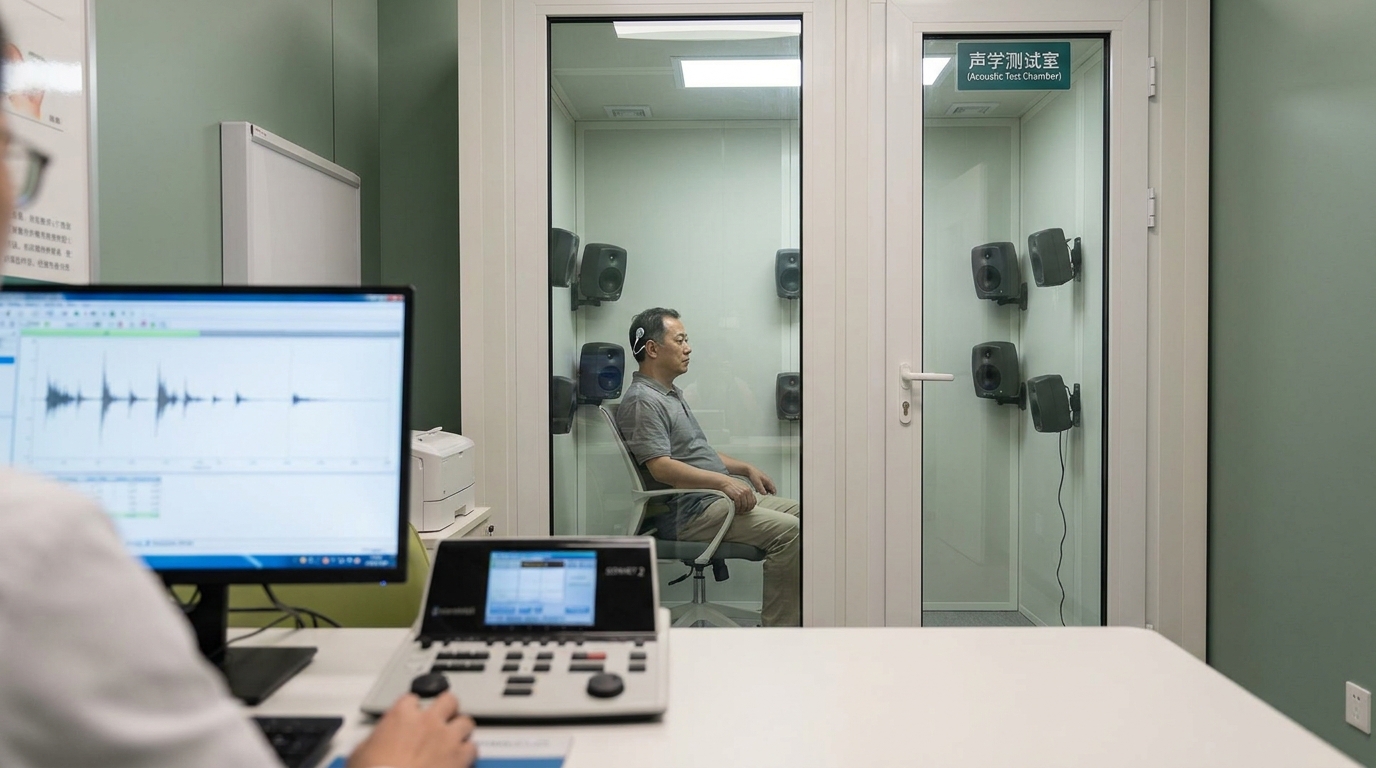
To quantify the clinical impact of hardware upgrades, researchers conducted a prospective single-subject repeated-measures study, a design where each participant serves as their own control to minimize the confounding effects of individual anatomical or neural variations. The study enrolled 51 native Mandarin-speaking cochlear implant users, a cohort size sufficient to evaluate performance across multiple listening conditions. Each participant underwent testing with five distinct processor configurations to compare older technology against current dual-microphone systems. These included the user's legacy baseline processor, the SONNET 2 (S2) in both omnidirectional (S2.OMNI) and adaptive intelligence (S2.Adaptive) modes, and the RONDO 3 (R3) in both omnidirectional (R3.OMNI) and adaptive intelligence (R3.Adaptive) modes. The technical distinction between these modes is central to the study's objectives: the omnidirectional setting, a microphone configuration that picks up sound equally from all directions, was compared against adaptive intelligence, a digital signal processing feature that automatically adjusts microphone directionality and noise reduction parameters based on the detected acoustic environment. To assess these configurations, the researchers utilized a comprehensive battery of outcome measures. Speech recognition in quiet was evaluated using monosyllabic words, disyllabic words, and full sentences, providing a baseline for basic phonetic and linguistic processing. Beyond quiet environments, the study rigorously tested sentence recognition in a co-located speech-shaped noise environment using the S0N0 paradigm. In this specific clinical setup, both the target speech and the competing noise are presented simultaneously from a single front-facing speaker located at zero degrees azimuth. This S0N0 configuration represents a particularly challenging listening scenario for cochlear implant users because it eliminates the spatial cues that normally allow the brain to separate speech from background noise, thereby isolating the processor's ability to manage noise through hardware and software algorithms alone.
Statistical Framework and Primary Endpoints
The researchers established a rigorous statistical hierarchy to evaluate the efficacy of the hardware upgrades in Mandarin-speaking users. The pre-specified primary endpoint was sentence recognition in noise for the SONNET 2 in omnidirectional mode (S2.OMNI) versus the legacy processor, a comparison designed to isolate the impact of dual-microphone hardware in a challenging acoustic environment. To ensure the robustness of this primary finding, the authors utilized confirmatory linear mixed-effects models (LMMs), which are statistical tools that account for both fixed effects, such as the processor type, and random effects, such as individual patient variability. These models allowed the researchers to determine if the processor upgrade served as an independent predictor of performance while controlling for baseline differences among the 51 participants. Beyond the primary cohort analysis, the researchers conducted pre-specified subgroup analyses for the primary endpoint to determine if clinical factors such as age (pediatric versus adult) or implantation status (unilateral versus bilateral) influenced the outcomes. For all other metrics, including word recognition in quiet and the performance of the RONDO 3 or adaptive intelligence modes, the study employed pairwise comparisons for all secondary exploratory endpoints. To maintain statistical rigor across these multiple comparisons and reduce the risk of false-positive results, the researchers applied False Discovery Rate (FDR) adjustments. This statistical correction, a method used to manage the increased probability of error when performing multiple hypothesis tests, ensures that the reported p-values remain clinically meaningful even when testing numerous variables simultaneously.
Significant Gains in Quiet and Noisy Environments
Evaluation of speech perception in quiet environments demonstrated broad improvements across the upgraded hardware configurations. When testing monosyllabic word recognition, all four upgraded configurations (S2.OMNI, S2.Adaptive, R3.OMNI, and R3.Adaptive) yielded significantly higher scores compared to the legacy baseline (all p < 0.05, FDR-adjusted). The benefits extended to more complex linguistic stimuli as well; the researchers found that all configurations except R3.Adaptive showed significant improvements in disyllabic word recognition (all p < 0.05, FDR-adjusted). These results suggest that the dual-microphone architecture and updated processing algorithms provide a clearer signal for the fundamental components of Mandarin speech when background interference is absent. In the more challenging S0N0 noise condition, the omnidirectional modes of the new processors demonstrated superior performance over the older technology. Specifically, S2.OMNI significantly enhanced sentence recognition compared to the legacy processor (p < 0.001, FDR-adjusted), meeting the study's primary endpoint with high statistical significance. Similarly, the R3.OMNI configuration significantly enhanced sentence recognition compared to the legacy processor (p = 0.011, FDR-adjusted). These findings indicate that the fixed omnidirectional settings of the SONNET 2 and RONDO 3 processors effectively improve the signal-to-noise ratio for Mandarin speakers in noisy environments. However, the study also highlighted limitations regarding the automated features of the new hardware in high-noise scenarios. While the omnidirectional settings provided clear benefits, no significant benefit was detected for either adaptive mode (S2.Adaptive or R3.Adaptive) in the noise condition after FDR correction. This suggests that while the adaptive intelligence modes perform well in quiet, they did not provide a statistically measurable advantage over legacy technology when participants were faced with the specific S0N0 noise paradigm. For clinicians, these data emphasize that while hardware upgrades offer clear advantages, the specific microphone mode selected can significantly influence a patient's ability to navigate noisy social settings.
Clinical Predictors and Subgroup Consistency
To determine whether the observed improvements in speech perception were truly attributable to the hardware upgrade rather than confounding variables, the researchers employed a linear mixed-effects model. The linear mixed-effects model analysis confirmed that upgrading to the S2.OMNI configuration was an independent positive predictor of noise sentence recognition, yielding a significant effect size (F = 9.885, p = 0.003). This finding provides clinicians with robust evidence that the transition from legacy hardware to the SONNET 2 processor in its omnidirectional setting directly contributes to better auditory outcomes in challenging environments, regardless of other individual factors. The study further validated these results through pre-specified subgroup analyses to ensure the benefits were not limited to a specific demographic or clinical profile. The researchers found that subgroup analyses showed consistent significant benefits for S2.OMNI across pediatric and adult users, suggesting that the dual-microphone technology is effective across the lifespan. Furthermore, the data remained stable when accounting for the patient's surgical history; subgroup analyses showed consistent significant benefits for S2.OMNI across unilateral and bilateral users. For practicing clinicians, these results indicate that the SONNET 2 upgrade provides a reliable performance boost for Mandarin speakers, whether the patient is a child or an adult, and whether they utilize one or two cochlear implants, filling a critical evidence gap for tonal language populations and helping to guide clinical device selection.
References
1. Buchman CA, Herzog JA, McJunkin JL, et al. Assessment of Speech Understanding After Cochlear Implantation in Adult Hearing Aid Users: A Nonrandomized Controlled Trial.. JAMA otolaryngology-- head & neck surgery. 2020. doi:10.1001/jamaoto.2020.1584
2. Liu H, Peng X, Zhao Y, Ni X. The effectiveness of sound-processing strategies on tonal language cochlear implant users: A systematic review.. Pediatric investigation. 2017. doi:10.1002/ped4.12011
3. Bance M, Marcos MC, Guignard J, et al. The benefit of bilateral cochlear implants in adults with bilateral sensorineural hearing loss: a systematic review and meta-analysis.. Cochlear implants international. 2025. doi:10.1080/14670100.2025.2516932
4. Schoonhoven JV, Sparreboom M, Zanten BGAV, et al. The effectiveness of bilateral cochlear implants for severe-to-profound deafness in adults: a systematic review.. Otology & neurotology : official publication of the American Otological Society, American Neurotology Society [and] European Academy of Otology and Neurotology. 2013. doi:10.1097/mao.0b013e318278506d
5. Sparreboom M, Schoonhoven JV, Zanten BGAV, et al. The effectiveness of bilateral cochlear implants for severe-to-profound deafness in children: a systematic review.. Otology & neurotology : official publication of the American Otological Society, American Neurotology Society [and] European Academy of Otology and Neurotology. 2010. doi:10.1097/MAO.0b013e3181e3d62c