
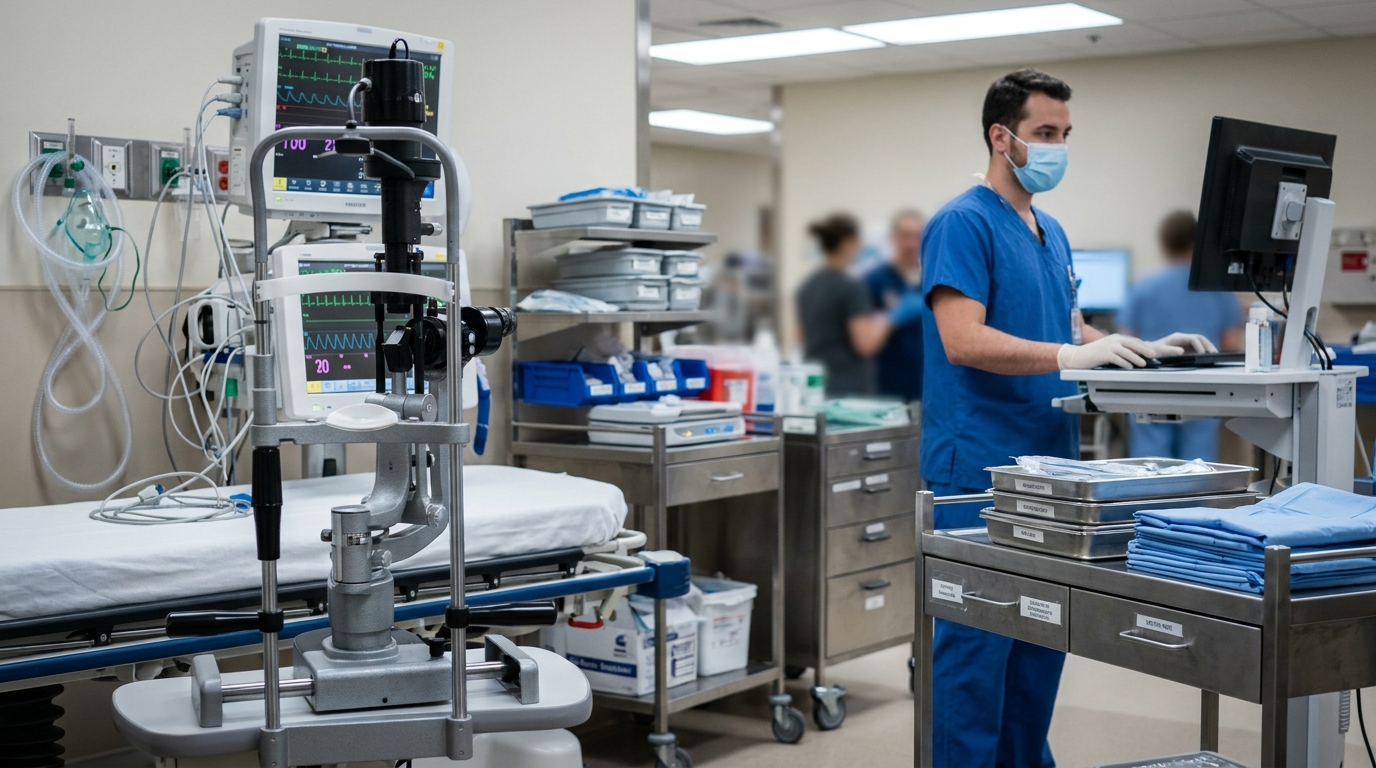
- Researchers investigated the characteristics and prehospital management of eye-related emergency calls to identify patterns in triage and clinical outcomes.
- This retrospective cohort study analyzed 340 patients with eye-related complaints from emergency calls recorded in Region Zealand, Denmark.
- Chemical exposures caused 31.5 percent of calls, while 7.4 percent of admitted patients received a stroke or transient ischemic attack diagnosis.
- The authors concluded that eye-related emergencies frequently involve chemical injuries or trauma but may also mask acute neurological events.
- Clinicians and dispatchers must improve recognition of visual symptoms to distinguish primary ocular trauma from acute cerebrovascular stroke.
The Diagnostic Challenge of Acute Ocular Presentations
Prehospital triage of acute eye symptoms presents a complex diagnostic challenge for emergency medical services, as presentations range from benign irritations to sight-threatening trauma and systemic emergencies. While many chemical exposures result in transient discomfort, data from 5,131 individuals show that 8.7% of injuries from chemical irritants require professional medical management, with projectile-related trauma causing permanent vision loss in a significant subset of cases [1]. Beyond local trauma, visual disturbances can signal a large vessel occlusion (a blockage of a major cerebral artery), yet traditional screening tools like the Face, Arm, Speech, Time (FAST) scale often prioritize motor deficits and may overlook these events [2, 3]. Research indicates that expanding these protocols to include balance and eye symptoms (BE-FAST) can increase sensitivity for stroke detection to 91%, compared to 76% for the standard FAST assessment [2]. Furthermore, the psychological distress associated with acute sensory loss necessitates early intervention, as clinician-delivered psychological protocols have demonstrated a significant reduction in post-traumatic stress symptoms (Standardized Mean Difference = -0.86; 95% CI, -1.34 to -0.39) [4, 5]. A retrospective cohort study now examines the alignment between these initial emergency calls and final clinical outcomes to identify gaps in current triage protocols, offering insights that could help clinicians better differentiate isolated eye injuries from acute neurological events.
Analysis of Danish Emergency Dispatch Data
To evaluate the accuracy of prehospital triage for ocular complaints, researchers conducted a retrospective cohort analysis of all emergency calls placed to the 1-1-2 system in Region Zealand, Denmark, between November 2017 and June 2025. The investigators utilized a comprehensive data linkage strategy to track patients from the initial call to hospital discharge. They merged information from the Computer-Aided Dispatch system (which records the initial call details) with Prehospital Patient Records (completed by paramedics on the scene) and the Danish National Patient Registry (which tracks final hospital diagnoses and outcomes). This methodology allowed the team to describe patient characteristics and prehospital management within the framework of the Danish Index for Emergency Care, a standardized tool used by dispatchers to prioritize calls based on symptom severity. The study initially identified 376 patients who contacted emergency services with eye-related issues as their primary complaint. After excluding 36 patients (9.6%) due to missing unique identifiers or incomplete prehospital records, the researchers established a final study cohort of 340 patients. Demographic analysis revealed a median age of 49.5 years (interquartile range, 29 to 68 years), with a male predominance of 62.1%. By tracking these individuals through the healthcare system, the authors sought to determine how often primary ocular symptoms masked more systemic, life-threatening conditions that require immediate clinical intervention.
Triage Patterns and Prehospital Symptomatology
The initial triage of these emergency calls followed the Danish Index for Emergency Care to prioritize medical responses. Within this framework, 70.9% of the calls were categorized as priority B, defined as an urgent situation not assessed as acutely life-threatening. This classification indicates that while most patients required prompt medical attention, dispatchers did not perceive them to be in immediate physiological danger. This pattern reflects the inherent diagnostic difficulty of ocular presentations, where the severity of an underlying pathology, such as an evolving stroke, may not be immediately apparent over the phone. Upon arrival at the scene, paramedics identified several leading primary problems prompting the emergency contact. Chemical exposures were the most frequent primary problem, accounting for 31.5% of cases, followed by vision loss at 25.9% and ocular trauma at 18.2%. When evaluating specific clinical manifestations documented by prehospital providers, vision disturbance emerged as the most frequently reported symptom, occurring in 54.4% of the cohort. These findings underscore the high prevalence of subjective visual changes in the prehospital setting, ranging from minor blurring to complete blindness. For practicing physicians, this highlights the critical need to systematically differentiate between localized ocular injury and systemic neurological events during the initial patient assessment.
Gaps in Prehospital Intervention and Documentation
The retrospective analysis revealed a significant lack of documented clinical activity during the prehospital phase of care. The researchers found that prehospital interventions were rarely recorded in the patient charts, suggesting either a low rate of active treatment by paramedics or a systemic failure in capturing the clinical actions taken before hospital arrival. This documentation gap occurred despite the high prevalence of acute symptoms, including vision disturbance in over half the cohort and chemical exposures driving nearly a third of the calls. Among the few clinical procedures that were recorded, irrigation was the most frequently reported prehospital intervention, performed in 27.1% of cases. This procedure is the standard of care for chemical exposures and burns confined to the eye and adnexa, yet it was documented in fewer than one third of the total cohort. This discrepancy highlights a potential gap in the immediate management of ocular emergencies. Because the median length of hospital stay was relatively short at 3.7 hours (interquartile range, 2.0 to 7.7 hours), the quality and documentation of these initial prehospital interventions remain critical for informing subsequent emergency department triage and expediting definitive care.
Ocular Complaints as Indicators of Cerebrovascular Events
The clinical intersection between acute ocular symptoms and cerebrovascular pathology is a critical finding for emergency physicians and neurologists. Among the 340 patients who initiated emergency calls for eye-related complaints, 39 individuals (11.5%) were suspected of having a stroke in the prehospital setting. This suspicion translated into significant clinical outcomes upon formal hospital evaluation. Of the 283 patients who were ultimately admitted to the hospital, 21 patients (7.4%) received a confirmed diagnosis of stroke or transient ischemic attack (TIA). These data demonstrate that while ocular symptoms often appear localized, they frequently serve as the primary manifestation of acute neurological deficits, requiring clinicians to maintain a high index of suspicion for vascular etiologies during initial triage. Despite the prevalence of cerebrovascular events, the majority of patients presented with localized trauma or environmental exposures. The most frequent discharge diagnosis was injury of the eye and orbit, accounting for 17.7% of the cases. Other common clinical findings included burn and corrosion confined to the eye and adnexa at 9.9% and the presence of a foreign body on the external eye in 7.8% of patients. The efficiency of the diagnostic process was reflected in the hospital throughput, as the median hospital length of stay was 3.7 hours (interquartile range, 2.0 to 7.7 hours). This relatively brief period of observation emphasizes the acute nature of these presentations and the necessity for rapid, accurate differentiation between benign ocular injuries and systemic conditions. Ultimately, the discrepancy between initial ocular complaints and final neurological diagnoses highlights a critical area for improvement in emergency medical services. The findings suggest a clear need for improved dispatcher recognition of visual symptoms associated with stroke, such as sudden vision loss or disturbances that may be misinterpreted as isolated ophthalmic issues. Enhancing the sensitivity of triage protocols at the point of the emergency call could facilitate more rapid transport to specialized stroke centers, directly improving outcomes for patients whose primary eye complaints mask an underlying cerebrovascular event.
References
1. Haar RJ, Iacopino V, Ranadive N, Weiser SD, Dandu M. Health impacts of chemical irritants used for crowd control: a systematic review of the injuries and deaths caused by tear gas and pepper spray. BMC Public Health. 2017. doi:10.1186/s12889-017-4814-6
2. Hilditch M, Brand CJ, Devlin S, Boyd A, Venema E. BE-FAST vs FAST in prehospital stroke recognition: a systematic review. British Journal of Community Nursing. 2025. doi:10.12968/bjcn.2025.0119
3. Antipova D, Eadie L, Macaden A, Wilson P. Diagnostic accuracy of clinical tools for assessment of acute stroke: a systematic review. BMC Emergency Medicine. 2019. doi:10.1186/s12873-019-0262-1
4. Hermosilla S, Forthal S, Sadowska K, Magill E, Watson P, Pike KM. We need to build the evidence: A systematic review of psychological first aid on mental health and well‐being. Journal of Traumatic Stress. 2022. doi:10.1002/jts.22888
5. Alshahrani KM, Johnson J, Prudenzi A, O’Connor DB. The effectiveness of psychological interventions for reducing PTSD and psychological distress in first responders: A systematic review and meta-analysis. PLoS ONE. 2022. doi:10.1371/journal.pone.0272732