For Doctors in a Hurry
- Clinicians lack clear criteria for observing traumatic hemothorax, leading to significant practice variation in tube thoracostomy placement.
- This prospective study at sixteen trauma centers evaluated 962 traumatic hemothoraxes in 932 adult patients over two years.
- Hemothorax volume exceeding 300 milliliters strongly predicted observation failure with an adjusted odds ratio of 16.01.
- The researchers concluded that initial observation is frequently successful, although 22 percent of patients eventually required secondary intervention.
- These findings suggest that quantifying hemothorax volume can standardize management and identify patients likely to fail conservative observation.
Refining Nonoperative Management in Thoracic Trauma
Traumatic hemothorax occurs in approximately 60% of polytrauma cases and contributes significantly to patient morbidity [1]. While tube thoracostomy remains the primary intervention to prevent complications like empyema or fibrothorax, the procedure is associated with significant patient discomfort and potential risks [2, 3]. Recent shifts in trauma care have favored conservative observation for stable patients, a strategy already validated in hemodynamically stable pneumothorax [4]. However, clinicians face uncertainty regarding the volume of blood that can be safely managed without drainage, as research indicates the risk of a retained hemothorax increases by 15% for every additional 100 mL of initial blood volume (odds ratio 1.15; 95% confidence interval, 1.08 to 1.21) [5]. A recent multicenter prospective study now offers specific volumetric thresholds to help physicians decide between expectant management and immediate intervention.
Prospective Multicenter Analysis of Hemothorax Management
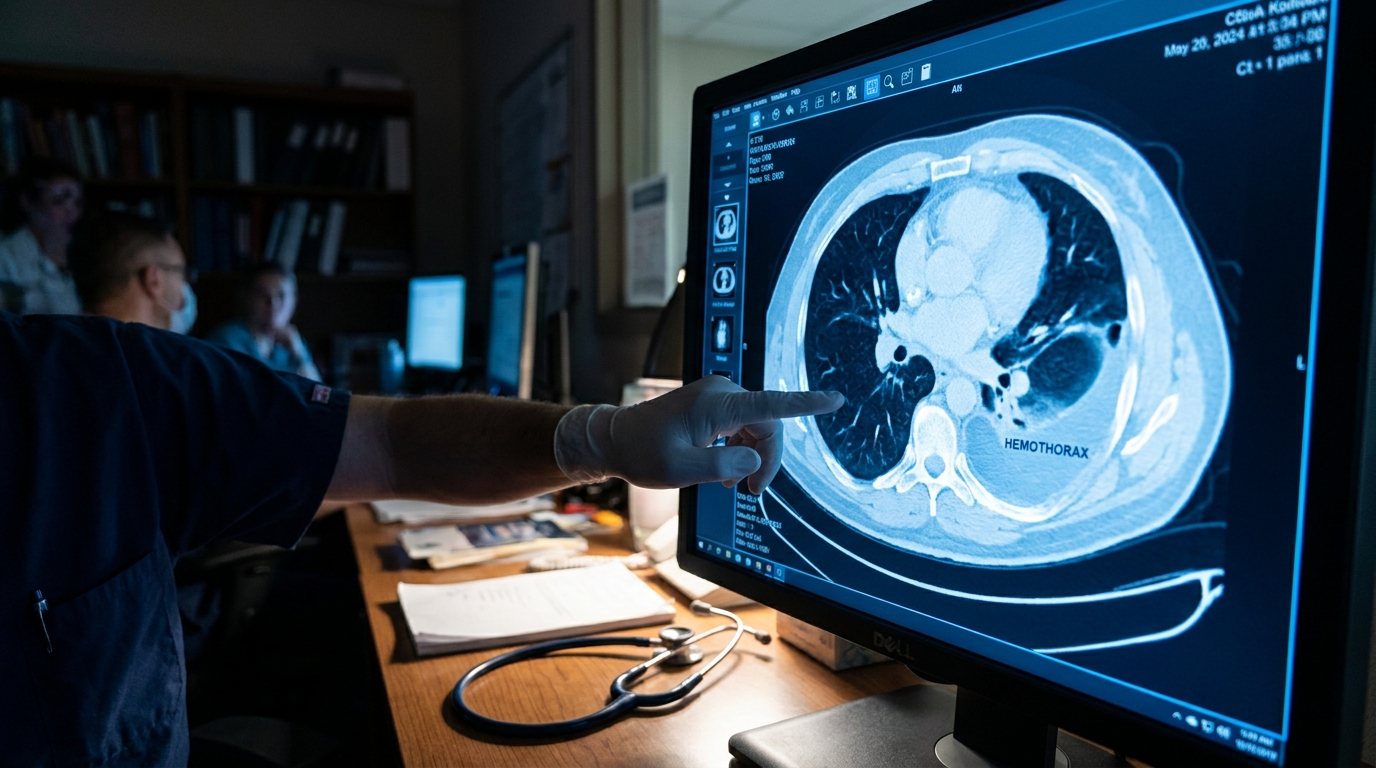
To establish clearer guidelines for conservative management, researchers conducted a prospective observational study between July 2023 and June 2025 across 16 trauma centers. The study population consisted of 932 adult patients who presented with traumatic hemothorax confirmed via computed tomography. Because physiological responses and drainage requirements can differ between the left and right pleural spaces, the researchers analyzed each hemithorax independently, resulting in a total of 962 individual hemothoraces for evaluation. Patients were excluded if they were under 18 years of age, required tube thoracostomy before a computed tomography scan could be performed, or presented with a concurrent pneumothorax greater than 35 mm. To ensure the data reflected the true success or failure of observation, the researchers also excluded patients who died within 48 hours of admission or those who experienced observation failure specifically due to the need for an immediate operative intervention. A critical component of the methodology involved the precise quantification of blood in the pleural cavity using Mergo's formula (V=d2×L), a geometric calculation where the volume is derived from the maximum depth of the fluid collection squared multiplied by its craniocaudal length on imaging. By applying this standardized volumetric assessment, the study determined that a hemothorax volume greater than 300 mL was the strongest predictor of observation failure, carrying an adjusted odds ratio of 16.01 (95% confidence interval, 8.25 to 31.06). For the practicing trauma surgeon or emergency physician, this sixteenfold increase in risk provides a concrete, imaging-based metric to guide the decision between immediate drainage and expectant management.
Volumetric Thresholds and Predictors of Failure
In this multicenter cohort, clinicians initially managed 68% (n=657) of the 962 hemothoraces with observation rather than immediate drainage. The primary outcome was observation failure, defined as a patient initially managed expectantly who eventually required a tube thoracostomy or other intervention. Among the patients selected for initial observation, the observation failure rate was 22% (n=141). When analyzing the specific reasons for this clinical deterioration, the researchers found that hemothorax progression was the most common cause of observation failure, accounting for 54% of cases where conservative management was abandoned. To identify which patients were at the highest risk for failing a trial of observation, the researchers utilized a multivariable logistic regression model, a statistical approach that adjusts for confounding patient variables to isolate the true predictive value of specific clinical features. Within this model, the analysis confirmed that a hemothorax volume greater than 300 mL strongly predicted observation failure, yielding the aforementioned adjusted odds ratio of 16.01. The 95% confidence interval for this predictor ranged from 8.25 to 31.06, underscoring a high degree of statistical certainty. Clinically, this indicates that patients presenting with more than 300 mL of blood in the pleural space are highly likely to fail conservative management, suggesting that early tube placement may be more appropriate for this specific subgroup to avoid delayed complications.
Clinical Outcomes and Resource Utilization
The decision to pursue initial observation rather than immediate intervention carries significant implications for hospital resource utilization and patient recovery timelines. In this multicenter study, patients in the observation group experienced a shorter hospital stay of 7 days, compared with 9 days for those who underwent immediate tube thoracostomy (p < 0.001). This reduction in length of stay was also reflected in critical care requirements, as the observation group had a shorter intensive care unit stay of 1 day, whereas the immediate intervention group required a median of 3 days (p < 0.001). These findings suggest that for appropriately selected patients, avoiding early invasive drainage can streamline the clinical course and reduce the burden on hospital infrastructure. While the benefits of successful observation are clear, clinicians must also consider the trajectory of the 22% of patients who eventually require intervention. The researchers found that patients who failed observation had longer hospital stays than those who received early tube thoracostomy, with a median of 13 days versus 9 days (p < 0.001). However, the delay in tube placement did not appear to result in clinical detriment beyond the extended admission. Data indicated that failed observation patients had similar complication rates, secondary intervention needs, and 30-day outcomes compared with those who received early tube thoracostomy. For the practicing physician, this provides reassurance that an initial trial of observation is a safe management strategy; even if a patient eventually requires drainage, they do not face increased morbidity or worse long-term outcomes due to the initial period of expectant management.
Addressing Practice Variation in Trauma Centers
The multicenter analysis revealed a lack of uniformity in how clinicians manage traumatic hemothorax across the 16 participating trauma centers, particularly regarding procedural techniques and equipment selection. One of the most striking areas of divergence was the choice of drainage hardware. The researchers found that thoracostomy tube sizes used in the study ranged from 8 to 36 Fr, reflecting a wide spectrum of clinical preferences regarding the use of small-bore pigtail catheters versus traditional large-bore chest tubes. Furthermore, the application of adjunct procedures to assist in pleural clearance was inconsistent. Only 16% of patients underwent pleural irrigation, a technique utilized to facilitate the evacuation of residual blood and prevent the formation of a retained hemothorax. These variations suggest that current management is often driven by institutional habit or individual surgeon preference rather than standardized protocols. Pharmacological adjuncts also showed significant heterogeneity among the study population. Specifically, the researchers noted that 52% of patients received antibiotics with tube thoracostomy, indicating that prophylactic antimicrobial coverage was utilized in only about half of the cases. This lack of consensus, combined with the volumetric data identifying 300 mL as a critical threshold for observation failure, underscores the need for more rigorous clinical pathways. The authors conclude that these notable practice variations highlight clear opportunities for the development of unified practice management guidelines. By standardizing care around objective metrics like computed tomography-derived hemothorax volume, trauma centers can reduce unnecessary interventions and improve the consistency of patient outcomes across different surgical environments.
References
1. Mowery NT, Gunter OL, Collier BR, et al. Practice Management Guidelines for Management of Hemothorax and Occult Pneumothorax. The Journal of Trauma: Injury, Infection, and Critical Care. 2011. doi:10.1097/ta.0b013e31820b5c31
2. Lyons N, Collie B, Cobler-Lichter M, et al. Thoracic irrigation for traumatic hemothorax: A systematic review and meta-analysis. Journal of Trauma and Acute Care Surgery. 2024. doi:10.1097/TA.0000000000004479
3. Patel NJ, Dultz L, Ladhani HA, et al. Management of simple and retained hemothorax: A practice management guideline from the Eastern Association for the Surgery of Trauma.. American journal of surgery. 2021. doi:10.1016/j.amjsurg.2020.11.032
4. Wahaibi HA, Salmi AA, Reesi AA, Shamsi MA. Comparison of Observation Alone Versus Interventional Procedures in Hemodynamically Stable Patients With Pneumothorax: A Systematic Review and Meta-Analysis. Cureus. 2024. doi:10.7759/cureus.58385
5. Prakash P, Moore S, Rezende-Neto J, et al. Predictors of Retained Hemothorax in Trauma: Results of an EAST Multi-Institutional Trial.. Journal of Trauma and Acute Care Surgery. 2020. doi:10.1097/TA.0000000000002881