
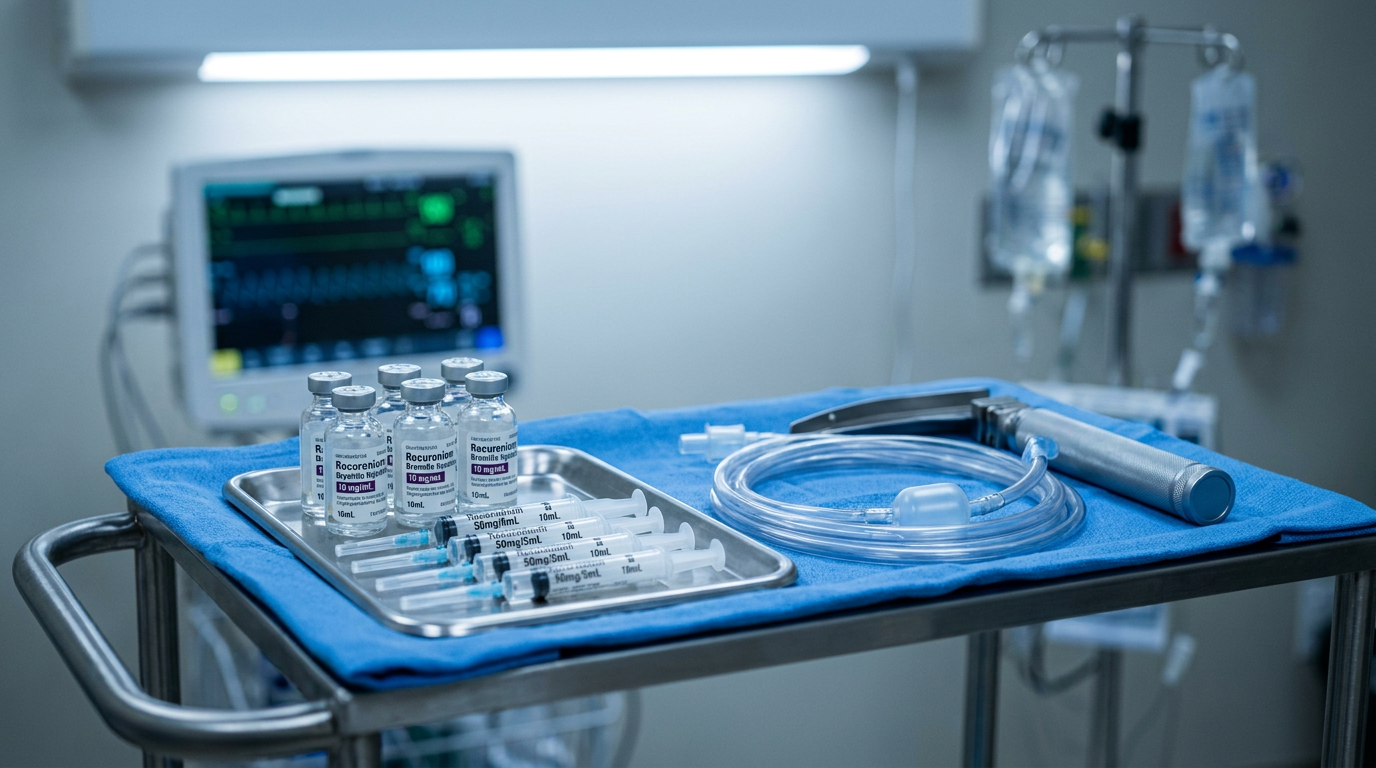
- The study investigated if rocuronium dose influences first-attempt intubation success in emergency department and intensive care unit settings.
- This secondary analysis used data from 1,822 patients receiving rocuronium from two multicenter randomized controlled trials.
- High-dose rocuronium (>1.2 mg/kg) was associated with a 1.06 adjusted relative risk (95% CI 1.01-1.11) for first-attempt success.
- The authors concluded that high-dose rocuronium was associated with higher first-attempt success, particularly in the ICU (RR 1.12).
- These findings warrant further evaluation in a randomized controlled trial due to potential unmeasured confounding.
Optimizing Neuromuscular Blockade for Emergency Airway Management
Emergency tracheal intubation is a common, high-risk procedure in critical care settings where first-attempt success is crucial for preventing complications like severe hypoxemia and cardiac arrest [1, 2, 3, 4]. Neuromuscular blocking agents (NMBAs) are standard for facilitating intubation, with rocuronium being a frequently used option [5, 6]. While rocuronium is considered an effective agent for rapid sequence intubation [7, 5], the optimal dose for maximizing first-attempt success has not been well established. A recent secondary analysis of two large clinical trials now provides new data on this specific clinical question, examining how rocuronium dosing impacts outcomes in the emergency department and intensive care unit.
Investigating Rocuronium Dosing in Critical Care Settings
To explore the dose-response relationship of rocuronium, researchers performed a secondary analysis of data from two multicenter randomized trials focused on airway management. The study aimed to determine if the dose of rocuronium administered during emergency intubation was associated with different outcomes for adult patients in either the emergency department (ED) or the intensive care unit (ICU). This design leveraged high-quality existing data to investigate a new hypothesis.
The analysis compared patients who received high-dose rocuronium, defined as greater than 1.2 mg/kg, against those who received standard-dose rocuronium, defined as less than or equal to 1.2 mg/kg. The primary outcome was successful intubation on the first attempt. To ensure a fair comparison, the researchers used propensity matching, a statistical method that balances measured baseline characteristics between the two dosing groups to reduce confounding and mimic the conditions of a randomized trial. Furthermore, the analysis was stratified by setting, meaning the data from EDs and ICUs were analyzed separately to determine if the clinical environment influenced the drug's effectiveness.
Study Population and Dosing Distribution
The analysis drew upon a substantial patient cohort from 9 emergency departments and 24 intensive care units across the United States. Of the 2,440 patients included in the original trials, the current study focused on the 1,822 patients (74.7%) who received rocuronium for emergency tracheal intubation. Within this group, 720 patients (39.5%) were administered high-dose rocuronium (>1.2 mg/kg), while the majority, 1,102 patients (60.5%), received the standard dose (≤1.2 mg/kg). This distribution provided a robust sample for comparing the effectiveness of the two dosing strategies in real-world critical care practice.
Differential Impact on First-Attempt Success
The study's main finding was a modest but statistically significant association between higher rocuronium doses and improved intubation outcomes overall. Across the entire cohort, patients receiving high-dose rocuronium had a higher likelihood of successful intubation on the first attempt, with an adjusted relative risk (RR) of 1.06 (95% confidence interval [CI] 1.01-1.11). This suggests a 6% relative increase in first-pass success with the higher dose when considering both ED and ICU patients together.
However, a more nuanced picture emerged when the results were stratified by clinical setting. The benefit of high-dose rocuronium was not apparent in the emergency department, where the adjusted RR for first-attempt success was 0.97 (95% CI 0.90-1.04). The confidence interval crossing 1.0 indicates this finding was not statistically significant. In stark contrast, the association was clear and significant for intubations performed in the ICU. For these patients, high-dose rocuronium was associated with a greater probability of first-attempt success, with an adjusted RR of 1.12 (95% CI 1.05-1.19). This finding points to a 12% relative increase in first-pass success specifically within the ICU environment.
Clinical Implications and Future Directions
This analysis suggests that for critically ill patients in the ICU, using a rocuronium dose greater than 1.2 mg/kg may improve the chance of successful intubation on the first attempt. The finding of a 12% relative increase in first-pass success in the ICU (adjusted RR 1.12, 95% CI 1.05-1.19) is clinically relevant, as reducing the number of intubation attempts can mitigate the risk of associated complications. The lack of a similar effect in the ED (adjusted RR 0.97, 95% CI 0.90-1.04) may reflect differences in patient populations, provider experience, or the overall circumstances of intubation between the two settings.
Despite these findings, the authors appropriately caution that these results are associative, not causal. As a secondary analysis, the study is susceptible to unmeasured confounding variables that could have influenced the outcomes. Therefore, the authors conclude that these findings warrant evaluation in a randomized controlled trial before they are used to guide widespread changes in clinical practice. Such a trial would be necessary to definitively establish whether administering rocuronium at doses above 1.2 mg/kg is a superior strategy for emergency intubation in the ICU.
References
1. Cabrini L, Landoni G, Redaelli MB, et al. Tracheal intubation in critically ill patients: a comprehensive systematic review of randomized trials. Critical Care. 2018. doi:10.1186/s13054-017-1927-3
2. Pandit JJ, Irwin MG. Airway management in critical illness: practice implications of new Difficult Airway Society guidelines. Anaesthesia. 2018. doi:10.1111/anae.14270
3. Bailly A, Lascarrou J, Thuaut AL, et al. McGRATH MAC videolaryngoscope versus Macintosh laryngoscope for orotracheal intubation in intensive care patients: the randomised multicentre MACMAN trial study protocol. BMJ Open. 2015. doi:10.1136/bmjopen-2015-009855
4. Kriege M, Alflen C, Tzanova I, Schmidtmann I, Piepho T, Noppens R. Evaluation of the McGrath MAC and Macintosh laryngoscope for tracheal intubation in 2000 patients undergoing general anaesthesia: the randomised multicentre EMMA trial study protocol. BMJ Open. 2017. doi:10.1136/bmjopen-2017-016907
5. Märsch S, Steiner LA, Bucher E, et al. Succinylcholine versus rocuronium for rapid sequence intubation in intensive care: a prospective, randomized controlled trial. Critical Care. 2011. doi:10.1186/cc10367
6. Radkowski P, Szewczyk M, Grażewicz M, Sobolewski K, Onichimowski D. Use of Muscle Relaxants in Emergency Medicine: A Review.. Medical science monitor : international medical journal of experimental and clinical research. 2025. doi:10.12659/MSM.949876
7. DeMasi SC, Self WH, Aggarawal NR, et al. Association Between Neuromuscular Blocking Agents and Outcomes of Emergency Tracheal Intubation: A Secondary Analysis of Randomized Trials.. Annals of Emergency Medicine. 2024. doi:10.1016/j.annemergmed.2024.08.509