For Doctors in a Hurry
- Researchers investigated whether home-based transcranial magnetic stimulation could overcome the logistical barriers that currently limit treatment to clinical settings.
- This pilot study followed five outpatients with major depressive disorder receiving five daily sessions of accelerated intermittent theta burst stimulation.
- Participants reported reduced depressive symptoms on the Hamilton Depression Rating Scale without experiencing any serious adverse events during home treatment.
- The authors concluded that home-based stimulation is feasible but restricted by significant device transport and on-site staffing requirements.
- Future research must utilize randomized controlled designs to compare the efficacy of portable neurostimulation devices against traditional clinic-based protocols.
The Access Bottleneck in Neuromodulation
Transcranial magnetic stimulation and its rapid variant, intermittent theta-burst stimulation (a non-invasive technique using magnetic fields to alter neural activity), are established interventions for major depressive disorder that yield significantly higher clinical response rates compared to sham treatments (relative risk 2.40, 95% confidence interval 1.27 to 4.55, p = 0.007) [1, 2]. Recently, accelerated protocols that deliver multiple daily stimulation sessions to the left dorsolateral prefrontal cortex (a frontal brain region critical for emotion regulation) have gained traction for treatment-resistant depression, producing rapid and substantial reductions in depressive symptom scores (standardized mean difference 1.80, p < 0.00001) [3, 4]. However, these intensive regimens, which can involve up to 10 sessions per day for five consecutive days [3], require patients to spend significant time in specialized clinics. This daily travel requirement creates substantial logistical and financial barriers, constraining the real-world clinical utility of these highly effective neuromodulation strategies. A new pilot study now explores whether these intensive stimulation protocols can be safely relocated from the hospital directly into the patient's living room, potentially expanding treatment access for severely depressed individuals who struggle with daily clinic visits.
Bringing the Clinic to the Living Room
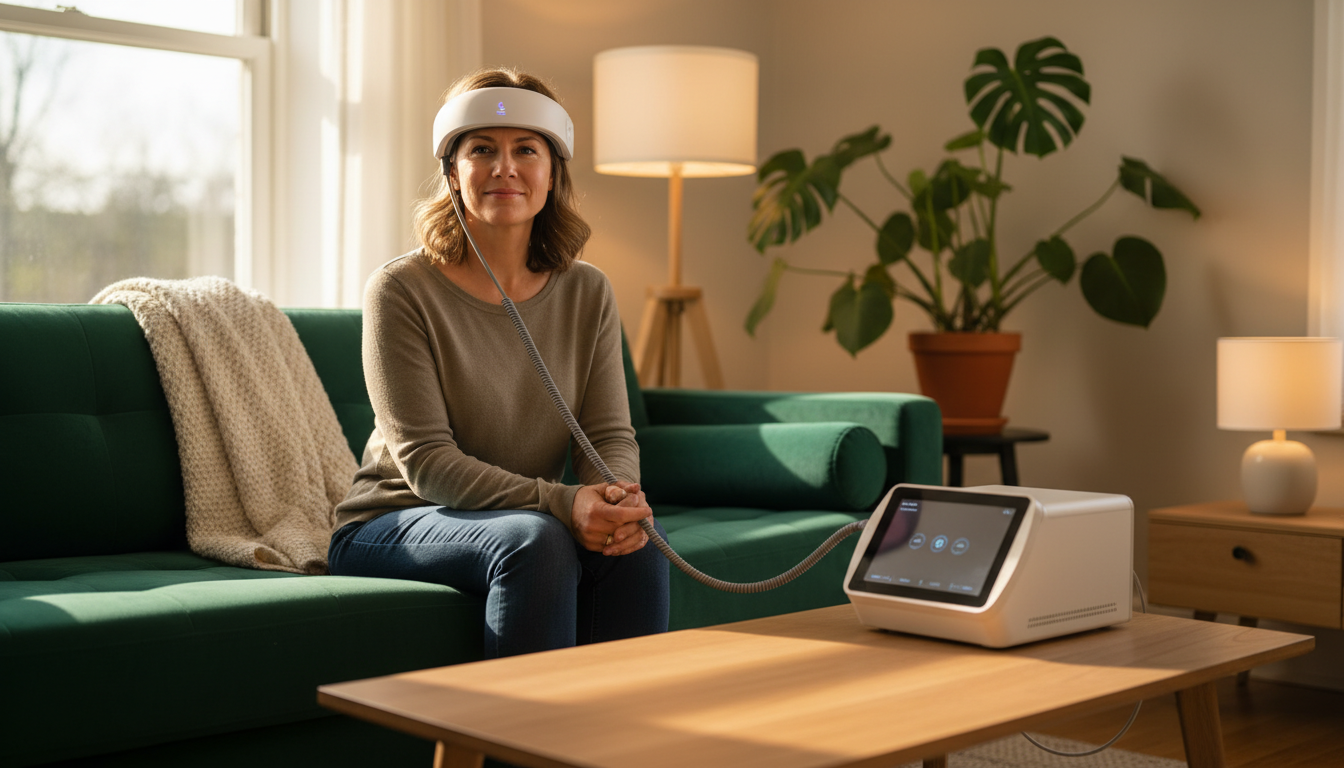
While transcranial magnetic stimulation is an established treatment option for major depressive disorder, it is currently limited to clinical settings such as hospitals or doctors' offices. Historically, technical and logistical challenges have prevented the application of this therapy in patients' homes. To determine if these barriers could be overcome, researchers designed a pilot study to test the feasibility of relocating this intensive therapy directly to the patient. The study included five outpatients with major depressive disorder, aged 29 to 65 years, who lived up to 120 km from a tertiary care hospital in Regensburg, Germany. By selecting patients who resided at a significant distance from the clinic, the investigators aimed to replicate the real-world travel burdens that often deter adherence to daily neuromodulation regimens.
Patients received home-based treatment using an accelerated intermittent theta burst stimulation protocol, an intensive regimen consisting of 5 sessions per day, with the device delivering 1800 pulses per session. Rather than utilizing a specialized portable unit, the treatment was delivered using a conventional DuoMAG XT-100 device (Deymed Diagnostics, Hronov, Czech Republic). This choice allowed the research team to evaluate whether standard clinical hardware could be safely and effectively operated in a residential environment, a critical step toward decentralizing psychiatric care.
Safety, Symptom Reduction, and Logistical Hurdles
To determine the viability of this intervention, researchers evaluated feasibility through the assessment of logistical challenges, device handling, safety, treatment tolerability, and patient satisfaction. Clinical efficacy was tracked by measuring depressive symptoms before and after treatment using the 21-item Hamilton Depression Rating Scale and the Major Depression Inventory. The clinical outcomes demonstrated that home-based transcranial magnetic stimulation was feasible with no serious adverse events reported. Furthermore, a reduction in depressive symptom scores was observed following the home-based treatment, indicating that the accelerated protocol retained its therapeutic effect outside the hospital setting.
Despite these positive clinical indicators, the transition from clinic to living room revealed substantial practical barriers. Because the study utilized a conventional clinical machine rather than a specialized portable unit, the researchers noted that major logistical challenges included device transport, space requirements, and the need for trained personnel on site. Moving heavy medical equipment into residential environments proved difficult, and standard stimulation setups demand significant physical room that many private homes lack. Furthermore, the protocol could not be entirely self-administered, requiring clinical staff to be physically present to operate the machinery and monitor the patients during the five daily sessions.
The Need for Purpose-Built Portable Devices
The pilot data demonstrate the feasibility of home-based transcranial magnetic stimulation using a conventional clinical device, while simultaneously highlighting substantial technical and logistical limitations. For practicing physicians, the ability to deliver intensive neuromodulation outside the hospital offers a clear path to improving treatment adherence for severely depressed patients who cannot manage daily travel. However, relying on heavy, space-consuming hospital equipment is not a sustainable long-term strategy for decentralized care. The authors emphasize that these limitations underscore the urgent need for the development of lightweight, portable, and patient-friendly devices. Creating purpose-built hardware is essential to facilitate neurostimulation therapies beyond clinical settings, allowing patients to receive accelerated protocols without requiring a dedicated room and specialized transport.
To move this intervention toward becoming a standard clinical option, rigorous validation is required. The investigators state that further studies with larger samples are warranted to build upon these initial findings. Specifically, future research must employ randomized controlled designs comparing home-based and clinic-based stimulation. This methodological rigor is necessary to evaluate feasibility and efficacy under standardized conditions. By directly comparing the at-home approach against the established hospital standard in a larger patient population, researchers can determine whether the clinical benefits of accelerated stimulation remain robust when the therapy is fully integrated into the patient's daily environment.
References
1. Saqib M, Ali S, Khan SIY, Dero AM, Bilal U, Rauf S. Effectiveness of Theta Burst Stimulation vs. Transcranial Magnetic Stimulation and Sham in Major Depressive Disorder: Updated Systematic Review and Meta-Analysis. 2025. doi:10.61919/2xpq4061
2. Kishi T, Ikuta T, Sakuma K, et al. Theta burst stimulation for depression: a systematic review and network and pairwise meta-analysis.. Molecular psychiatry. 2024. doi:10.1038/s41380-024-02630-5
3. Sheline YI, Makhoul W, Batzdorf AS, et al. Accelerated Intermittent Theta-Burst Stimulation and Treatment-Refractory Bipolar Depression: A Randomized Clinical Trial.. JAMA psychiatry. 2024. doi:10.1001/jamapsychiatry.2024.1787
4. Shi R, Wang Z, Yang D, et al. Short-term and long-term efficacy of accelerated transcranial magnetic stimulation for depression: a systematic review and meta-analysis.. BMC psychiatry. 2024. doi:10.1186/s12888-024-05545-1