For Doctors in a Hurry
- Researchers developed an intracortical brain-computer interface to restore rapid keyboard communication for patients experiencing paralysis.
- The study tested a neuroprosthesis decoding attempted finger movements in two participants with tetraplegia from amyotrophic lateral sclerosis and spinal cord injury.
- Participants achieved typing speeds of 110 characters per minute, or 22 words per minute, with a 1.6 percent word error rate.
- The authors concluded that decoding attempted finger movements provides an intuitive and familiar communication method for individuals with motor impairments.
- This interface provides a practical strategy to restore high-speed digital communication for patients experiencing severe communication impairment due to paralysis.
The Communication Bottleneck in Severe Paralysis
For patients with severe motor impairments from conditions like amyotrophic lateral sclerosis (ALS) or spinal cord injury, losing the ability to communicate drastically reduces quality of life. A recent review of 1,701 patients showed that users prioritize communication accuracy above all other device features [1]. Early brain-computer interfaces (BCIs, devices that translate brain activity into computer commands) offered a way to spell words using visual attention paradigms (systems requiring users to focus on flashing letters). However, these platforms yielded an unreliable pooled accuracy of 74 percent and failed when patients lost the eye-movement control required to operate them [2]. Recent advances in intracortical implants, such as 96-channel microelectrode arrays or endovascular sensors, have demonstrated that patients can control robotic limbs or digital devices by decoding neural signals directly from the motor cortex [3, 4]. Despite these advances, achieving rapid text generation without a massive training burden remains a major clinical hurdle [1]. To address this barrier, researchers developed a typing neuroprosthesis that decodes attempted bimanual finger movements, allowing two paralyzed patients to type on a virtual QWERTY keyboard at 22 words per minute with a 1.6 percent word error rate after practicing with only 30 calibration sentences [5].
Decoding Attempted Finger Movements on a QWERTY Layout
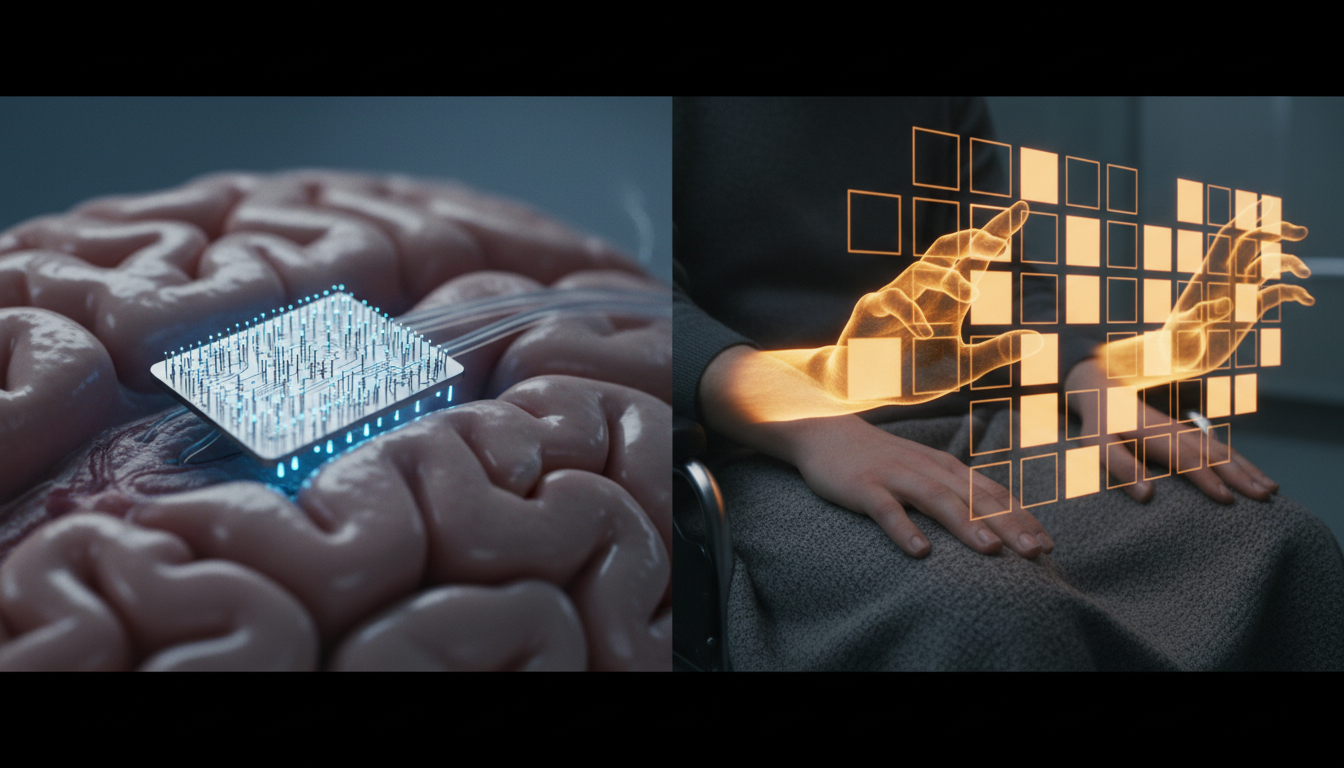
To overcome the limitations of gaze-dependent communication tools, the researchers developed an intracortical brain-computer interface (iBCI) typing neuroprosthesis. This system relies on microelectrodes implanted directly into the motor cortex to capture neural signals. The iBCI provides bimanual QWERTY keyboard functionality for people with paralysis, allowing patients to use a familiar typing layout rather than learning a completely new communication system. Clinically, this design reduces the cognitive load required to operate the device. Typing with the iBCI involves only attempted finger movements. When a patient intends to press a specific key, the neural activity corresponding to that specific finger motion is captured and translated into a digital keystroke, bypassing the damaged neuromuscular pathways entirely.
A major barrier to adopting neural prosthetics in clinical practice is the extensive training time typically required to calibrate the software to an individual patient. In this study, the attempted finger movements are decoded accurately with as few as 30 calibration sentences. This low training burden means patients can begin communicating quickly without experiencing excessive fatigue. To further enhance accuracy, the sentence decoding is improved using a 5-gram language model (a statistical tool that predicts the next word based on the sequence of the previous four words). By integrating this predictive text algorithm, the system corrects minor decoding errors in real time, ensuring that the final text output remains highly accurate even if the initial neural signal is slightly ambiguous.
To evaluate the clinical viability of the device, the typing neuroprosthesis was tested on two intracortical brain-computer interface (iBCI) clinical trial participants with tetraplegia. The researchers selected patients with distinct etiologies for their paralysis to assess the system across different conditions. Specifically, one participant had amyotrophic lateral sclerosis (a progressive neurodegenerative disease affecting motor neurons), and one participant had a spinal cord injury. By testing the device in these two distinct clinical scenarios, the investigators demonstrated that the system can successfully decode motor intentions regardless of whether the paralysis stems from upper motor neuron degeneration or a structural disconnection in the spinal cord.
During the testing phase, the system demonstrated high throughput that closely mimics natural communication. A key feature of the neuroprosthesis is that the typing speed is user-regulated, meaning patients can control the pace of their text generation based on their comfort and cognitive fatigue levels. At peak performance, the typing speed reached 110 characters per minute. This character output translated directly to a functional communication rate, as the typing speed resulted in 22 words per minute. Furthermore, this rapid text generation did not compromise accuracy. The system maintained a word error rate of 1.6 percent, providing a highly reliable communication channel for patients who would otherwise rely on slow, gaze-based spelling systems.
Restoring Intuitive Communication
The clinical utility of any communication device depends heavily on its reliability and speed. The researchers noted that the accuracy of the intracortical brain-computer interface (iBCI) resembles able-bodied typing accuracy. By maintaining a low error rate, the system minimizes the frustration and fatigue often associated with correcting mistakes in assistive communication devices. Furthermore, the iBCI provides higher throughput than current state-of-the-art hand motor iBCI decoding. This improvement in text generation speed allows patients to participate more naturally in real-time conversations, translating neural intent into digital output more effectively than previous motor-decoding platforms.
For practicing physicians managing patients with severe motor impairments, these findings highlight a practical advancement in assistive technology. Ultimately, the typing neuroprosthesis provides an intuitive, familiar, and easy-to-learn paradigm for individuals with impaired communication due to paralysis. Because the system relies on the standard QWERTY layout and translates the natural cognitive process of attempted finger movements, patients do not need to master complex new spelling interfaces. This familiarity reduces the cognitive burden, offering a highly functional communication channel for patients who have lost the ability to speak or type due to severe neurological injury or neurodegenerative disease.
References
1. Brannigan JFM, Liyanage K, Horsfall HL, Bashford L, Muirhead W, Fry A. Brain-computer interfaces patient preferences: a systematic review.. Journal of neural engineering. 2024. doi:10.1088/1741-2552/ad94a6
2. Marchetti M, Priftis K. Effectiveness of the P3-speller in brain-computer interfaces for amyotrophic lateral sclerosis patients: a systematic review and meta-analysis.. Frontiers in neuroengineering. 2014. doi:10.3389/fneng.2014.00012
3. Putrino D, Majidi S, Harel N, et al. 47238 Results of the Command Trial: An Early Feasibility Study of the Synchron Endovascular Brain-Computer Interface. Neurosurgery. 2025. doi:10.1227/neu.0000000000003360_47238
4. Hochberg L, Bacher D, Jarosiewicz B, et al. Reach and grasp by people with tetraplegia using a neurally controlled robotic arm. Nature. 2012. doi:10.1038/nature11076
5. Jude JJ, Levi-Aharoni H, Acosta AJ, et al. Restoring rapid natural bimanual typing with a neuroprosthesis after paralysis.. Nature neuroscience. 2026. doi:10.1038/s41593-026-02218-y