
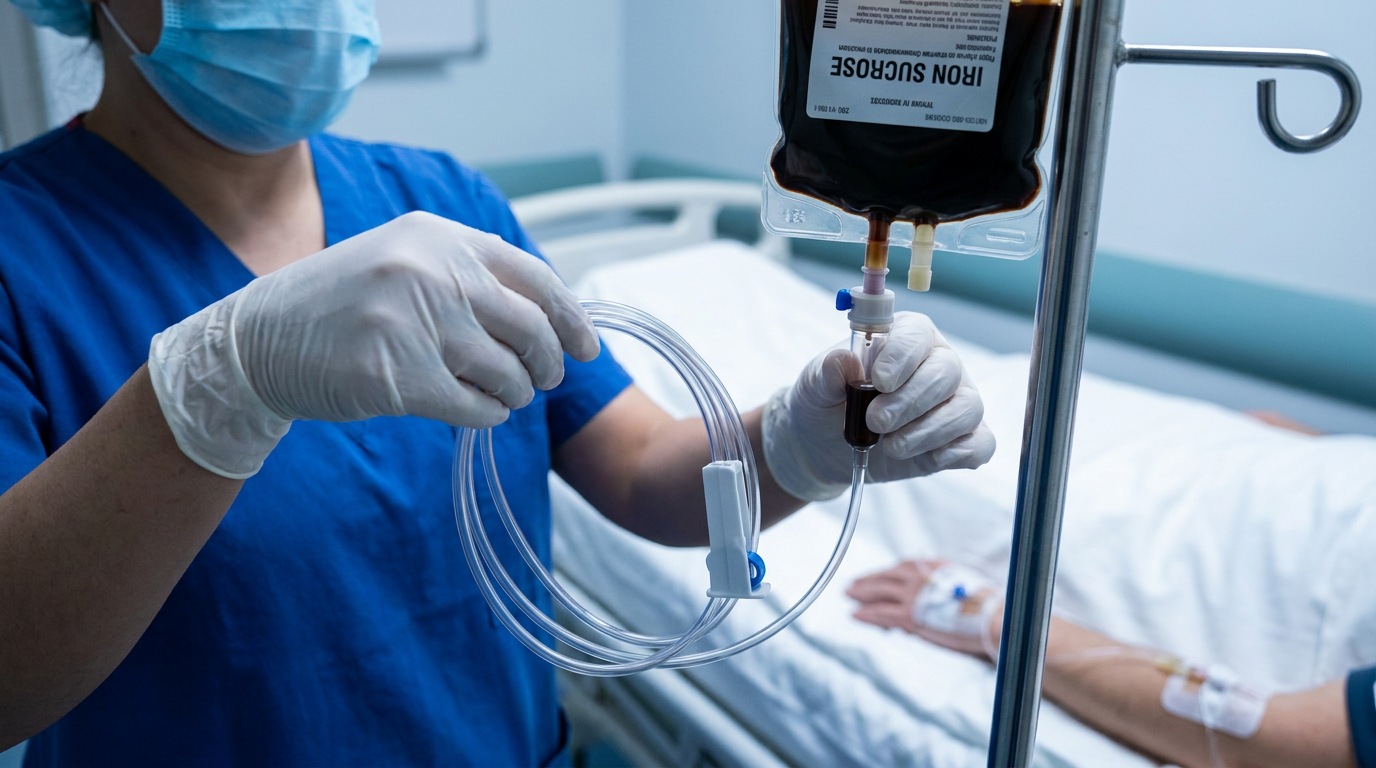
- Concerns persist regarding intravenous iron administration safety in iron deficiency anemia patients with acute infection.
- A retrospective cohort study using the TriNetX Research Network evaluated IV iron safety and efficacy across five infection types.
- IV iron recipients showed significantly higher 90-day survival (e.g., 88.6% vs 83.8% for MRSA bacteremia, P< .001).
- The authors concluded IV iron does not worsen infection and improves survival and hemoglobin recovery in hospitalized patients.
- These findings suggest IV iron may be considered for anemic patients with acute infection, pending prospective confirmation.
Intravenous Iron and Acute Infection: Re-evaluating a Clinical Dilemma
Iron deficiency anemia is a frequent comorbidity in hospitalized patients, particularly those with conditions like heart failure, inflammatory bowel disease, and chronic kidney disease [1, 2, 3, 4]. While intravenous (IV) iron effectively raises hemoglobin and improves outcomes in various settings, its use during acute infection has been historically limited [5, 6, 7, 8]. This caution stems from the long-held biological concern that parenteral iron could act as a nutrient for pathogenic microbes, potentially exacerbating the infection. Consequently, many clinicians delay iron repletion in acutely ill, anemic patients, despite the known benefits of correcting iron deficiency, such as improved functional capacity and reduced transfusion needs [7, 9]. A large, retrospective study now provides real-world evidence to inform this clinical judgment.
Study Design and Patient Cohort
To investigate the safety and efficacy of IV iron during acute infection, researchers conducted a large-scale retrospective cohort study. They utilized the TriNetX Research Network, a federated database that aggregates de-identified electronic health records from numerous healthcare organizations, providing a vast and diverse patient population for analysis. The study period spanned from 2000 to June 2025. The investigators focused on adults with a concurrent diagnosis of iron deficiency anemia and one of five common, serious infections: methicillin-resistant Staphylococcus aureus (MRSA) bacteremia, pneumonia, urinary tract infection (UTI), colitis, or cellulitis. A critical inclusion criterion was the receipt of antibiotics within two days of the infection diagnosis, ensuring the analysis was confined to patients receiving active antimicrobial treatment.
Survival Outcomes Across Infection Types
The analysis revealed a consistent and statistically significant survival advantage for patients who received IV iron. Across all five infection types studied, survival was significantly higher (P< .001 for each infection) at both 14 and 90 days in the IV iron group. For patients with MRSA bacteremia, 90-day survival was 88.6% with IV iron versus 83.8% without. This pattern held for pneumonia, where 90-day survival was 84.7% in the iron-treated group compared to 78.1% in the control group. The survival benefit was also evident at the 14-day mark; for instance, in patients with pneumonia, 14-day survival was 95.7% with IV iron versus 91.5% without. This association between IV iron administration and improved survival was consistently observed for UTI (90-day survival: 89.1% vs 85.6%), colitis (90-day survival: 89.7% vs 83.8%), and cellulitis (90-day survival: 92.2% vs 89.2%). To ensure a fair comparison between groups, the researchers used 1:1 propensity score matching. This statistical technique balances baseline patient characteristics, such as age and comorbidities, between the group that received IV iron and the group that did not, thereby reducing selection bias and strengthening the confidence that the observed differences are associated with the treatment itself.
Enhanced Hemoglobin Recovery
In addition to improved survival, the study found that IV iron administration led to a more robust hematologic recovery. Measured 60 to 90 days after the initial infection, hemoglobin recovery was significantly greater (all P< .001) in patients who received IV iron across all infection subgroups. For example, patients with pneumonia who received IV iron had a mean hemoglobin increase of +1.3 g/dL, compared to +1.0 g/dL for those who did not. The effect was even more pronounced in patients with colitis, where the IV iron group saw a hemoglobin increase of +1.5 g/dL, more than double the +0.7 g/dL increase seen in the control group. Similar significant improvements were noted for MRSA bacteremia (+1.3 g/dL vs +1.0 g/dL), UTI (+1.4 g/dL vs +1.0 g/dL), and cellulitis (+1.4 g/dL vs +0.9 g/dL). This enhanced correction of anemia may contribute to the observed survival benefit and suggests a potential for faster functional recovery in these patients.
Clinical Implications and Future Directions
The findings from this large cohort study directly challenge the conventional wisdom of withholding IV iron from acutely infected patients with iron deficiency anemia. The data indicate that, in patients already receiving appropriate antibiotic therapy, IV iron administration was not associated with worse outcomes and, in fact, was associated with improved survival and better resolution of anemia. This consistent signal across five distinct types of infection, including severe MRSA bacteremia, provides a degree of reassurance for clinicians managing these complex cases. For the practicing physician, these results suggest that the benefits of correcting anemia with IV iron may outweigh the theoretical risks in this population, potentially justifying a re-evaluation of institutional protocols. While the use of propensity matching strengthens these retrospective findings, the authors appropriately note that prospective, randomized controlled trials are necessary to definitively confirm these associations and establish a clear causal link. Such studies will be essential to formally guide future clinical practice guidelines.
References
1. Jankowska EA, Tkaczyszyn M, Suchocki T, et al. Effects of Intravenous Iron Therapy in Iron-Deficient Patients with Systolic Heart Failure: A Meta-Analysis of Randomized Controlled Trials. European Journal of Heart Failure. 2016. doi:10.1002/ejhf.473
2. Zhao C, He W. Efficacy of oral vs. intravenous iron for the treatment of iron deficiency anemia in different conditions: A systematic review and meta-analysis.. Biomedical reports. 2026. doi:10.3892/br.2025.2084
3. Alenazi K, Alhemaid S, Abbas D, et al. Safety and Efficacy of Ferric Carboxymaltose for Iron Deficiency Anemia in Inflammatory Bowel Disease: A Systematic Review and Meta-analysis. International Journal of Medicine in Developing Countries. 2026. doi:10.24911/ijmdc.51-1764689048
4. Khan AI, Khan A, Sam K, et al. Title: Efficacy and Safety of Ferric Derisomaltose for Treatment of Anemia in Chronic Kidney Disease Patients: A Systematic Review. Blood. 2021. doi:10.1182/blood-2021-152272
5. Xue Q, Zhang B, Xing Z, Sun F, Zhao Q, Mu S. Efficacy and safety of intravenous iron supplementation for perioperative iron deficiency anemia: a systematic review and network meta-analysis of randomized controlled trials.. Journal of clinical anesthesia. 2026. doi:10.1016/j.jclinane.2025.112062
6. Toro HIG, Jaramillo AP, Pazmino G, Caceres VM. Intravenous and Oral Iron Strategies for Iron-Deficiency Anemia in Pregnancy: A Systematic Review of Randomized Controlled Trials From a Hematology Perspective.. Cureus. 2026. doi:10.7759/cureus.106291
7. Litton E, Xiao J, Ho KM. Safety and efficacy of intravenous iron therapy in reducing requirement for allogeneic blood transfusion: systematic review and meta-analysis of randomised clinical trials. BMJ. 2013. doi:10.1136/bmj.f4822
8. Pintaningrum Y, Yunandari NP. Iron therapy effect on chronic heart failure and iron-deficiency anemia: a systematic review and meta-analysis.. The Egyptian heart journal : (EHJ) : official bulletin of the Egyptian Society of Cardiology. 2024. doi:10.1186/s43044-024-00545-8
9. Bedan M, Lottrup C. Intravenous Iron Therapy Versus Blood Transfusion for Iron Deficiency Anemia: A Systematic Review.. Transfusion medicine reviews. 2025. doi:10.1016/j.tmrv.2025.150905