For Doctors in a Hurry
- Clinicians frequently struggle to identify which patients with acute respiratory distress will fail noninvasive ventilation in the emergency department.
- This prospective observational study evaluated 126 adult patients to determine if diaphragmatic thickening fraction predicts the need for endotracheal intubation.
- A diaphragmatic thickening fraction of 32.35 percent or less after one hour showed an odds ratio of 8.19 for failure.
- The researchers concluded that measuring diaphragmatic thickening fraction one hour after starting ventilation independently identifies patients at high risk of failure.
- Physicians may use this ultrasound measurement to improve early clinical decision-making regarding the necessity for invasive mechanical ventilation.
Predicting the Failure of Noninvasive Respiratory Support
Noninvasive ventilation remains a cornerstone of management for patients presenting to the emergency department with acute respiratory failure, particularly in cases of hypercapnic chronic obstructive pulmonary disease or acute heart failure [1, 2]. While these modalities can reduce the need for invasive mechanical ventilation, identifying which patients will eventually require endotracheal intubation remains a significant clinical challenge [3, 4]. Delayed intubation in the setting of failing noninvasive support is associated with increased morbidity, yet the criteria for treatment failure are often poorly defined in clinical practice [3, 5]. Current guidelines emphasize the importance of early identification and appropriate management in the initial hours of respiratory distress to improve patient outcomes [6, 7]. A new prospective study now evaluates whether bedside ultrasound of the diaphragm can provide an objective predictor of treatment trajectory during the first hour of support.
Ultrasound Assessment of Diaphragmatic Function
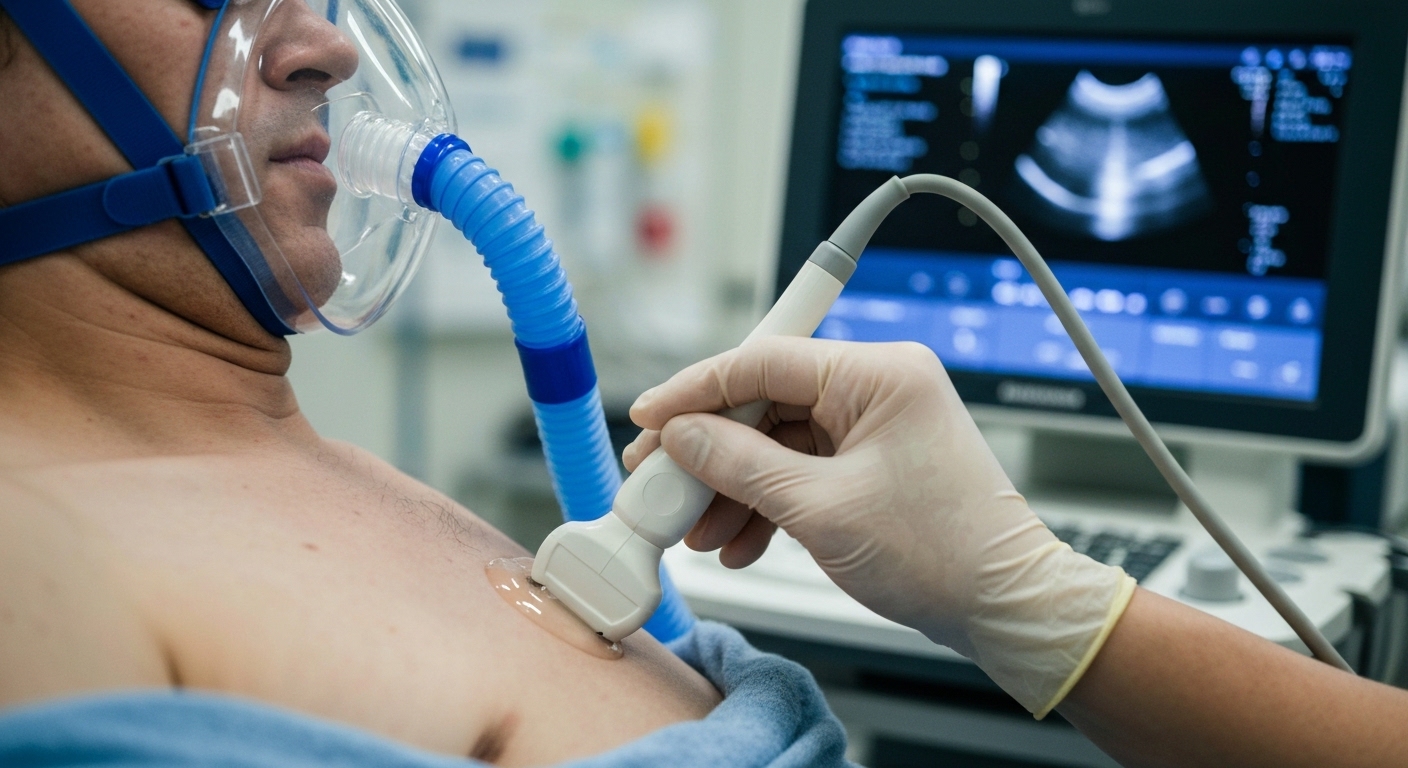
The researchers conducted a prospective observational study in the emergency department of a tertiary care hospital to evaluate the utility of bedside ultrasound in predicting respiratory outcomes. The study enrolled 126 adult patients who presented with undifferentiated dyspnea (shortness of breath with an undetermined cause) and required noninvasive ventilation (NIV) as part of their initial management. By focusing on patients with undifferentiated dyspnea, the authors aimed to provide a tool applicable to the broad range of respiratory pathologies encountered in acute care settings, from pulmonary edema to obstructive airway disease. To assess respiratory effort and diaphragm performance, the investigators used point-of-care ultrasound to measure the diaphragmatic thickening fraction (DTF). The DTF is a calculated percentage representing the increase in diaphragm thickness during inspiration compared to expiration, which serves as a surrogate for the work of breathing and muscle contractile strength. These measurements were recorded at two distinct time points: immediately at the initiation of NIV and again after one hour of treatment. This temporal approach allowed the researchers to observe how the diaphragm responded to the mechanical support provided by the ventilator, providing a dynamic view of patient physiology. The primary outcome of the study was NIV failure within 24 hours, which the authors strictly defined as the clinical requirement for endotracheal intubation. Beyond this primary endpoint, the study tracked several secondary clinical outcomes to determine the broader prognostic value of diaphragmatic ultrasound. These included in-hospital mortality, the duration of invasive ventilation for those who failed noninvasive support, and the total length of stay in the intensive care unit (ICU) and the hospital. By correlating early ultrasound findings with these longitudinal metrics, the study sought to establish a reliable physiological marker for patients at high risk of clinical deterioration.
One-Hour Thickening Fraction as a Predictor of Intubation
Among the 126 patients enrolled in the study, 36 individuals (28.6%) experienced NIV failure, requiring endotracheal intubation within 24 hours of admission. The researchers found that the diaphragmatic thickening fraction (DTF) measured after 60 minutes of support was a more robust indicator of clinical trajectory than the initial baseline assessment. Specifically, a DTF of 32.35% or less at the 1-hour mark was significantly associated with NIV failure (P < 0.001). This 1-hour measurement provided better discrimination for predicting the need for invasive ventilation than measurements taken at the time of NIV initiation, suggesting that the diaphragm's response to initial mechanical support is more clinically informative than its state upon arrival. The diagnostic accuracy of the 1-hour DTF measurement was characterized by an area under the curve (AUC) of 0.802, a statistical measure where 1.0 represents perfect prediction and 0.5 represents chance. At the identified threshold of 32.35%, the test demonstrated a sensitivity of 75% and a specificity of 74.4%. Notably, the negative predictive value reached 88.2%, indicating that patients with a thickening fraction above this cutoff are highly likely to be successfully managed without progressing to intubation. In a multivariate analysis (a statistical method that controls for multiple clinical variables simultaneously to isolate the effect of a single factor), a DTF at 1 hour of 32.35% or less was independently associated with NIV failure with an odds ratio of 8.19 (P < 0.001). This finding indicates that these patients were more than eight times as likely to require invasive airway management compared to those with higher thickening fractions, providing clinicians with a clear, quantifiable threshold for risk stratification.
Correlation with Mortality and Resource Utilization
The clinical utility of the diaphragmatic thickening fraction (the percentage increase in diaphragm thickness during inspiration) extends beyond the immediate prediction of intubation. The researchers found that the diaphragmatic thickening fraction at 1 hour significantly correlated with in-hospital mortality (P = 0.007). This suggests that the degree of diaphragmatic recruitment or exhaustion observed early in the course of noninvasive support serves as a marker for overall disease severity and the risk of death during the hospital stay. For the clinician, a low thickening fraction after 60 minutes of noninvasive ventilation may signal a patient who requires not only airway intervention but also more intensive monitoring and aggressive management of their underlying pathology. In addition to mortality, the 1-hour ultrasound assessment provided insight into the long-term resource needs of patients who eventually required escalation of care. The study demonstrated that the diaphragmatic thickening fraction at 1 hour significantly correlated with the number of invasive ventilation days (P < 0.001) for those who failed noninvasive support. Furthermore, the researchers observed that the diaphragmatic thickening fraction at 1 hour significantly correlated with the duration of intensive care unit stay (P = 0.002). These findings indicate that patients with poor diaphragmatic performance early in their treatment course are likely to face more prolonged and complicated recoveries. By identifying these high-risk individuals within the first hour of emergency department care, physicians can better anticipate the need for critical care resources and potentially expedite the transition to invasive support before clinical deterioration becomes severe, thereby avoiding the risks associated with emergency intubation in a crashing patient.
References
1. Qin J, Wang G, Liao Y, Shang W, Han D. High flow nasal therapy versus noninvasive ventilation for AECOPD with acute hypercapnic respiratory failure: a meta-analysis of randomized controlled trials.. Annals of intensive care. 2025. doi:10.1186/s13613-025-01480-w
2. Marjanovic N, Couvreur R, Lamarre J, Piton M, Guenezan J, Mimoz O. High-flow nasal cannula oxygen therapy versus noninvasive ventilation in acute respiratory failure related to suspected or confirmed acute heart failure: a systematic review with meta-analysis.. European journal of emergency medicine : official journal of the European Society for Emergency Medicine. 2024. doi:10.1097/MEJ.0000000000001171
3. Hakim R, Watanabe-Tejada L, Sukhal S, Tulaimat A. Acute respiratory failure in randomized trials of noninvasive respiratory support: A systematic review of definitions, patient characteristics, and criteria for intubation.. Journal of critical care. 2020. doi:10.1016/j.jcrc.2020.02.018
4. Xu X, Yuan B, Liang Q, et al. Noninvasive ventilation for acute lung injury a meta-analysis of randomized controlled trials.. Heart & lung : the journal of critical care. 2016. doi:10.1016/j.hrtlng.2016.02.005
5. Zayed Y, Banifadel M, Barbarawi M, et al. Noninvasive Oxygenation Strategies in Immunocompromised Patients With Acute Hypoxemic Respiratory Failure: A Pairwise and Network Meta-Analysis of Randomized Controlled Trials. Journal of Intensive Care Medicine. 2020. doi:10.1177/0885066619844713
6. Evans L, Rhodes A, Alhazzani W, et al. Surviving Sepsis Campaign: International Guidelines for Management of Sepsis and Septic Shock 2021. Critical Care Medicine. 2021. doi:10.1097/ccm.0000000000005337
7. Kalil AC, Metersky ML, Klompas M, et al. Management of Adults With Hospital-acquired and Ventilator-associated Pneumonia: 2016 Clinical Practice Guidelines by the Infectious Diseases Society of America and the American Thoracic Society. Clinical Infectious Diseases. 2016. doi:10.1093/cid/ciw353