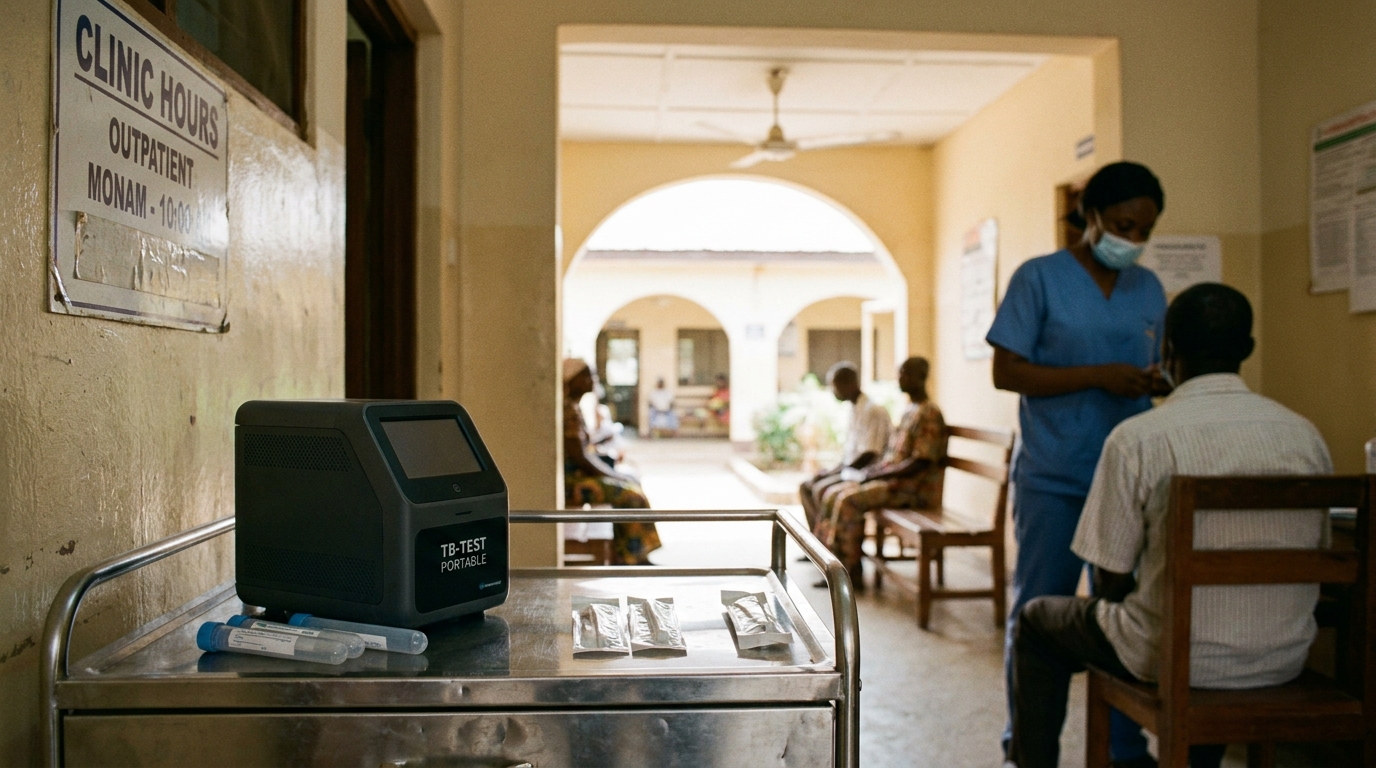
For Doctors in a Hurry
- Clinicians require accurate, accessible diagnostic tools for pulmonary tuberculosis that function effectively within resource-limited peripheral health centers.
- This prospective cross-sectional study evaluated 1380 participants across seven countries to assess the MiniDock MTB diagnostic test.
- MiniDock MTB demonstrated 85.7 percent sensitivity using sputum and 79.6 percent sensitivity using tongue swabs, with specificity exceeding 97.5 percent.
- The researchers concluded that the test meets World Health Organization accuracy targets for near-point-of-care tuberculosis detection in diverse settings.
- This tool offers a high-accuracy alternative to smear microscopy, potentially improving case notification through easier specimen collection and good usability.
Closing the Diagnostic Gap in Pulmonary Tuberculosis
Tuberculosis remains a primary driver of infectious disease mortality worldwide, with 2021 estimates highlighting the persistent challenge of undiagnosed cases across 204 countries and territories [1]. While sputum-based nucleic acid amplification tests (molecular techniques that identify specific genetic sequences of the pathogen) have improved detection, many patients struggle to expectorate the high-quality samples required for these assays [2, 3]. This challenge is particularly acute in pediatric populations and individuals with human immunodeficiency virus (HIV), where low bacterial loads often lead to false-negative results on traditional smear microscopy [4, 5]. Recent meta-analyses indicate that oral swabs, a noninvasive alternative, demonstrate a combined sensitivity of 0.67 and specificity of 0.95 in pulmonary tuberculosis cases [5]. Specifically, tongue swabs have shown a higher sensitivity of 0.75 (95% CI: 0.65 to 0.83) compared to 0.52 (95% CI: 0.34 to 0.70) for cheek specimens [5]. To address this diagnostic gap, a multi-country prospective study now evaluates the diagnostic accuracy and clinical usability of a new molecular system designed for these diverse healthcare environments.
Multicenter Evaluation of Swab-Based Molecular Detection
To evaluate the MiniDock MTB test across seven high-burden countries (India, Nigeria, the Philippines, South Africa, Uganda, Vietnam, and Zambia), the researchers conducted a prospective, cross-sectional study, an observational design that analyzes data from a population at a specific point in time. This multicenter approach ensured the diagnostic tool was tested in diverse clinical environments where tuberculosis is endemic. Between September 12, 2024, and March 31, 2025, the study enrolled patients 12 years of age or older who presented at outpatient centers with presumptive pulmonary tuberculosis. A total of 1380 participants were enrolled to provide a robust dataset for accuracy assessment. Within this cohort, 255 participants (18.5%) were living with HIV infection, a critical subgroup given the diagnostic challenges often associated with coinfection. The researchers identified 226 participants (16.4%) with culture-confirmed tuberculosis (cases where Mycobacterium tuberculosis was grown and identified in a laboratory culture), which served as the reference standard for evaluating the sensitivity and specificity of the swab-based molecular tests. Funded by the National Institutes of Health and other organizations, the trial was formally registered under the ClinicalTrials.gov identifiers NCT04923958 and NCT05941052, corresponding to the Rapid Research in Diagnostics Development for TB Network and the Assessing Diagnostics at Point-of-Care for Tuberculosis initiatives. By utilizing a large, multi-country cohort, the study aimed to establish whether swab-based molecular detection could meet the rigorous standards required for clinical implementation in resource-limited settings.
Diagnostic Accuracy Across Sputum and Tongue Specimens
The researchers evaluated the diagnostic performance of the MiniDock MTB test by comparing results from both sputum swabs and tongue swabs against a sputum culture reference standard. Among the 1380 participants, the molecular assay demonstrated high levels of accuracy that varied slightly depending on the specimen type. For patients providing sputum swabs, the MiniDock MTB sensitivity was 85.7% (95% confidence interval [CI], 80.4 to 90.0). When tongue swabs were utilized as a less invasive alternative, the sensitivity was 79.6% (95% CI, 73.8 to 84.7). These findings indicate that while sputum remains the more sensitive medium for molecular detection, tongue swabs provide a viable diagnostic yield for patients who struggle to produce adequate sputum samples. The clinical utility of the test is further supported by its high specificity, which is essential for minimizing false-positive results and unnecessary treatment in high-burden settings. The specificity for MiniDock MTB was greater than 97.5% for both sputum and tongue swabs, ensuring that the vast majority of patients without tuberculosis were correctly identified. This performance profile is particularly relevant for clinicians working in peripheral health centers, as the test results align with the rigorous benchmarks established by global health authorities. Specifically, the diagnostic accuracy was consistent with World Health Organization (WHO) targets for near-point-of-care diagnostics, which require a sensitivity of at least 85% for sputum specimens and at least 75% for nonsputum specimens, alongside a specificity of at least 98% for both categories. By meeting these WHO accuracy targets, the MiniDock MTB system demonstrates the technical maturity required for deployment in decentralized clinical environments. For practicing physicians, the ability to achieve 85.7% sensitivity in sputum and 79.6% sensitivity in tongue swabs while maintaining a specificity above 97.5% provides confidence that this test offers a reliable, culture-independent alternative to initiate timely treatment.
Comparison with Established Diagnostic Standards
To determine the clinical utility of the MiniDock MTB assay, the researchers evaluated its diagnostic accuracy against a sputum-culture-based reference, which serves as the gold standard for confirming active infection. The study also included head-to-head comparisons with two common diagnostic modalities: sputum-smear microscopy and the Xpert MTB/RIF Ultra assay. When analyzing sputum specimens, the MiniDock MTB sensitivity closely matched that of the Xpert MTB/RIF Ultra assay, showing a narrow difference of -2.8 percentage points (95% CI, -6.0 to 0.5). This finding suggests that the swab-based molecular test provides a diagnostic yield nearly equivalent to established automated nucleic acid amplification tests, which are the current standard for rapid molecular detection in many clinical settings. Furthermore, the assay demonstrated a significant advantage over traditional sputum-smear microscopy, a method that often fails to detect cases with low bacterial loads. In sputum samples, the MiniDock MTB showed a greater sensitivity than smear microscopy, with a difference of 24.3 percentage points (95% CI, 17.9 to 30.7). This increased sensitivity extended to nonsputum specimens as well, which is critical for patients who cannot easily produce deep lung secretions. Specifically, the MiniDock MTB tongue swabs achieved a greater sensitivity than smear microscopy with a difference of 18.3 percentage points (95% CI, 12.0 to 24.7). For the practicing clinician, these data indicate that switching from microscopy to swab-based molecular testing could substantially reduce the rate of false-negative results and facilitate earlier treatment initiation for pulmonary tuberculosis.
Clinical Usability and Safety in Resource-Limited Settings
Beyond diagnostic accuracy, the practical implementation of the MiniDock MTB test in diverse clinical environments depends on its ease of use for healthcare providers. The researchers evaluated this through direct observation and the system usability scale, a standardized metric ranging from 0 to 100 where higher scores reflect better perceived usability of a tool. Among the clinicians and technicians participating in the study across seven countries, the median score on the system usability scale was 75 (interquartile range, 65 to 80). This score indicates good usability, suggesting that the platform is well suited for integration into peripheral health centers where specialized laboratory training may be limited. Safety remains a primary concern when introducing diagnostic modalities into routine clinical practice, particularly when involving specimen collection from symptomatic patients. Throughout the evaluation of 1380 participants, the researchers monitored for any complications arising from the collection of sputum or tongue swabs. The study findings confirmed a favorable safety profile, as no adverse events related to the index test were reported. For the practicing physician, these results demonstrate that the MiniDock MTB system provides a reliable and safe alternative for tuberculosis screening, combining high diagnostic yield with a user interface that facilitates consistent performance across varied medical settings.
References
1. Ferrari AJ, Santomauro D, Aali A, et al. Global incidence, prevalence, years lived with disability (YLDs), disability-adjusted life-years (DALYs), and healthy life expectancy (HALE) for 371 diseases and injuries in 204 countries and territories and 811 subnational locations, 1990–2021: a systematic analysis for the Global Burden of Disease Study 2021. The Lancet. 2024. doi:10.1016/s0140-6736(24)00757-8
2. Savage HR, Rickman HM, Burke RM, et al. Accuracy of upper respiratory tract samples to diagnose Mycobacterium tuberculosis: a systematic review and meta-analysis. The Lancet Microbe. 2023. doi:10.1016/s2666-5247(23)00190-8
3. Denkinger CM, Schumacher SG, Boehme C, Dendukuri N, Pai M, Steingart KR. Xpert MTB/RIF assay for the diagnosis of extrapulmonary tuberculosis: a systematic review and meta-analysis. European Respiratory Journal. 2014. doi:10.1183/09031936.00007814
4. Church EC, Steingart KR, Cangelosi GA, Ruhwald M, Kohli M, Shapiro AE. Oral swabs with a rapid molecular diagnostic test for pulmonary tuberculosis in adults and children: a systematic review.. The Lancet. Global health. 2024. doi:10.1016/S2214-109X(23)00469-2
5. Zhang F, Wang Y, Zhang X, et al. Diagnostic accuracy of oral swab for detection of pulmonary tuberculosis: a systematic review and meta-analysis. Frontiers in Medicine. 2024. doi:10.3389/fmed.2023.1278716