For Doctors in a Hurry
- Researchers investigated the outcomes of managing acute respiratory distress syndrome using extracorporeal membrane oxygenation without invasive mechanical ventilation.
- This retrospective cohort study analyzed 307 adult patients across 14 international centers who received either primary awake or extubated extracorporeal support.
- Ninety-day mortality was 30.1 percent for primary awake patients and 14.9 percent for those extubated during extracorporeal support.
- Strategy failure, occurring in 40.7 percent of primary awake cases, significantly increased mortality risk with hazard ratios exceeding 5.95.
- Clinicians should monitor for respiratory worsening and delirium, as these factors frequently lead to strategy failure and poor outcomes.
Acute respiratory distress syndrome remains a significant driver of morbidity and mortality in the intensive care unit, frequently necessitating advanced ventilatory support [1, 2]. While lung-protective ventilation and prone positioning are mainstays of treatment, venovenous extracorporeal membrane oxygenation (ECMO) is an established salvage therapy for patients with refractory hypoxemia [3, 4]. In recent years, clinical focus has expanded to strategies that minimize the complications of invasive mechanical ventilation, such as ventilator-associated pneumonia and prolonged sedation, by keeping patients awake and non-intubated during ECMO support [5, 6]. These approaches aim to facilitate early mobilization and potentially shorten intensive care stays, but their safety and efficacy are still under investigation [7, 8]. A new international retrospective cohort study provides a detailed analysis of outcomes and risk factors associated with these non-intubated ECMO strategies.
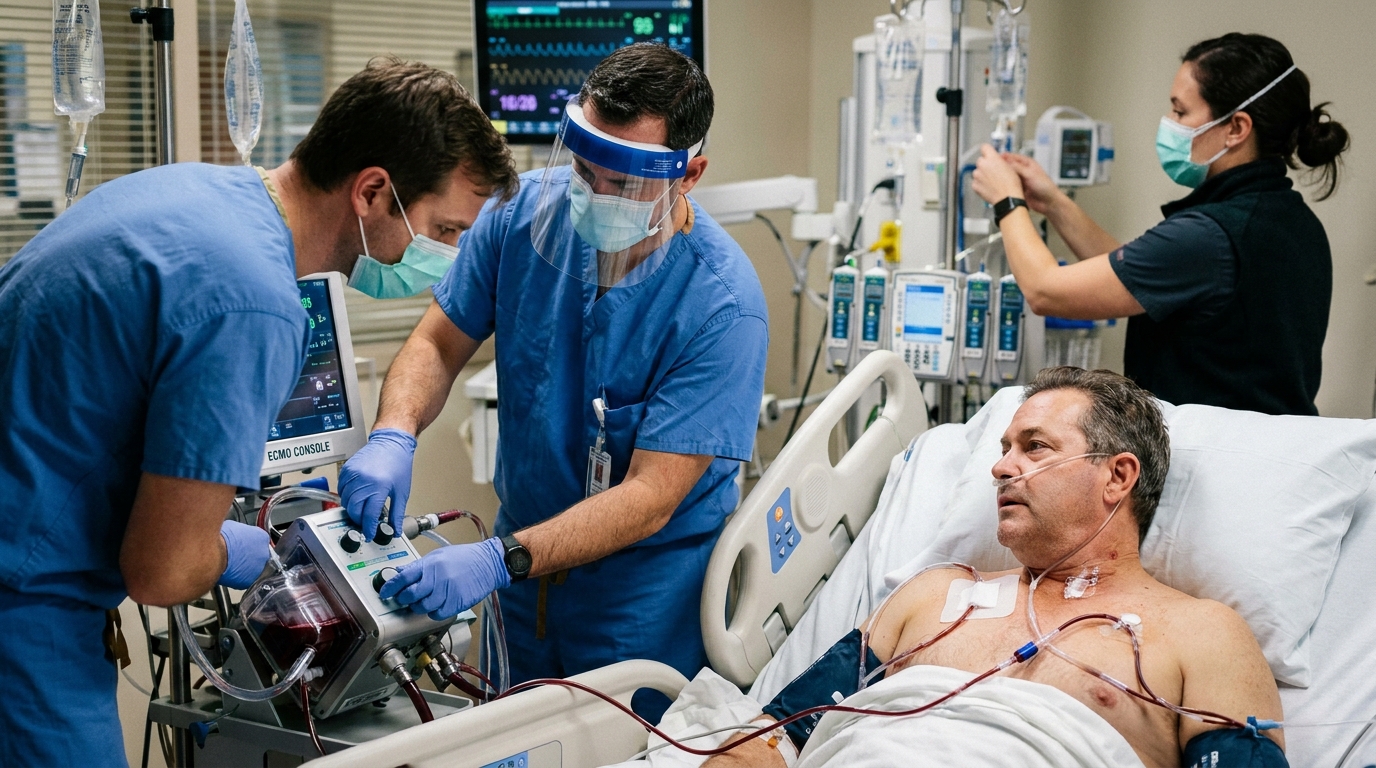
To evaluate the outcomes of non-intubated extracorporeal support, researchers conducted an international retrospective cohort study of 307 adult patients with acute respiratory distress syndrome (ARDS). The analysis drew from data collected between 2015 and 2024 at 14 centers in 8 countries, offering a broad perspective on real-world clinical application. The study population was stratified into two distinct groups based on the clinical approach. The first cohort included 113 patients who received 'primary awake ECMO', a strategy where ECMO was initiated specifically to avoid intubation and invasive mechanical ventilation altogether. The second cohort comprised 194 patients who were 'extubated on ECMO', meaning the endotracheal tube was removed while they were already stable on extracorporeal support. The authors noted that patients selected for each strategy presented with different baseline clinical characteristics, suggesting that clinicians tailor the approach based on the patient's physiological state. The primary outcome for the study was all-cause mortality at 90 days following the initiation of ECMO.
Quantifying Mortality and Strategy Failure Rates
A significant difference in survival was observed between the two cohorts. The 90-day mortality rate was 30.1% in the 'primary awake ECMO' group, more than double the 14.9% mortality rate seen in the 'extubated ECMO' group. This disparity in outcomes was mirrored by the rates of strategy failure, defined as the need to initiate or resume invasive mechanical ventilation. Failure of the non-intubated approach was common, particularly in the primary awake cohort, where 46 patients (40.7%) ultimately required intubation. In the 'extubated ECMO' group, the strategy failed in 47 patients (24.2%). The investigators found that this period of vulnerability was most pronounced early in the treatment course, with most failures occurring within the first 10 days of non-intubated support. The primary driver of failure in both groups was a worsening of the underlying respiratory failure. However, the secondary causes differed: agitation and delirium were frequent triggers for intubation in the 'primary awake ECMO' group, whereas an inability to clear secretions was a common problem leading to re-intubation in the 'extubated ECMO' group.
The Clinical Cost of Strategy Failure
The study's multivariate analysis revealed that the failure of a non-intubated strategy was a powerful independent predictor of death. For patients who were extubated on ECMO, subsequent re-intubation was associated with a more than sevenfold increase in the risk of death, with a hazard ratio for 90-day mortality of 7.67 (95% confidence interval, 3.44 to 17.11; P < .001). A similarly high risk was observed in the primary awake group, where strategy failure was associated with a nearly sixfold increase in mortality risk, with a hazard ratio of 5.95 (95% confidence interval, 2.63 to 13.46; P < .001). These findings highlight that while avoiding intubation is the goal, a transition to invasive mechanical ventilation in this context signals a grave prognosis. Other factors also influenced survival. In the 'extubated ECMO' group, higher age was associated with increased 90-day mortality. For the 'primary awake ECMO' patients, a longer time from ICU admission to ECMO cannulation (the procedure to insert the large-bore catheters for the ECMO circuit) was a key predictor of mortality, suggesting that delays in initiating support for this strategy may negatively impact outcomes.
References
1. Bellani G, Laffey JG, Pham T, et al. Epidemiology, Patterns of Care, and Mortality for Patients With Acute Respiratory Distress Syndrome in Intensive Care Units in 50 Countries. JAMA. 2016. doi:10.1001/jama.2016.0291
2. Guérin C, Reignier J, Richard J, et al. Prone Positioning in Severe Acute Respiratory Distress Syndrome. New England Journal of Medicine. 2013. doi:10.1056/nejmoa1214103
3. Combes A, Hajage D, Capellier G, et al. Extracorporeal Membrane Oxygenation for Severe Acute Respiratory Distress Syndrome. New England Journal of Medicine. 2018. doi:10.1056/nejmoa1800385
4. Combes A, Peek GJ, Hajage D, et al. ECMO for severe ARDS: systematic review and individual patient data meta-analysis. Intensive Care Medicine. 2020. doi:10.1007/s00134-020-06248-3
5. Belletti A, Sofia R, Cicero P, et al. Extracorporeal Membrane Oxygenation Without Invasive Ventilation for Respiratory Failure in Adults: A Systematic Review*. Critical Care Medicine. 2023. doi:10.1097/CCM.0000000000006027
6. Zhu Y, Zhang M, Zhang R, Ye X, Wei J. Extracorporeal membrane oxygenation versus mechanical ventilation alone in adults with severe acute respiratory distress syndrome: A systematic review and meta-analysis.. International journal of clinical practice. 2021. doi:10.1111/ijcp.14046
7. Shrestha DB, Sedhai YR, Budhathoki P, et al. Extracorporeal Membrane Oxygenation (ECMO) Dependent Acute Respiratory Distress Syndrome (ARDS): A Systematic Review and Meta-Analysis.. Cureus. 2022. doi:10.7759/cureus.25696
8. Turgeon J, Venkatamaran V, Englesakis M, Fan E. Long-term outcomes of patients supported with extracorporeal membrane oxygenation for acute respiratory distress syndrome: a systematic review and meta-analysis.. Intensive care medicine. 2024. doi:10.1007/s00134-023-07301-7