
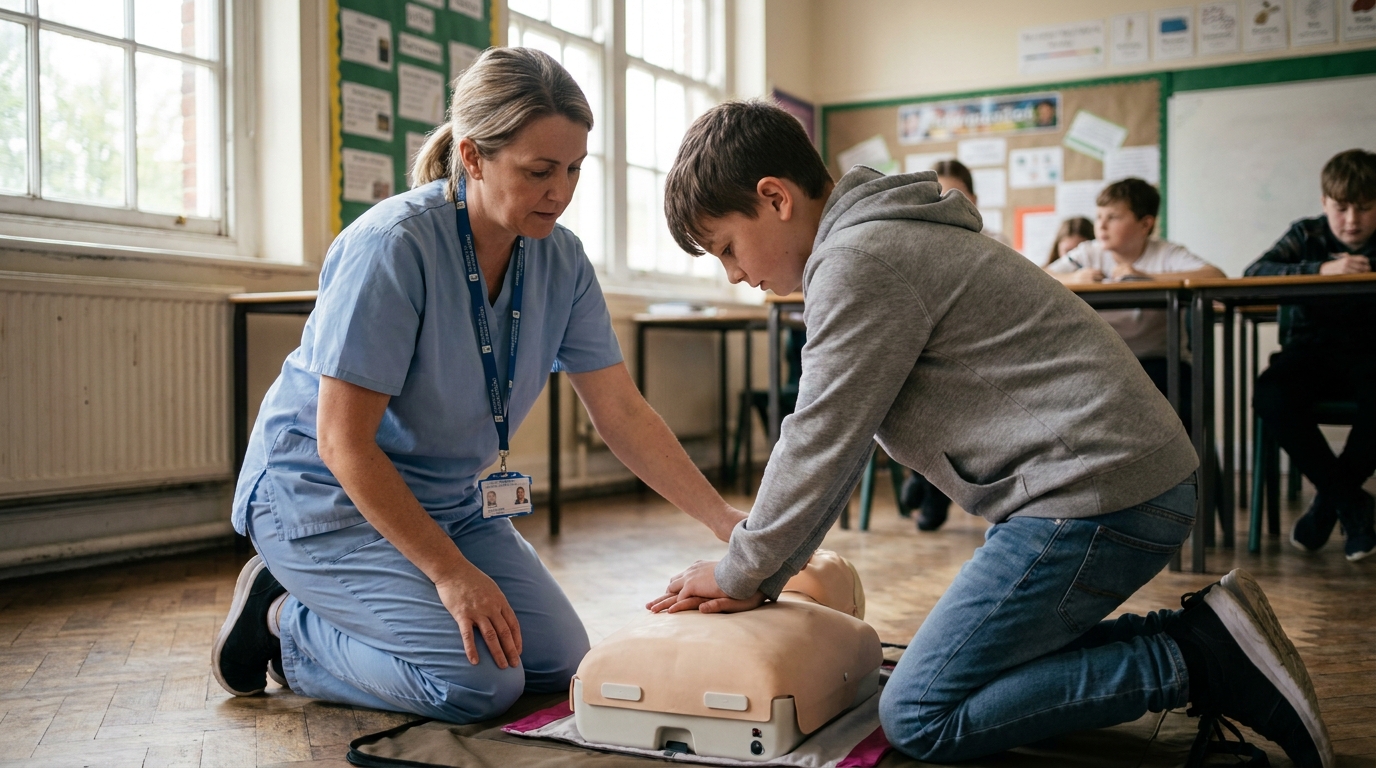
- Researchers investigated if a nurse-led school program using low-cost manikins could effectively extend cardiopulmonary resuscitation training into the community.
- This prospective observational study involved nine community nurses who trained 1,047 students aged 10 to 12 in Murcia, Spain.
- Participating students trained 1,136 family members, achieving a multiplying effect of 2.41 trainees per student (95% CI 2.27 to 2.55).
- The authors concluded that school-based programs using handmade manikins are feasible and produce adequate performance scores of 7.8 out of 11.
- Clinicians should recognize school-based initiatives as efficient tools for increasing community-wide proficiency in basic life support and emergency response.
Expanding the Chain of Survival Through Community Training
Out-of-hospital cardiac arrest remains a leading cause of mortality and neurological morbidity, carrying a global survival rate to hospital discharge of approximately 8.8 percent (95% CI 8.2 to 9.4) [1]. While hospital-based interventions like targeted temperature management (the controlled maintenance of a specific core body temperature to limit reperfusion injury) are standard, research indicates that maintaining a target of 33 degrees Celsius does not provide a survival benefit over 36 degrees Celsius [2]. Because clinical outcomes depend heavily on the immediate initiation of high-quality bystander cardiopulmonary resuscitation, which is associated with a survival-to-discharge rate of 11.3 percent [1, 3], public health strategies increasingly focus on community education. Current efforts often rely on school-based curricula and online modules, though a recent cluster-randomized trial of high school students found that a 30-minute online session alone did not significantly improve practical skill scores (p=0.176) [4, 5]. Consequently, clinicians and health systems are investigating more effective, hands-on methods to broaden community training, such as the nurse-led initiative evaluated in this study.
A Scalable Model for School-Based Instruction
To evaluate a decentralized approach to basic life support training, researchers conducted a prospective observational study in Murcia, Spain, between June and August 2025. The initiative was implemented across public and publicly funded private schools using a workforce of nine community school nurses. To ensure consistency in educational delivery, each nurse was assigned to a specific health area and received standardized preparation before entering the classroom. This framework allowed the program to reach a diverse student population while maintaining uniform instructional quality across different regional districts.
The intervention consisted of a single basic life support session lasting approximately 60 minutes, delivered to intact classes of students aged 10 to 12 years old. A central component of the curriculum involved students constructing their own low-cost manikins, a strategy designed to bypass the financial and logistical barriers associated with purchasing professional medical simulation equipment. By building these hand-made trainers, the 1,047 participating students gained a portable tool that facilitated hands-on practice without the need for expensive infrastructure.
To measure the program's reach beyond the classroom, the protocol included a multiplier component where students were invited to teach cardiopulmonary resuscitation to a family member or close contact at home. This transition from learner to instructor was documented by the students, who submitted a WhatsApp video of their home training session for expert review. For practicing physicians, this methodology is highly relevant: because the vast majority of cardiac arrests occur in residential settings, turning children into community trainers offers a practical way to disseminate life-saving skills directly to the adult population most likely to witness a sudden collapse.
Quantifying the Multiplier Effect in the Community
The study established two primary outcomes to evaluate the program's efficacy: school reach and the multiplying effect, defined as the number of home trainees generated per participating student. During the study period, the nine community nurses successfully trained a total of 1,047 students in basic life support techniques. This initial cohort served as the foundation for the subsequent dissemination of skills into private residences, where the majority of out-of-hospital cardiac arrests occur. By focusing on school-aged children, the program aimed to create a sustainable pipeline of potential rescuers embedded directly within the community.
The transition from classroom learning to community application was measured by the students' engagement with the at-home training assignment. The findings show that the at-home training activity was completed by 472 out of 1,047 students, representing 45.1 percent of the cohort (95% CI 42.1 to 48.1). These participating students successfully trained a total of 1,136 family members or close contacts, effectively doubling the reach of the professional nursing staff. This high level of engagement among nearly half of the student population suggests that a nurse-led school curriculum can successfully mobilize young learners to act as health educators within their own households.
The resulting multiplying effect was calculated at 2.41 per student (95% CI 2.27 to 2.55), a metric that underscores the potential for school-based interventions to rapidly expand the pool of trained bystanders. For clinicians, this multiplier is a critical data point because it addresses the persistent challenge of low bystander cardiopulmonary resuscitation rates in residential settings. By achieving a ratio of more than two additional trainees for every student who completed the task, the program demonstrates a scalable method for increasing bystander density, a known determinant of survival and neurological recovery following cardiac arrest.
Evaluating Skill Acquisition and Technical Proficiency
To determine the quality of the instruction provided by the students to their families, the researchers established secondary outcomes focused on video-based cardiopulmonary resuscitation performance scores. Two independent experts, who were not involved in the initial training delivery, evaluated the submitted videos using a standardized 11-item checklist. This assessment tool provided a total score range of 0 to 11 to quantify technical proficiency. To ensure the reliability of the data, any disagreements between the two independent experts regarding a trainee's performance were resolved by consensus. This rigorous review process allowed the researchers to move beyond simple participation metrics and evaluate the actual clinical competency of the laypeople trained in the home environment.
The analysis of the community-generated data revealed that out of 1,136 submitted videos, 489 were deemed analyzable (43.0%; 95% CI 40.2 to 45.9). Among these evaluable sessions, trainees achieved a mean total performance score of 7.8 out of 11 (95% CI 7.63 to 7.97). When the researchers disaggregated the checklist items, they found that performance scores were higher for the recognition of cardiac arrest, activation of emergency services, and the technical execution of chest compressions. In contrast, scores were lower for the specific steps of requesting or simulating the use of an automated external defibrillator. This discrepancy suggests that while basic manual skills and situational awareness are effectively transmitted through student-led instruction, the more complex integration of medical devices may require additional reinforcement.
Based on these findings, the researchers concluded that the nurse-delivered school program was feasible and produced a substantial home-training multiplier that significantly extends the reach of traditional basic life support instruction. For the practicing clinician, these results indicate that a 60-minute school-based intervention can result in adequate skill acquisition among family members, even when the training is mediated by a child using a low-cost manikin. While the lower proficiency in automated external defibrillator use highlights a specific area for curriculum refinement, the overall performance scores suggest that this model can effectively increase the density of capable bystanders in residential areas, ultimately strengthening the chain of survival before emergency medical services arrive.
References
1. Yan S, Gan Y, Jiang N, et al. The global survival rate among adult out-of-hospital cardiac arrest patients who received cardiopulmonary resuscitation: a systematic review and meta-analysis. Critical Care. 2020. doi:10.1186/s13054-020-2773-2
2. Nielsen N, Wetterslev J, Cronberg T, et al. Targeted Temperature Management at 33°C versus 36°C after Cardiac Arrest. New England Journal of Medicine. 2013. doi:10.1056/nejmoa1310519
3. Chen K, Ko Y, Hsieh M, Chiang W, Huei‐Ming M. Interventions to improve the quality of bystander cardiopulmonary resuscitation: A systematic review. PLoS ONE. 2019. doi:10.1371/journal.pone.0211792
4. Bathe J, Daubmann A, Doehn C, Napp A, Raudies M, Beck S. Online training to improve BLS performance with dispatcher assistance? Results of a cluster-randomised controlled simulation trial.. Scandinavian journal of trauma, resuscitation and emergency medicine. 2024. doi:10.1186/s13049-024-01226-w
5. Maár C, Zima E, Nagy B, et al. The investigation of the efficiency of basic life support education among high school students: Protocol, design and implementation of an interventional, prospective longitudinal, individually randomised, parallel 1:1 grouped trial.. Resuscitation plus. 2024. doi:10.1016/j.resplu.2024.100585