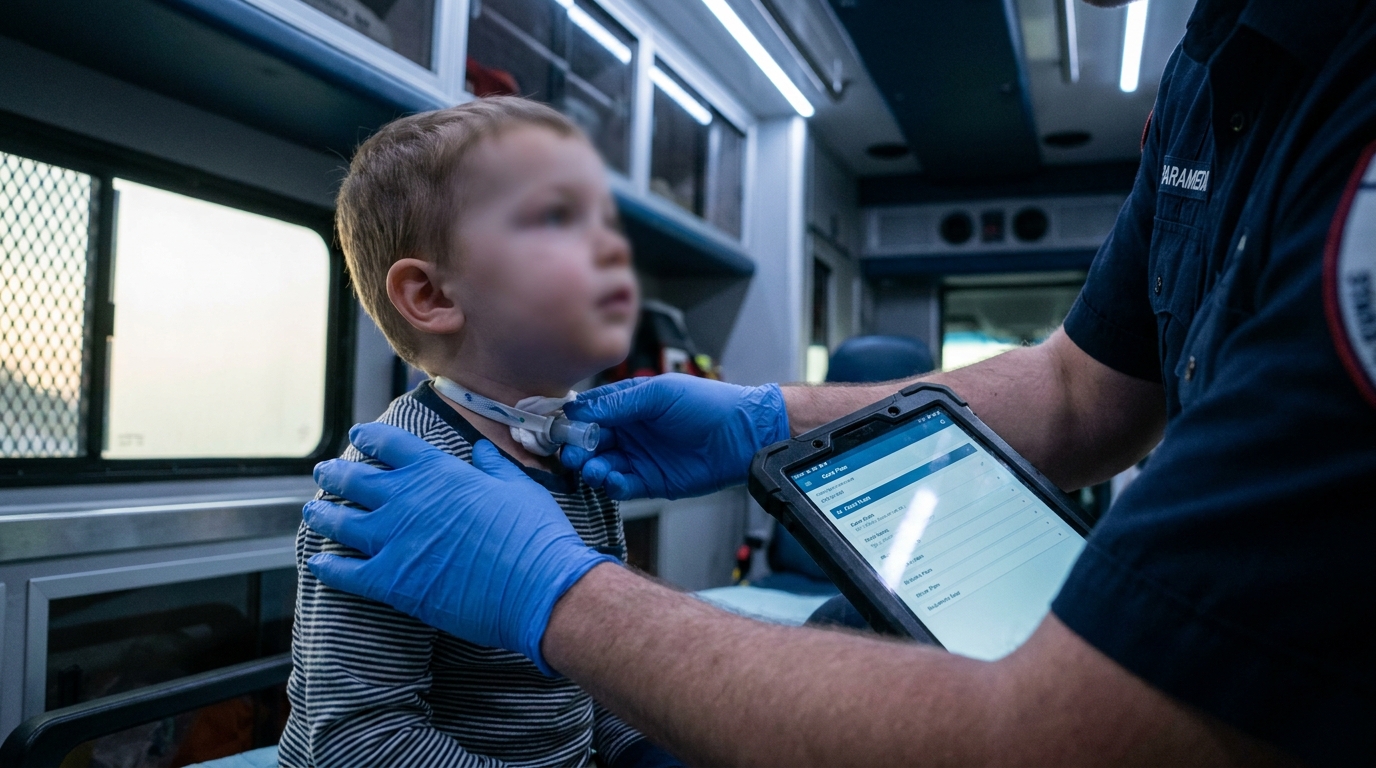
For Doctors in a Hurry
- Emergency medical services often lack sufficient training to manage children with medical complexity who require specialized home care.
- The study evaluated the Special Needs Tracking and Awareness Response System, which enrolled 2424 patients since its 2014 inception.
- This physician-led program reduced unnecessary patient transports and improved disaster response readiness for these high-risk pediatric populations.
- The authors conclude that providing real-time access to individualized emergency care plans enhances prehospital safety for complex children.
- Clinicians should consider implementing similar collaborative models to standardize care and address health inequities in their local communities.
Bridging the Gap in Emergency Care for Medically Complex Children
The population of children with medical complexity is expanding rapidly as advances in care allow those with chronic, technology-dependent conditions to live at home [1]. These patients frequently utilize emergency services, yet they often encounter a prehospital system where clinicians have limited pediatric training and infrequent exposure to rare clinical presentations. A systematic review of 16 studies indicates that 24/7 access to knowledgeable providers and expedited ambulatory care (outpatient medical services provided on an urgent, same-day, or next-day basis) are critical components in preventing avoidable emergency department visits [2]. Furthermore, systemic and structural barriers, such as logistical hurdles and limited service availability, are cited in 58% of research as primary factors that impede access to necessary pediatric interventions [3]. While clinical guidelines emphasize the importance of structured performance improvement programs (systematic, data-driven efforts to standardize and upgrade patient care) to improve outcomes in acute settings, implementing these models across the prehospital-to-hospital continuum remains a significant challenge [4, 5]. A new study now examines the evolution of a specialized tracking and response system designed to address these systemic gaps.
The Challenge of Home-Based Complex Pediatric Care
The demographic landscape of pediatric medicine is shifting as the population of children and youth with special health care needs (CYSHCN) grows significantly. Within this group, children with medical complexity (CMC) represent a particularly vulnerable cohort defined by chronic conditions, functional limitations, or a heavy reliance on medical technology such as ventilators, feeding tubes, or shunts. Because of substantial advances in medical care, these children are now frequently able to live at home rather than in long-term care facilities. While this transition improves quality of life, it simultaneously makes encounters with emergency medical services (EMS) more likely when acute complications or equipment failures occur in the community setting. Despite the increasing frequency of these interactions, systemic gaps in prehospital readiness persist. EMS clinicians typically receive limited pediatric training and have infrequent encounters with the specific population of children with medical complexity. This lack of exposure and specialized education results in variable comfort and preparedness among first responders when managing high-stakes pediatric emergencies. These challenges are further compounded by social determinants of health (the economic and social conditions that influence individual and group differences in health status), which create stark disparities in outcomes. The findings indicate that disadvantaged communities experience higher emergency department use for children with medical complexity and suffer from increased child mortality within this demographic. For the practicing clinician, these findings underscore the necessity of integrated systems that provide EMS providers with real-time, patient-specific data to mitigate the risks associated with infrequent but high-acuity pediatric encounters.
Evolution of the STARS Coordination Model
The Special Needs Tracking and Awareness Response System (STARS) was developed to enhance EMS readiness and promote health equity for children with medical complexity. Originally launched in 2014 as an EMS-driven initiative, the program has since evolved into a hospital-based, physician-led program. This transition from a field-led effort to a clinical leadership model allows for deeper integration between hospital specialists and prehospital providers. As of 2025, the program has enrolled 2424 patients, providing a substantial database for coordinating care across the continuum and ensuring that the specific needs of these high-risk pediatric populations are met during acute crises. Central to the STARS model is the use of individualized emergency care plans stored in a secure electronic system. These plans provide real-time access to patient-specific data, which is critical for children who may have unique anatomical or physiological requirements that deviate from standard pediatric advanced life support protocols. By utilizing this secure electronic system, the program ensures that first responders have immediate access to a child's medical history, baseline vitals, and specific intervention requirements before they even arrive at the bedside. This infrastructure allows for a more tailored clinical response, moving away from generic protocols toward precision prehospital medicine. A major focus of STARS is providing emergency care education to EMS and community emergency departments in their catchment area (the geographic region from which a hospital or health system draws its patients). This targeted training addresses the specific needs of the 2424 enrolled patients, ensuring that both prehospital clinicians and hospital staff in smaller community settings are prepared for low-frequency, high-acuity encounters. The researchers found that this collaborative approach has reduced unnecessary transports and strengthened disaster response capabilities. By bridging the gap between specialized pediatric centers and community-based emergency services, the program offers a scalable framework to address health inequities in children with medical complexity through interdisciplinary care coordination.
Clinical Outcomes and Scalability in High-Risk Populations
As of 2025, the Special Needs Tracking and Awareness Response System (STARS) has enrolled 2424 patients, establishing a robust framework for managing children with medical complexity. By providing emergency medical services (EMS) clinicians with real-time access to patient-specific plans, the program has successfully reduced unnecessary transports to hospital facilities. This immediate availability of individualized clinical data allows first responders to manage acute issues on-site when appropriate, rather than defaulting to emergency department transfer for every encounter. Furthermore, the integration of these detailed care protocols has strengthened disaster response capabilities, ensuring that the most vulnerable pediatric patients receive specialized support during large-scale public health emergencies or environmental crises. The STARS framework functions as a scalable and collaborative model that prioritizes medically complex, high-risk pediatric populations through a multi-pronged clinical strategy. This approach relies on targeted EMS training and interdisciplinary care coordination, which involves active communication between primary specialists, hospitalists, and prehospital providers. By streamlining these interactions, the program has offered a structured opportunity to address health inequities in children with medical complexity, particularly for those in underserved areas where access to specialized pediatric care is often limited. The researchers emphasize that this model can be adapted by other health systems to improve outcomes for high-risk children by ensuring that their unique medical requirements are recognized and addressed before they reach the hospital doors.
References
1. Vos T, Abajobir AA, Abate KH, et al. Global, regional, and national incidence, prevalence, and years lived with disability for 328 diseases and injuries for 195 countries, 1990–2016: a systematic analysis for the Global Burden of Disease Study 2016. The Lancet. 2017. doi:10.1016/s0140-6736(17)32154-2
2. Pulcini CD, Coller RJ, Houtrow AJ, Belardo Z, Zorc JJ. Preventing Emergency Department Visits for Children With Medical Complexity Through Ambulatory Care: A Systematic Review.. Academic pediatrics. 2021. doi:10.1016/j.acap.2021.01.006
3. Radež J, Reardon T, Creswell C, Lawrence PJ, Evdoka-Burton G, Waite P. Why do children and adolescents (not) seek and access professional help for their mental health problems? A systematic review of quantitative and qualitative studies. European Child & Adolescent Psychiatry. 2020. doi:10.1007/s00787-019-01469-4
4. Evans L, Rhodes A, Alhazzani W, et al. Surviving Sepsis Campaign: International Guidelines for Management of Sepsis and Septic Shock 2021. Critical Care Medicine. 2021. doi:10.1097/ccm.0000000000005337
5. Lamb CA, Kennedy NA, Raine T, et al. British Society of Gastroenterology consensus guidelines on the management of inflammatory bowel disease in adults. Gut. 2019. doi:10.1136/gutjnl-2019-318484