
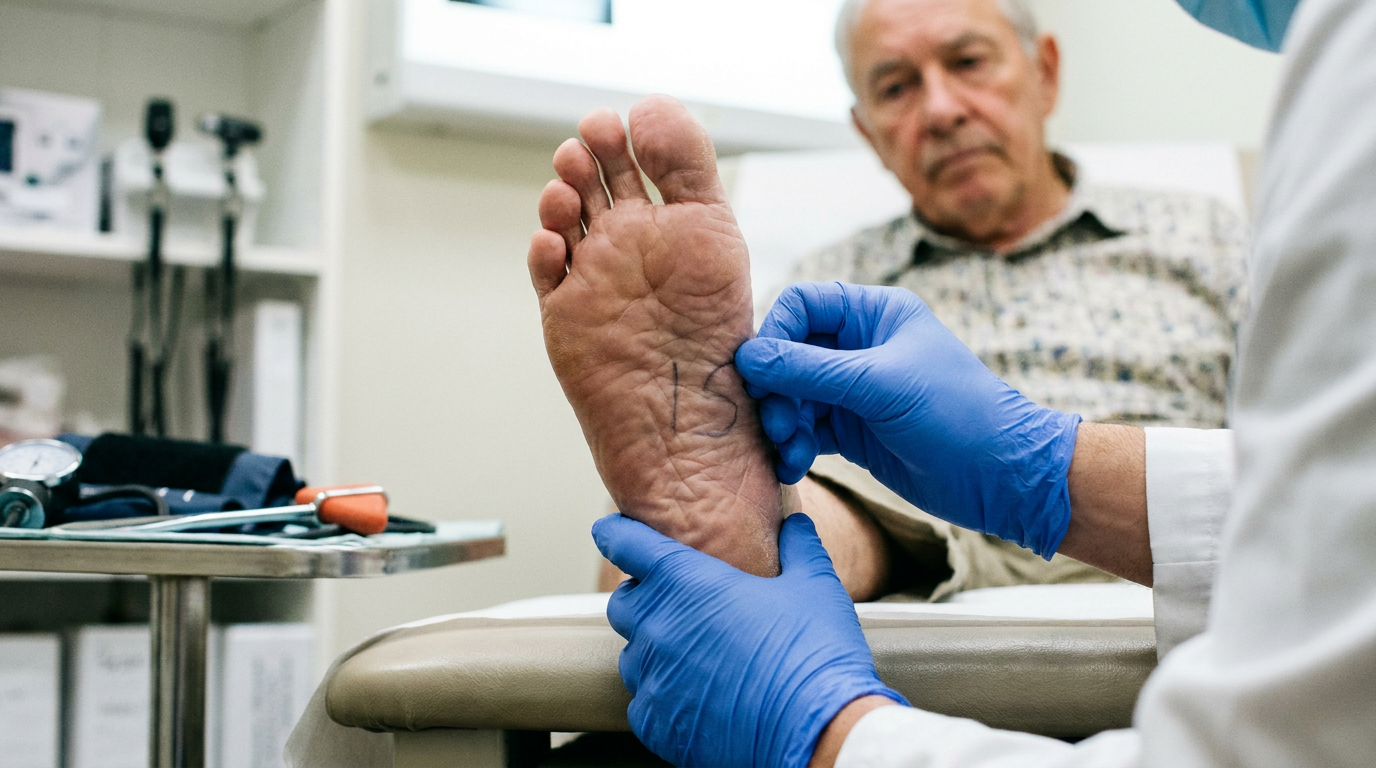
- This case report addresses the clinical significance of plantar agraphesthesia in diagnosing lower limb cortical sensory loss.
- This is a case report detailing the clinical presentation of a 70-year-old man with progressive neurological decline.
- The patient exhibited plantar agraphesthesia, foot dystonia, and bradykinesia, with brain MRI showing asymmetric right parietal atrophy.
- The authors conclude that plantar agraphesthesia is a valuable bedside sign of lower limb cortical sensory loss, even without hand involvement.
- Clinicians should consider plantar agraphesthesia as an indicator of cortical sensory dysfunction in patients with gait disturbance.
Unraveling Corticobasal Syndrome: The Importance of Subtle Sensory Signs
Neurodegenerative diseases in older adults frequently present with overlapping symptoms, complicating accurate and timely diagnosis [1]. Clinicians must often differentiate between conditions like Parkinson's disease, corticobasal degeneration, and frontotemporal dementia, which share motor features but demand distinct management [1, 2]. While bradykinesia and dystonia are well-recognized, subtle cortical sensory deficits are often overlooked. These sensory signs, however, can be critical for diagnosis, and the ability to elicit them at the bedside is an invaluable skill for navigating these complex neurological presentations [3, 2].
A Patient's Journey: Progressive Neurological Decline
A recent case study details the diagnostic journey of a 70-year-old man with no significant prior medical history who presented with progressive left leg numbness, gait dysfunction, and recurrent falls. Over the course of a year, his symptoms evolved significantly. He developed difficulty initiating steps, and more revealingly, reported a profound sense of alienation from his own limb, describing a difficulty in perceiving his left leg as his own. This type of perceptual disturbance, a form of asomatognosia, strongly points to a disruption in the brain's cortical processing of body representation, shifting the diagnostic focus from peripheral nerve or spinal issues to a central, cerebral pathology.
Key Diagnostic Clues: Unpacking Neurological Findings
The patient's neurologic examination revealed objective signs consistent with a complex movement disorder, including foot dystonia and bradykinesia. A key finding, however, was plantar agraphesthesia, the inability to recognize numbers or letters traced onto the sole of the foot. This specific deficit is a classic sign of cortical sensory dysfunction, indicating that the brain's parietal lobe is failing to process and interpret tactile information, rather than a failure of peripheral nerves to transmit the signal. This objective finding correlated directly with the patient's subjective feeling of limb dissociation.
Treatment Response and Clinical Implications
Further investigation helped to pinpoint the origin of the deficit. Electromyography and nerve conduction studies were both unremarkable, effectively ruling out a peripheral neuropathy or myopathy. Brain magnetic resonance imaging (MRI), however, revealed asymmetric parietal atrophy that was most pronounced on the right side. This anatomical finding provides a clear structural basis for the patient's left-sided symptoms, as the right parietal lobe is critical for integrating sensory information and maintaining spatial awareness of the left side of the body. In a therapeutic trial, the patient did not improve despite treatment with high-dose carbidopa-levodopa (900 mg/day). This lack of response is a crucial diagnostic clue, helping to differentiate his condition from Parkinson's disease, which typically responds to dopaminergic therapy, and further supporting a diagnosis of corticobasal syndrome. The case highlights that plantar agraphesthesia is a valuable bedside sign of lower limb cortical sensory loss, even when more common signs in the hands are absent. For clinicians evaluating patients with unexplained gait dysfunction or falls, testing for this specific cortical sign can provide an early and specific indicator of an underlying neurodegenerative process.
References
1. Erkkinen M, Kim M, Geschwind MD. Clinical Neurology and Epidemiology of the Major Neurodegenerative Diseases. Cold Spring Harbor Perspectives in Biology. 2017. doi:10.1101/cshperspect.a033118
2. Massano J, Bhatia KP. Clinical Approach to Parkinson's Disease: Features, Diagnosis, and Principles of Management. Cold Spring Harbor Perspectives in Medicine. 2012. doi:10.1101/cshperspect.a008870
3. Perkins JA, Price RS, Vizcarra JA. Pearls & Oy-Sters: Plantar Agraphesthesia in Corticobasal Syndrome.. Neurology. 2026. doi:10.1212/WNL.0000000000218062