For Doctors in a Hurry
- Researchers investigated how postural control impairments contribute to gait dysfunction across the spectrum of Huntington's disease.
- This study evaluated 38 participants, including 10 healthy controls, 17 pre-manifest, and 11 manifest Huntington's disease patients using wearable sensors.
- Postural control deficits explained 14% to 39% of the variance in gait dysfunction and clinical rating scale items (p < .05).
- The authors concluded that postural control deficits contribute substantially to gait dysfunction rather than merely co-occurring with other symptoms.
- These findings suggest that early intervention targeting postural control may be necessary for effective clinical gait rehabilitation programs.
Postural Stability and Mobility in Huntington's Disease
Gait and balance impairments represent some of the most debilitating motor symptoms in Huntington’s disease, frequently leading to a loss of independence and a high risk of falls [1, 2]. While pharmacological options for these symptoms remain limited, a meta-analysis of 122 studies involving 7,231 participants indicates that structured exercise significantly improves quality of life (effect size = 0.40, p < 0.0001) and motor function across various neurodegenerative conditions [3, 4]. Although clinicians typically rely on subjective rating scales, wearable sensors offer an objective method for longitudinal monitoring by identifying distinct activity profiles in both clinic and home settings [5, 6]. Despite established patterns of cerebellar and subcortical atrophy (the wasting of brain tissue in regions responsible for coordination and motor control) in these patients, the mechanical relationship between standing postural stability and active walking remains insufficiently characterized [7]. A recent study clarifies this relationship, detailing how specific postural control deficits contribute to gait dysfunction as patients progress from the pre-manifest stage to manifest disease.
Quantifying Subclinical Deficits via Wearable Sensors
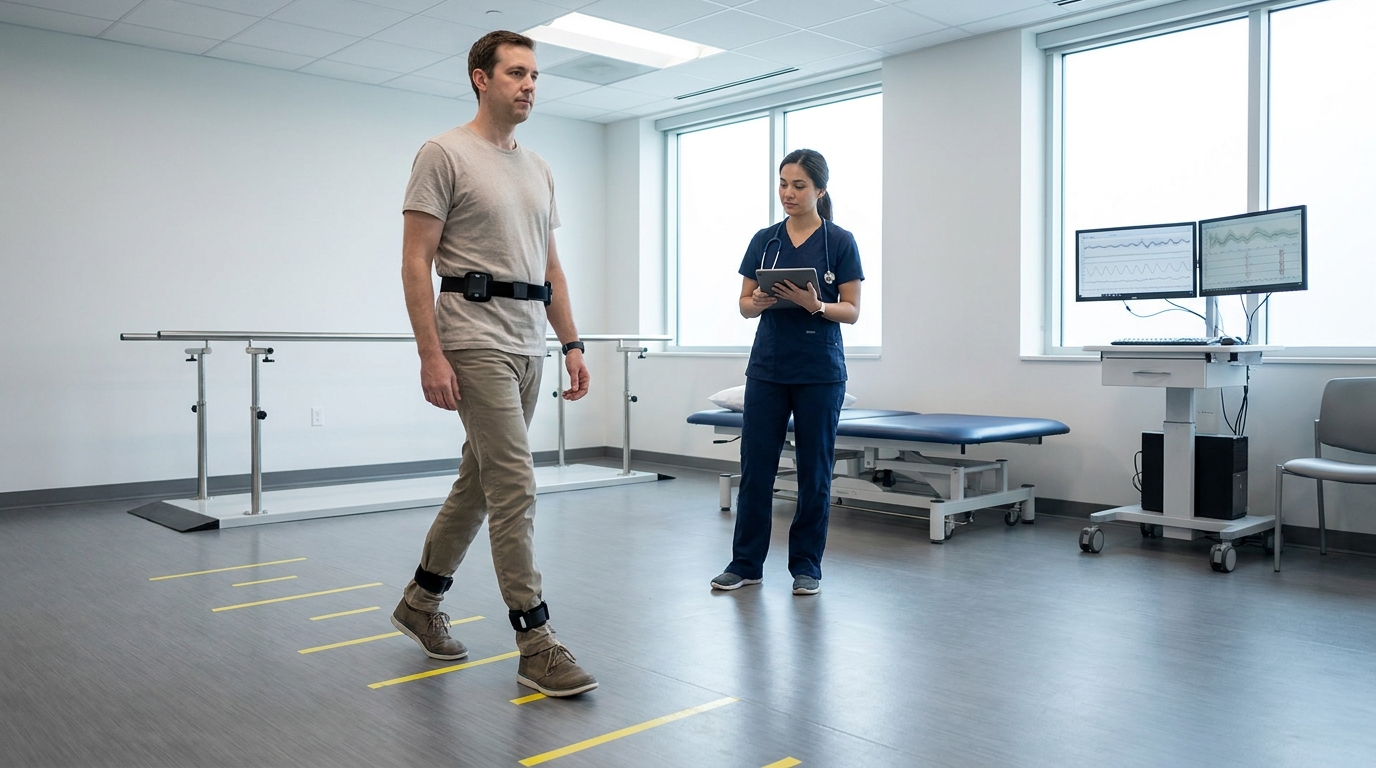
To delineate the progression of motor impairment across the disease spectrum, researchers evaluated a cohort of 38 participants, consisting of 10 healthy controls, 17 individuals with pre-manifest Huntington's disease, and 11 individuals with manifest Huntington's disease. To capture objective data that might elude standard clinical observation, the team utilized wearable sensors to monitor participants during sensory-challenging conditions. This methodology allowed for the precise quantification of postural control through specific biomechanical metrics. These included Jerk (a measure of movement smoothness where higher values indicate less stability) and Total Sway Area (the total area covered by a patient's center of pressure while standing). By capturing these subtle shifts, clinicians can detect micro-instabilities long before a patient reports feeling off-balance.
Gait was subsequently assessed at a self-selected pace to identify early markers of mobility decay. The researchers focused on several parameters of gait quality, including peak swing velocity, stride length, cadence, and the percentage of the gait cycle spent in the stance and swing phases. The assessment also measured stride-to-stride variability, which quantifies the fluctuation in timing and distance between consecutive steps. The findings indicated that impairments in both postural control and gait variability were evident in the pre-manifest Huntington's disease group and increased substantially in the manifest Huntington's disease group (p < 0.05).
Multiple regression analyses (a statistical method used to determine the influence of independent variables on a dependent outcome) revealed that these postural control deficits are primary drivers of walking difficulties rather than isolated symptoms. Specifically, postural control deficits explained 14 percent to 39 percent of the variance in gait dysfunction, affecting both objective quality metrics and the gait items on the Unified Huntington's Disease Rating Scale (p < 0.05). For the practicing physician, these data suggest that balance impairments emerge during the pre-manifest stage and directly fuel subsequent gait instability, highlighting a critical window for early physical therapy before overt manifest symptoms appear.
Progression of Impairment from Pre-manifest to Manifest Disease
Motor deficits are detectable well before the onset of overt clinical symptoms, providing a clearer picture of the early physiological impact of the disease. Specifically, impairments in postural control, characterized by increased Jerk and Total Sway Area, were evident in the pre-manifest Huntington's disease group (p < 0.05). These static balance issues were accompanied by dynamic gait impairments, primarily manifested as increased stride-to-stride variability (p < 0.05). These findings suggest that the underlying neurodegenerative process disrupts the coordination of both static and dynamic tasks in the pre-symptomatic phase, long before traditional diagnostic criteria for motor manifestation are met.
As the disease transitions into the manifest stage, these motor deficits become significantly more pronounced. The researchers found that both postural control and gait impairments substantially increased in the manifest Huntington's disease group (p < 0.05) compared to both healthy controls and those in the pre-manifest stage. This trajectory confirms that deficits in postural control and gait begin in the pre-manifest stage of Huntington's disease and worsen as the disease progresses to the manifest stage. For the practicing clinician, these data emphasize that gait and balance decay are not merely late-stage complications but rather continuous processes that evolve over the entire disease course. This progression underscores the clinical necessity of identifying subclinical changes early, allowing physicians to initiate targeted rehabilitation programs before the significant escalation in motor instability that characterizes manifest disease.
The Mechanistic Link Between Balance and Gait
To determine whether balance and walking issues are merely parallel symptoms or if one actively drives the other, the researchers utilized multiple regression analyses. This statistical modeling confirmed that postural control deficits contribute substantially to gait deficits in Huntington's disease rather than merely co-occurring as independent symptoms. For the clinician, this suggests that the observable instability in a patient's walk is often a direct consequence of failing postural maintenance systems. This mechanistic link indicates that therapeutic interventions targeting static balance may have a direct, downstream impact on walking proficiency.
The quantitative impact of these balance impairments is significant, as the study found that postural control deficits explained 14 percent to 39 percent of the variance in gait dysfunction. This range of influence was not limited to a single metric. Instead, the variance explained by postural deficits applied to gait quality, gait variability, and gait items of the Unified Huntington's Disease Rating Scale (p < 0.05). By demonstrating that objective balance metrics correlate strongly with the Unified Huntington's Disease Rating Scale (the standard clinical assessment tool for this patient population), the findings provide a clear rationale for prioritizing balance-oriented physical therapy. Because these postural deficits explain up to 39 percent of the variance in walking ability, addressing core stability early in the disease course may be essential for preserving functional mobility and delaying the onset of severe gait-related disability.
References
1. Lekoubou A, Echouffo‐Tcheugui JB, Kengne AP. Epidemiology of neurodegenerative diseases in sub-Saharan Africa: a systematic review. BMC Public Health. 2014. doi:10.1186/1471-2458-14-653
2. Bachoud‐Lévi A, Ferreira JJ, Massart R, et al. International Guidelines for the Treatment of Huntington's Disease. Frontiers in Neurology. 2019. doi:10.3389/fneur.2019.00710
3. Dauwan M, Begemann M, Slot MIE, Lee E, Scheltens P, Sommer IE. Physical exercise improves quality of life, depressive symptoms, and cognition across chronic brain disorders: a transdiagnostic systematic review and meta-analysis of randomized controlled trials. Journal of Neurology. 2019. doi:10.1007/s00415-019-09493-9
4. Fritz NE, Rao AK, Kegelmeyer D, et al. Physical Therapy and Exercise Interventions in Huntington’s Disease: A Mixed Methods Systematic Review. Journal of Huntington s Disease. 2017. doi:10.3233/jhd-170260
5. Adams J, Dinesh K, Xiong M, et al. Multiple Wearable Sensors in Parkinson and Huntington Disease Individuals: A Pilot Study in Clinic and at Home. Digital Biomarkers. 2017. doi:10.1159/000479018
6. Lu L, Zhang J, Xie Y, et al. Wearable Health Devices in Health Care: Narrative Systematic Review. JMIR mhealth and uhealth. 2020. doi:10.2196/18907
7. Gellersen HM, Guo CC, O’Callaghan C, Tan RH, Sami S, Hornberger M. Cerebellar atrophy in neurodegeneration—a meta-analysis. Journal of Neurology Neurosurgery & Psychiatry. 2017. doi:10.1136/jnnp-2017-315607