For Doctors in a Hurry
- Researchers investigated the efficacy of resuscitative thoracotomy for managing traumatic cardiac arrest in modern combat settings involving high-energy penetrating injuries.
- This retrospective cohort study analyzed 27 combat casualties who underwent emergency department thoracotomy among 2,335 total trauma admissions.
- While 40.7 percent achieved return of spontaneous circulation, the 30-day survival rate was 7.4 percent with good neurologic outcomes.
- The authors concluded that survival after combat-related thoracotomy is comparable to civilian rates despite the presence of complex injury patterns.
- Clinicians should prioritize thoracotomy for penetrating abdominal or extremity hemorrhage, though prehospital circulatory arrest indicates an extremely poor prognosis.
Aortic Occlusion Strategies in Exsanguinating Trauma
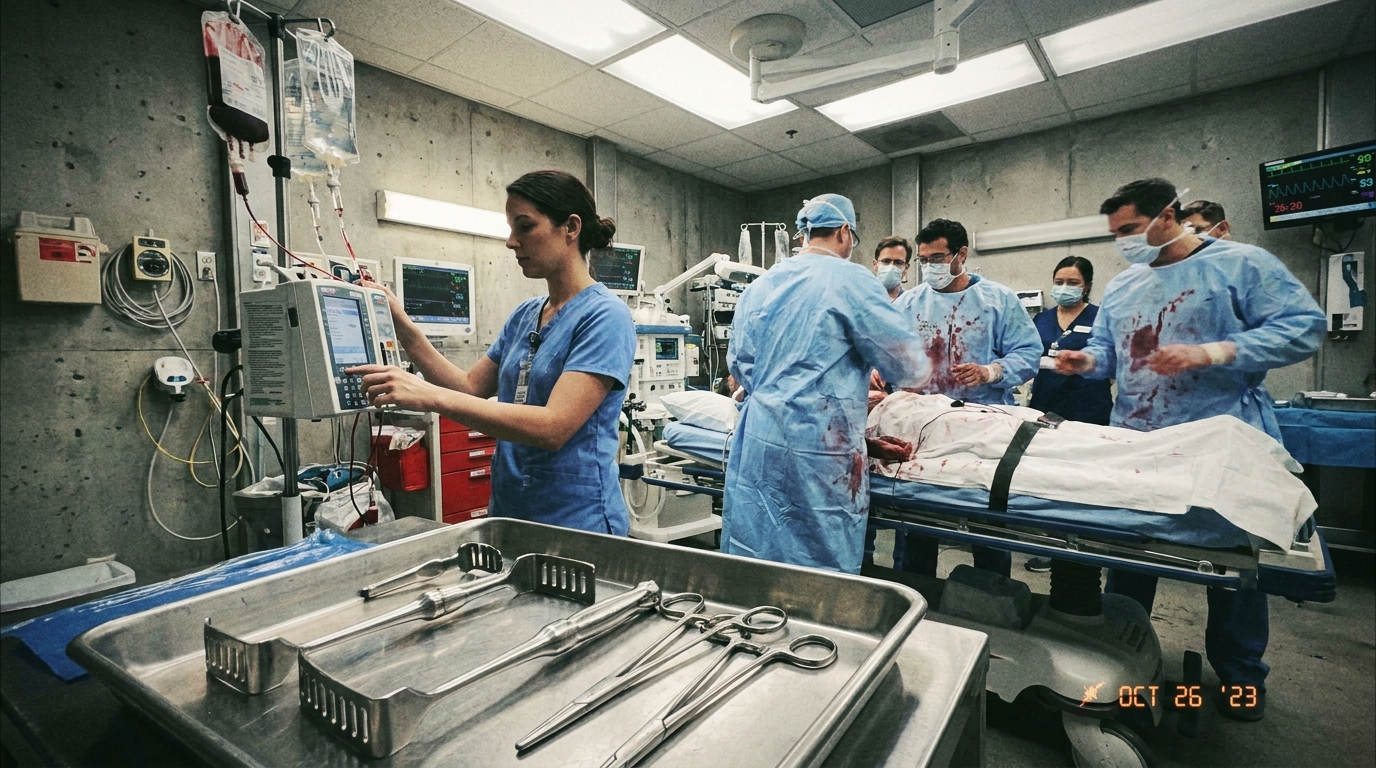
Managing traumatic cardiac arrest or impending cardiovascular collapse from noncompressible torso hemorrhage requires rapid physiological control to prevent irreversible organ damage. Clinicians currently weigh the use of resuscitative thoracotomy (a surgical opening of the chest to allow for direct cardiac massage and aortic clamping) against less invasive options like resuscitative endovascular balloon occlusion of the aorta, a technique involving a catheter-based balloon to stop internal bleeding [1, 2]. While survival rates for out-of-hospital cardiac arrest in trauma remain low at approximately 5 percent, outcomes are significantly influenced by the mechanism of injury and the speed of the multidisciplinary response [3, 4]. Recent evidence suggests that achieving return of spontaneous circulation (the restoration of a palpable pulse and blood pressure) is more frequent when interventions occur before total circulatory collapse [5, 6]. A recent study now provides specific outcome data for these high-stakes procedures within the unique constraints of a modern military-civilian trauma system, offering critical insights for emergency physicians and trauma surgeons deciding when to open the chest.
Cohort Characteristics and High-Energy Mechanisms
To evaluate the efficacy of emergency department resuscitative thoracotomy in modern warfare, researchers conducted a retrospective cohort study of casualties from the Israel-Hamas conflict between October 27, 2023, and October 27, 2025. Data were extracted from prehospital and emergency department medical records, alongside postmortem computed tomography reports that provided detailed anatomical insights into fatal injury patterns. Out of 2,335 combat trauma admissions managed within this combined military-civilian system, 27 patients (1.2%) required an emergency department resuscitative thoracotomy, a procedure reserved for those in pulseless cardiac arrest or experiencing profound, refractory hypotension. The clinical profile of the cohort reflected the high-energy nature of modern battlefield trauma. All 27 patients who underwent the procedure were young males who sustained penetrating injuries. Explosive mechanisms accounted for 74.1% of the injuries in this group, presenting clinicians with complex, multi-cavitary trauma often involving significant tissue loss and shrapnel contamination. The anatomical burden of these injuries was quantified using the Injury Severity Score (an established anatomical scoring system where higher values represent a greater risk of mortality). The study found that 92.6% of the patients had an Injury Severity Score of 25 or higher, indicating critical trauma that frequently involves multiple organ systems and necessitates immediate, resource-intensive surgical intervention.
Prehospital Care and Emergency Department Intervention
Resuscitative thoracotomy serves as a final effort to achieve physiological control in the face of exsanguinating hemorrhage, allowing for direct cardiac massage, cross-clamping of the descending aorta to prioritize cerebral and coronary perfusion, and the repair of cardiac injuries. In this cohort, the researchers defined the procedure specifically as a thoracotomy performed in the emergency department on a pulseless patient with the clinical intent to restore spontaneous circulation. The effectiveness of such high-acuity interventions is heavily dependent on the speed of the trauma chain and the intensity of early resuscitation. The study found that 66.7% of patients arrived at the emergency department within 60 minutes of injury, reflecting an efficient evacuation system capable of delivering critically unstable casualties to definitive care within the golden hour. Furthermore, the integration of advanced resuscitation into the prehospital phase was evident, as prehospital blood products were administered in 77.8% of patients prior to their arrival at the trauma center. This early administration of blood products is a cornerstone of modern trauma care, aimed at mitigating the lethal triad of coagulopathy, acidosis, and hypothermia before the patient reaches the operating table.
Survival Outcomes and Neurologic Recovery
The primary measure of procedural success was 30-day survival, with secondary outcomes including 24-hour survival and the return of spontaneous circulation (ROSC), defined as the restoration of a palpable pulse and measurable blood pressure. In this cohort of 27 patients, return of spontaneous circulation was achieved in 40.7% of the individuals undergoing resuscitative thoracotomy. This initial physiological stabilization allowed for an immediate transition to definitive surgical care, as 90.9% of those who achieved ROSC were subsequently transferred to the operating room for hemorrhage control and injury repair. The final analysis showed that two patients (7.4%) survived to both 24 hours and 30 days. Critically for clinical prognosis and long-term quality of life, both survivors (7.4%) demonstrated good neurologic outcomes, suggesting that rapid intervention successfully preserved cerebral perfusion despite the severity of the initial cardiovascular collapse. These results indicate that survival after resuscitative thoracotomy in modern warfare is comparable to civilian series, even when clinicians face the complex injury patterns and high-energy mechanisms characteristic of combat trauma. For practicing trauma surgeons, this confirms that the procedure remains a viable salvage maneuver for patients who have not yet experienced prehospital circulatory arrest.
Clinical Predictors of Futility and Viability
The timing of circulatory arrest emerged as the most critical prognostic indicator for survival following resuscitative thoracotomy. Data from the cohort revealed that no patient who lost their pulse before hospital arrival survived to the 30-day endpoint. This finding confirms that prehospital circulatory arrest is associated with an extremely poor prognosis, likely due to the prolonged duration of global ischemia and the metabolic exhaustion that occurs before surgical intervention can be initiated. For the emergency clinician, this dictates that the physiological window for a successful outcome closes rapidly once spontaneous circulation ceases in the field, making the presence of a pulse upon arrival a primary determinant of procedural viability. Despite the severity of combat-related injuries, the researchers established that certain injury patterns previously thought to be terminal may still benefit from aggressive intervention. The analysis indicates that resuscitative thoracotomy should not be considered futile for penetrating abdominal, pelvic, or extremity hemorrhage, as these patients may still achieve stabilization through proximal aortic occlusion. Furthermore, the findings suggest that resuscitative thoracotomy should not be considered futile even in the presence of associated head injury, provided the patient has not experienced prehospital arrest. This is a significant clinical distinction, implying that concomitant traumatic brain injury should not automatically preclude the use of the procedure when managing multi-system trauma. Ultimately, these results provide a concrete framework for triage and resource allocation, emphasizing that the anatomical site of hemorrhage and the timing of arrest are more reliable predictors of outcome than the complexity of the injury pattern itself.
References
1. Harfouche MN, Bugaev N, Como JJ, et al. Resuscitative Endovascular Balloon Occlusion of the Aorta in surgical and trauma patients: a systematic review, meta-analysis and practice management guideline from the Eastern Association for the Surgery of Trauma.. Trauma surgery & acute care open. 2025. doi:10.1136/tsaco-2024-001730
2. Barrientos ML, Gutierrez DA, Zapata CAL, Morales-Uribe CH, Toro DAM, López CAD. Resuscitative endovascular balloon occlusion of the aorta versus resuscitative thoracotomy for noncompressible torso hemorrhage: A systematic review and meta-analysis.. The journal of trauma and acute care surgery. 2026. doi:10.1097/TA.0000000000004962
3. Vianen NJ, Lieshout EMV, Maissan IM, et al. Prehospital traumatic cardiac arrest: a systematic review and meta-analysis. European Journal of Trauma and Emergency Surgery. 2022. doi:10.1007/s00068-022-01941-y
4. Rossaint R, Afshari A, Bouillon B, et al. The European guideline on management of major bleeding and coagulopathy following trauma: sixth edition. Critical Care. 2023. doi:10.1186/s13054-023-04327-7
5. Lopez JM, Dueñas CAF, Ochoa EVB, et al. STRATEGIES FOR CONTROLLING AORTIC HEMORRHAGE IN EXSANGUINATING ABDOMINAL TRAUMA: A SYSTEMATIC REVIEW COMPARING REBOA VERSUS RESUSCITATIVE THORACOTOMY FOR VASCULAR COMPLICATIONS, TRANSFUSION REQUIREMENTS AND RETURN OF SPONTANEOUS CIRCULATION (ROSC). Veredas do Direito. 2026. doi:10.18623/rvd.v23.5433
6. Hughes M, Perkins Z. Outcomes following resuscitative thoracotomy for abdominal exsanguination, a systematic review. Scandinavian Journal of Trauma Resuscitation and Emergency Medicine. 2020. doi:10.1186/s13049-020-0705-4