For Doctors in a Hurry
- Clinicians require rapid diagnostic tools to identify trauma-induced coagulopathy, as conventional laboratory tests often suffer from significant turnaround delays.
- The researchers conducted a multicenter analysis of 504 severe trauma patients to validate the Quantra sonorheometry device against standard coagulation tests.
- The study reported an area under the curve of 0.91 for clot time to predict an activated partial thromboplastin time ratio above 1.5.
- The authors concluded that early analysis with the Quantra device provides a reliable method for the rapid exclusion of trauma-induced coagulopathy.
- Future prospective investigations are necessary to determine if this bedside technology improves clinical management and outcomes for patients with severe trauma.
Accelerating Coagulation Assessment in Severe Trauma
Trauma-induced coagulopathy remains a critical driver of mortality and massive transfusion requirements in the emergency department, yet traditional laboratory assays often fail to provide actionable data within the initial window of resuscitation [1, 2]. While established viscoelastic hemostatic assays (tests that measure the physical properties of a blood clot as it forms) provide a more comprehensive view of clot formation than static tests, their reliance on mechanical systems can introduce technical variability and require specialized training [3, 4]. Newer technologies, such as those utilizing ultrasound-based sonorheometry (a technique that uses acoustic radiation force to measure the stiffness of a developing clot without physical contact), aim to simplify bedside monitoring by removing direct physical contact with the blood sample [3, 5]. A multi-center study now evaluates whether this specific acoustic approach can reliably identify or exclude coagulopathic states during the initial management of severely injured patients.
Validating Bedside Sonorheometry in the Emergency Department
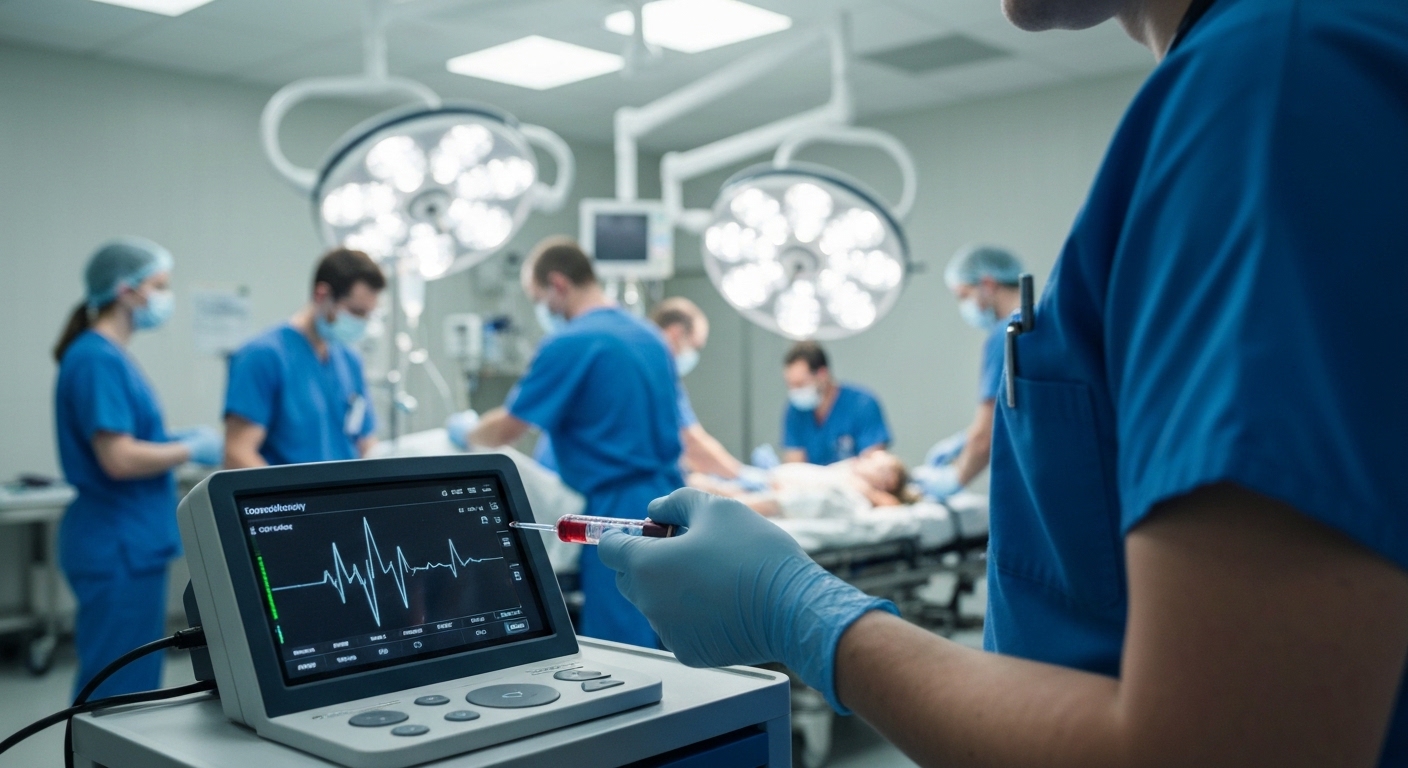
Approximately 30% of patients with severe trauma develop trauma-induced coagulopathy, a systemic failure of the coagulation system that is associated with higher mortality, the need for massive transfusion, and prolonged intensive care stay. While conventional coagulation assays remain the diagnostic standard, they present significant limitations in the acute trauma setting, primarily due to delayed turnaround times that can exceed 60 minutes, often leaving clinicians to manage hemorrhage blindly. To address these delays and enhance early management, clinical guidelines have included viscoelastic tests as a standard of care. The Quantra device utilizes sonorheometry analysis, an ultrasound-based technique that measures clot stiffness by using acoustic radiation force, to offer a rapid bedside assessment of a patient's hemostatic profile. This technology allows for point-of-care testing, potentially reducing the time to targeted therapy compared to central laboratory processing.
Researchers conducted a multicenter analysis of prospectively collected data from January 1, 2022, to December 31, 2024, to validate the Quantra device against standard blood coagulation tests in severe trauma patients. The study was conducted across four level-1 trauma centers and included participants older than 16 years who underwent simultaneous Quantra and standard laboratory testing immediately upon hospital admission. The primary objective was to determine how accurately the bedside device could identify coagulopathy as defined by traditional laboratory parameters. By comparing these methods side-by-side, the study aimed to establish if the device could provide the rapid diagnostic clarity required during the initial, high-pressure stages of trauma resuscitation.
The diagnostic performance of the device was assessed using several prespecified clinical thresholds: an activated partial thromboplastin time (aPTT) ratio greater than 1.5, a prothrombin time ratio (PTr) greater than 1.5, a fibrinogen concentration of 1.5 g/L or less, and platelet concentrations at levels of 50 G/L or less, 100 G/L or less, and 150 G/L or less. These thresholds represent the standard triggers for blood product replacement in many trauma protocols, making the validation highly relevant to daily clinical decision-making.
The researchers evaluated the diagnostic performance of sonorheometry using receiver operating characteristic (ROC) curves, which are statistical plots used to illustrate the diagnostic ability of a test by weighing sensitivity against specificity. This analysis was initially conducted in a derivation cohort of 285 patients to establish the most accurate diagnostic thresholds for identifying trauma-induced coagulopathy. To bridge the gap between statistical modeling and clinical application, the authors utilized Youden-optimized cutoffs (a statistical method that identifies the single value on a test scale that maximizes the test's ability to correctly identify both the presence and absence of a condition). These thresholds were subsequently applied to an external validation cohort to confirm their reliability in a real-world trauma setting.
In the derivation cohort, the device demonstrated high diagnostic accuracy across multiple coagulation parameters. The area under the curve (AUC) for clot time to predict an activated partial thromboplastin time (aPTT) ratio greater than 1.5 was 0.91 (95% CI, 0.84 to 0.98), with an optimal cutoff identified at 144.5 seconds. For predicting a prothrombin time ratio (PTr) greater than 1.5, the AUC for clot stiffness was 0.82 (95% CI, 0.75 to 0.90), utilizing a best cutoff of 15.4 hectopascals (hPa), a unit of pressure used in this context to measure the elastic modulus (the physical stiffness) of the developing clot.
The study also quantified the specific contributions of fibrinogen and platelets to overall clot strength, which is critical for targeted blood product resuscitation. To predict a fibrinogen concentration of less than 1.5 g/L, the AUC for the fibrinogen contribution to clot stiffness was 0.87 (95% CI, 0.81 to 0.93) with a best cutoff of 1.1 hPa. Furthermore, the device effectively identified significant thrombocytopenia; the AUC for the platelet contribution to clot stiffness to predict a platelet count of 100 G/L or less was 0.90 (95% CI, 0.84 to 0.95), with an optimal cutoff of 12.4 hPa. These specific sonorheometry values provide clinicians with objective bedside metrics that correlate closely with traditional, but slower, laboratory markers of hemostatic failure, potentially allowing for more precise replacement of specific clotting factors or platelets.
Clinical Utility in Ruling Out Coagulopathy
The clinical utility of sonorheometry was confirmed in a validation cohort of 219 patients, where the device demonstrated its primary strength as a tool for the rapid exclusion of trauma-induced coagulopathy. For clinicians at the bedside, the most critical metric is the negative predictive value (NPV), which represents the probability that a patient truly does not have a condition when the test result is negative. In this cohort, the NPV for clot time was 1.00 (95% CI, 0.98 to 1.00), indicating that a normal clot time result can effectively rule out an activated partial thromboplastin time ratio greater than 1.5. Similarly, the NPV for platelet contribution to clot stiffness was 0.99 (95% CI, 0.96 to 1.00), providing a highly reliable means of excluding significant thrombocytopenia (defined as a platelet count of 100 G/L or less) during the initial stages of trauma resuscitation.
While the device excels at ruling out hemostatic deficiencies, its positive predictive value (PPV), the probability that a patient with a positive test actually has the condition, was more variable. The PPV for clot time was 0.67 (95% CI, 0.50 to 0.80), and the PPV for platelet contribution to clot stiffness was 0.13 (95% CI, 0.24 to 0.99). Other parameters showed moderate predictive performance; the clot stiffness measurement yielded a PPV of 0.50 (95% CI, 0.39 to 0.61) and an NPV of 0.88 (95% CI, 0.80 to 0.93) for predicting a prothrombin time ratio greater than 1.5. For fibrinogen, the fibrinogen contribution to clot stiffness showed a PPV of 0.58 (95% CI, 0.44 to 0.70) and an NPV of 0.91 (95% CI, 0.85 to 0.95) when predicting concentrations below 1.5 g/L. These data suggest that while a negative result is highly dependable, a positive result may occasionally reflect a false alarm, requiring clinicians to correlate findings with the broader clinical picture.
The researchers concluded that early Quantra analysis provides rapid and reliable exclusion of trauma-induced coagulopathy, potentially allowing trauma teams to focus resources on other life-saving interventions when normal hemostasis is confirmed. By providing these results at the point of care, the device addresses the critical time lag associated with traditional laboratory testing. However, the authors note that prospective investigations remain required to determine the usefulness of this technology in the active management of trauma-induced coagulopathy, particularly in guiding specific blood product replacement strategies and improving long-term patient outcomes.
References
1. Singh T, Hasan M, Gaule TG, Ajjan R. Exploiting the Molecular Properties of Fibrinogen to Control Bleeding Following Vascular Injury. International Journal of Molecular Sciences. 2025. doi:10.3390/ijms26031336
2. Xu Z, Cao H, Sun D, et al. Critical trigger thresholds for hemostatic management: a narrative review of viscoelastic hemostatic assay applications. Frontiers in Medicine. 2025. doi:10.3389/fmed.2025.1658845
3. Bareille M, Lecompte T, Mullier F, Roullet S. Are Viscoelastometric Assays of Old Generation Ready for Disposal? Comment on Volod et al. Viscoelastic Hemostatic Assays: A Primer on Legacy and New Generation Devices. J. Clin. Med. 2022, 11, 860. Journal of Clinical Medicine. 2023. doi:10.3390/jcm12020477
4. Faraoni D, DiNardo JA. Viscoelastic hemostatic assays: Update on technology and clinical applications. American Journal of Hematology. 2021. doi:10.1002/ajh.26285
5. Whitton T, Healy W. Review of Thromboelastography (TEG): Medical and Surgical Applications. Therapeutic Advances in Pulmonary and Critical Care Medicine. 2023. doi:10.1177/29768675231208426