For Doctors in a Hurry
- Clinicians lack evidence regarding the safety and feasibility of structured rehabilitation programs for patients requiring extracorporeal membrane oxygenation support.
- This prospective pilot study followed 20 patients, mostly on venovenous extracorporeal membrane oxygenation, through a standardized daily mobility and resistance regimen.
- Participants completed a median of 35 minutes of daily exercise, with longer sessions correlating to improved functional performance (p=0.002 to p<0.001).
- The researchers concluded that a structured daily program combining mobility and resistance training is feasible and safe for these patients.
- Larger controlled trials are required to determine if this rehabilitation protocol improves long-term recovery and clinical outcomes for survivors.
Extracorporeal membrane oxygenation has become a mainstay for managing refractory acute respiratory distress syndrome and severe cardiopulmonary dysfunction [1, 2]. While its clinical application has expanded to include complex cases such as rheumatologic complications involving diffuse alveolar hemorrhage [3] and toxicological emergencies like calcium channel blocker overdose [4], the primary focus often remains on physiological stabilization and survival. However, survivors frequently face significant morbidity, particularly in cases of prolonged support exceeding seven days where multiorgan failure and severe comorbidities complicate the recovery process [5]. Despite the known benefits of early mobilization in general intensive care settings, the safety and feasibility of intensive, structured physical rehabilitation for patients requiring extracorporeal life support remain poorly defined. A new prospective pilot study of 20 patients (mean age 47 years) now examines the implementation of a standardized exercise regimen, finding that daily mobility therapy combined with resistance training is feasible and resulted in only two minor, immediately resolvable adverse events [6].
A Standardized Twice-Daily Rehabilitation Protocol
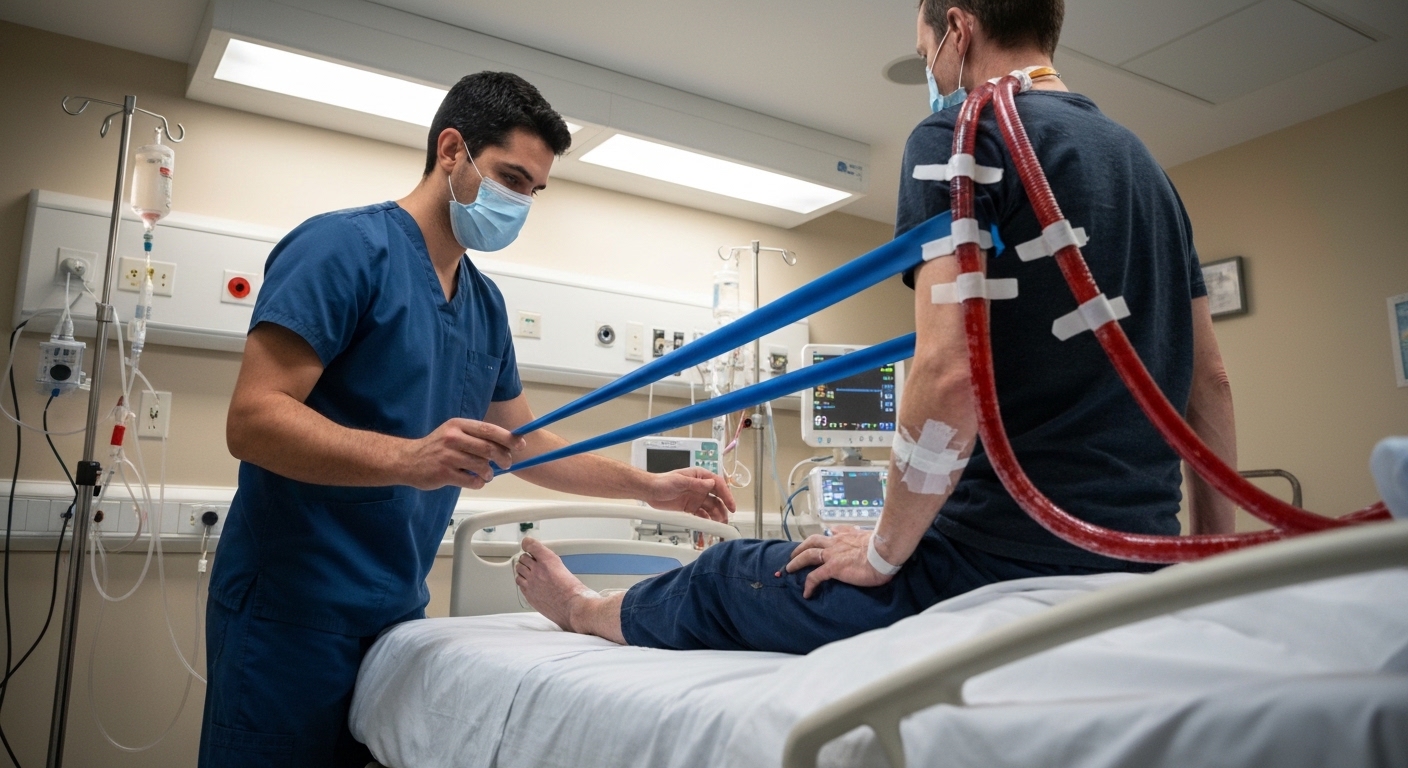
The researchers conducted a prospective single-center pilot study to evaluate the safety and feasibility of a standardized daily program that integrated mobility therapy with resistance training. The study cohort consisted of 20 subjects on extracorporeal membrane oxygenation (ECMO) with a mean age of 47 plus or minus 15 years. Demographic analysis showed that 80% of the study participants were male, and the vast majority of the cohort, specifically 95% of the subjects, were receiving venovenous ECMO support (a form of extracorporeal support that provides respiratory assistance by circulating blood from the venous system through an oxygenator and back into the venous circulation). This specific patient population represents a high-acuity group where physical deconditioning is a significant clinical concern during prolonged life support. The intervention followed a rigorous twice-daily protocolized regimen designed to address different aspects of physical function. Morning sessions focused on mobility and were led by physical and occupational therapy teams. These sessions utilized a tilt or verticalization bed, which is a specialized piece of equipment that gradually moves a patient from a flat to an upright position to improve orthostatic tolerance (the ability of the circulatory system to maintain blood pressure while upright) and prepare the body for weight-bearing. During these morning interventions, clinicians guided patients through activities of daily living and graded transitions, including sitting, standing, and ambulation, to maintain functional independence. Afternoon sessions complemented the morning mobility work by focusing on strength through resistance exercises. These sessions were conducted by a clinical exercise physiologist and were performed at least 5 days per week. By separating the protocol into morning mobility and afternoon resistance training, the researchers aimed to maximize the intensity of rehabilitation while monitoring for adverse events. This structured approach allowed for a high volume of activity, with the study documenting a maximum of 122 minutes of combined daily exercise for some participants, demonstrating that intensive physical therapy is achievable even in the context of complex extracorporeal circuit management.
Safety Profile and Survival Outcomes
The safety profile of the intervention was a primary focus of the pilot study, given the inherent risks of mobilizing patients on extracorporeal circuits. The researchers documented only two minor adverse events throughout the study period, both of which resolved immediately without further clinical complication. Based on these observations, the researchers concluded that a structured daily program combining mobility, verticalization (the process of moving a patient from a supine to an upright position), and resistance exercises during ECMO was feasible and safe. This finding suggests that the presence of large-bore cannulae and the complexity of the extracorporeal circuit do not necessarily preclude intensive physical rehabilitation when performed under the supervision of a multidisciplinary team. Clinical outcomes for the cohort were favorable despite the severity of their underlying conditions. The day-28 survival rate was 95%, while the overall in-hospital survival rate was 85%. These survival figures are particularly relevant for clinicians managing high-acuity patients who often face prolonged recovery trajectories and high mortality risks. Furthermore, the study tracked hospital disposition to assess the degree of functional recovery achieved by the end of the acute care stay. Among the survivors, 56% were discharged directly home, indicating a level of functional independence that may be linked to the early and consistent physical intervention provided during their time on life support. In addition to survival and mobility metrics, the researchers monitored changes in body mass index (BMI), which serves as a surrogate marker for nutritional status and muscle mass preservation during critical illness. The data showed that 44% of survivors experienced an increase in BMI from admission to discharge. This increase in BMI suggests that the combination of structured exercise and nutritional support may help mitigate the profound catabolism (the metabolic breakdown of complex molecules and tissues, often leading to significant muscle wasting) typically observed in patients requiring prolonged mechanical circulatory support. These findings provide a clinical basis for integrating intensive rehabilitation into the standard care of patients on extracorporeal membrane oxygenation.
Dose-Response Relationship in Functional Recovery
The primary outcome of the study was the time spent on exercise training per day, which served as a quantitative measure of the feasibility and intensity of the intervention. The researchers found that patients were able to tolerate significant durations of physical activity despite the complexity of their clinical status. Specifically, daily therapy times averaged 21 minutes for physical and occupational therapy (median: 20 minutes). When evaluating the afternoon sessions led by clinical exercise physiologists, daily resistance sessions averaged 30 minutes (median: 27 minutes). Across the entire cohort, the combined daily exercise averaged 35 minutes (median: 35 minutes), with some patients achieving a maximum of 122 minutes of activity in a single day. These metrics demonstrate that a structured rehabilitation protocol can be consistently delivered to patients on extracorporeal membrane oxygenation. The study identified a clear relationship between the duration of these sessions and the degree of functional improvement. Longer session times correlated with faster supine-to-sitting transitions in physical and occupational therapy (p = 0.002), suggesting that increased time spent in mobility training directly translates to improved bed mobility and core strength. This finding is clinically significant as the ability to transition from a lying to a seated position is a critical milestone in the recovery of functional independence for critically ill patients. The benefits of increased exercise duration extended to the resistance training component of the protocol, where the researchers observed that longer resistance training sessions were associated with significantly increased repetitions in bicep and triceps flexion and extensions (p < 0.001). Furthermore, the data indicated that longer resistance training sessions were associated with significantly increased repetitions in chest press, shoulder press, and hip/knee flexion (p < 0.001). These data points indicate a dose-response relationship where higher volumes of exercise correlate with improved muscular endurance and strength across both upper and lower extremities. For the clinician, these results suggest that maximizing the time spent in structured rehabilitation may accelerate the physical recovery of patients requiring extracorporeal support, as increased session duration was consistently linked to better performance in both gross motor transitions and specific muscle group exercises.
References
1. Vaquer S, Haro CD, Peruga P, Oliva JC, Artigas A. Systematic review and meta-analysis of complications and mortality of veno-venous extracorporeal membrane oxygenation for refractory acute respiratory distress syndrome. Annals of Intensive Care. 2017. doi:10.1186/s13613-017-0275-4
2. Papazian L, Aubron C, Brochard L, et al. Formal guidelines: management of acute respiratory distress syndrome. Annals of Intensive Care. 2019. doi:10.1186/s13613-019-0540-9
3. Falaas KL, Tiegs LY, Theis-Mahon N, Gertner E. The Role of Extracorporeal Membrane Oxygenation in Cardiopulmonary Dysfunction Due to Rheumatologic Diseases: A Systematic Review.. ACR open rheumatology. 2026. doi:10.1002/acr2.90025
4. Finn D, Stevens J, Tolkacz M, Robinson J, Mangla J, Iacco A. Calcium Channel Blocker Overdose: What Role Does Extracorporeal Membrane Oxygenation Have in Support? A Systematic Review of the Literature.. ASAIO journal (American Society for Artificial Internal Organs : 1992). 2024. doi:10.1097/MAT.0000000000002129
5. Zangrillo A, Biondi‐Zoccai G, Landoni G, et al. Extracorporeal membrane oxygenation (ECMO) in patients with H1N1 influenza infection: a systematic review and meta-analysis including 8 studies and 266 patients receiving ECMO. Critical Care. 2013. doi:10.1186/cc12512
6. Hagiwara J, Hunt J, Hunt J, et al. Use of Structured Exercise Program with Resistance Training and Verticalization in Adults on Extracorporeal Membrane Oxygenation: A Prospective Pilot Study.. Critical care medicine. 2026. doi:10.1097/CCM.0000000000007132