
- This study addressed the need for improved understanding of subsolid nodule natural history to guide clinical decision-making.
- Researchers used natural language processing and manual chart review to analyze 322 patients with subsolid nodules over five years.
- Only 19% of patients underwent treatment, with part-solid nodules treated more often than non-solid (32% vs 11%, p<0.001).
- The authors concluded that subsolid nodules have excellent survival, with most patients dying from a second primary malignancy.
- Clinicians can reassure patients about high subsolid nodule survival, but should monitor for new primary cancers.
Navigating the Nuances of Subsolid Lung Nodules
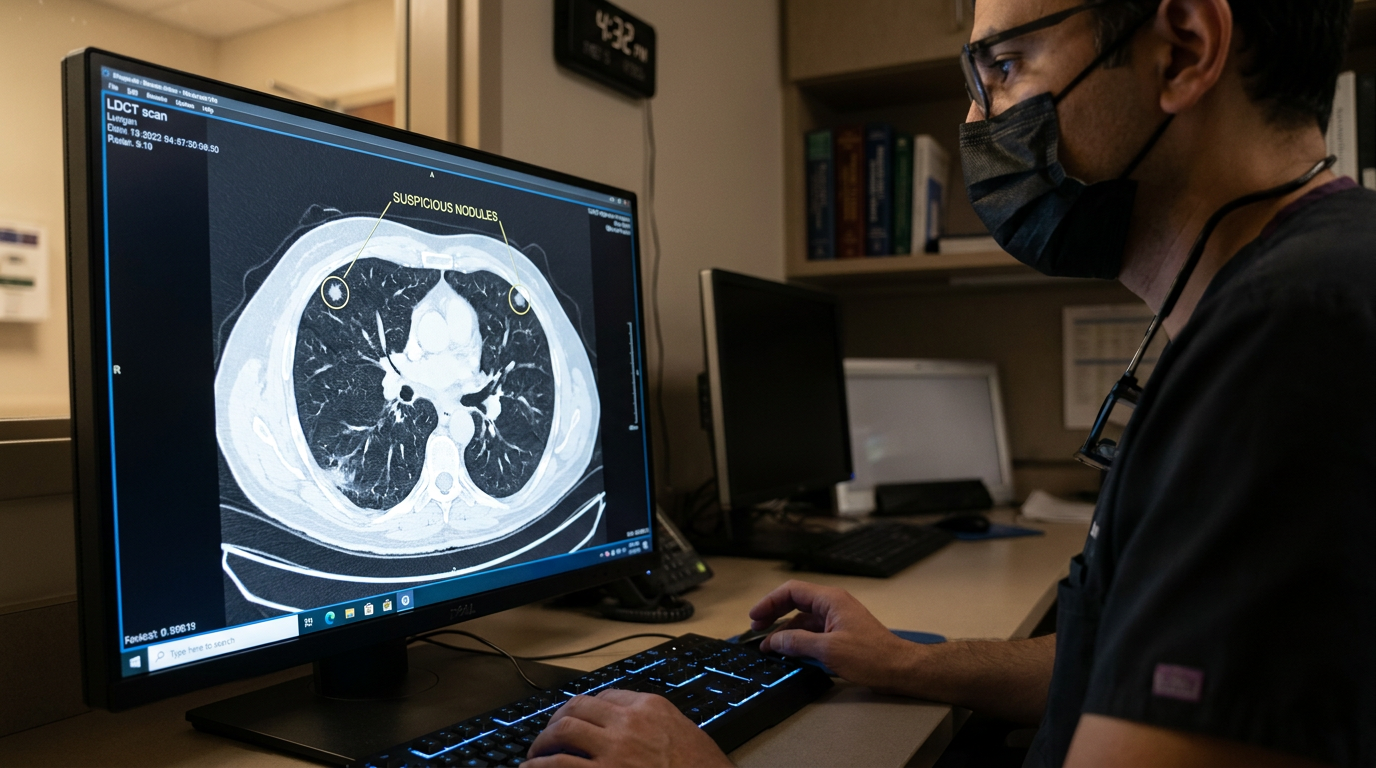
The increasing use of low-dose computed tomography (LDCT) for lung cancer screening has led to more frequent detection of subsolid nodules (SSNs) and ground-glass opacities (GGOs), presenting a common clinical dilemma [1, 2, 3]. While early detection is crucial, many of these incidental findings are indolent, making the decision between surveillance and intervention challenging [1, 4]. Current guidelines advocate for personalized management, but distinguishing lesions that will remain stable from those that may progress to invasive cancer is difficult [5, 6]. A clear understanding of the natural history of SSNs is therefore essential to guide clinical decisions, avoid overtreatment, and reduce patient anxiety [7]. A recent retrospective cohort study provides new data on the long-term trajectory, treatment rates, and mortality causes for patients with these nodules.
Study Design and Patient Cohort Characteristics
To clarify the natural history of subsolid nodules, researchers at Yale New Haven Health conducted a retrospective analysis of patients identified with SSNs on outpatient chest CT scans. The team first used natural language processing, an automated technique for extracting clinical data from free-text radiology reports, to screen all scans from 2017. This initial step identified a pool of 17,276 patients. From this group, a detailed manual chart review was performed to confirm the presence of SSNs and collect data on demographics, nodule characteristics, growth on subsequent imaging, treatment, pathology, and survival. This process yielded a final study cohort of 322 patients. The cohort was composed of 64% (n=207) patients with non-solid nodules (pure GGOs) and 36% (n=115) with part-solid nodules.
Natural History and Treatment Patterns
The five-year follow-up data offer important insights into the typical evolution of these lesions. The findings confirm that a majority of non-solid nodules follow an indolent course. Among patients with pure GGOs, 81% of nodules remained non-solid over five years. However, a clinically significant minority, 19% of these non-solid nodules, developed a new solid component during the follow-up period. The development of a solid component is a key morphological change that often signals progression and influences management decisions. Overall, just 19% (n=60) of the entire cohort underwent treatment within five years. The likelihood of intervention was strongly associated with nodule type; patients with part-solid nodules at baseline were significantly more likely to undergo treatment than those with non-solid nodules (32% vs 11%, p<0.001). This evidence supports a strategy of active surveillance for many pure GGOs, while the presence of a solid component warrants closer consideration for intervention.
Survival Outcomes and Mortality Causes
For clinicians counseling patients, the study's survival data are particularly reassuring. The five-year overall survival for the cohort was 79.8%. More pointedly, the five-year subsolid nodule-related survival was 98.4%, indicating that the nodules themselves are rarely fatal within this timeframe. The difference between overall and nodule-related survival suggests that other comorbidities are the primary drivers of mortality in this population. A critical finding from the analysis was the high incidence of other malignancies. The study revealed that patients with SSNs were significantly more likely to die from a new, secondary primary cancer than from their subsolid nodule at five years (8.43% vs 1.54%, p<0.001). This suggests that the presence of an SSN may identify a patient population at higher risk for other cancers, underscoring the need for comprehensive health monitoring that extends beyond surveillance of the initial lung nodule.
References
1. Chen D, Yang L, Zhang W, et al. Prevalence and management of pulmonary nodules: a systematic review and meta-analysis. Journal of Thoracic Disease. 2024. doi:10.21037/jtd-24-874
2. Wood DE, Kazerooni EA, Baum S, et al. Lung Cancer Screening, Version 3.2018, NCCN Clinical Practice Guidelines in Oncology. Journal of the National Comprehensive Cancer Network. 2018. doi:10.6004/jnccn.2018.0020
3. Wood DE, Kazerooni EA, Aberle DR, et al. NCCN Guidelines® Insights: Lung Cancer Screening, Version 1.2022. Journal of the National Comprehensive Cancer Network. 2022. doi:10.6004/jnccn.2022.0036
4. Akın O, Brennan S, Dershaw DD, et al. Advances in oncologic imaging. CA A Cancer Journal for Clinicians. 2012. doi:10.3322/caac.21156
5. Cardillo G, Petersen RH, Ricciardi S, et al. European guidelines for the surgical management of pure ground-glass opacities and part-solid nodules: Task Force of the European Association of Cardio-Thoracic Surgery and the European Society of Thoracic Surgeons. European Journal of Cardio-Thoracic Surgery. 2023. doi:10.1093/ejcts/ezad222
6. Lim W, Ridge CA, Nicholson AG, Mirsadraee S. The 8th lung cancer TNM classification and clinical staging system: review of the changes and clinical implications. Quantitative Imaging in Medicine and Surgery. 2018. doi:10.21037/qims.2018.08.02
7. Balbi M, Sabia F, Ledda R, et al. Surveillance of subsolid nodules avoids unnecessary resections in lung cancer screening: long-term results of the prospective BioMILD trial. ERJ Open Research. 2024. doi:10.1183/23120541.00167-2024