
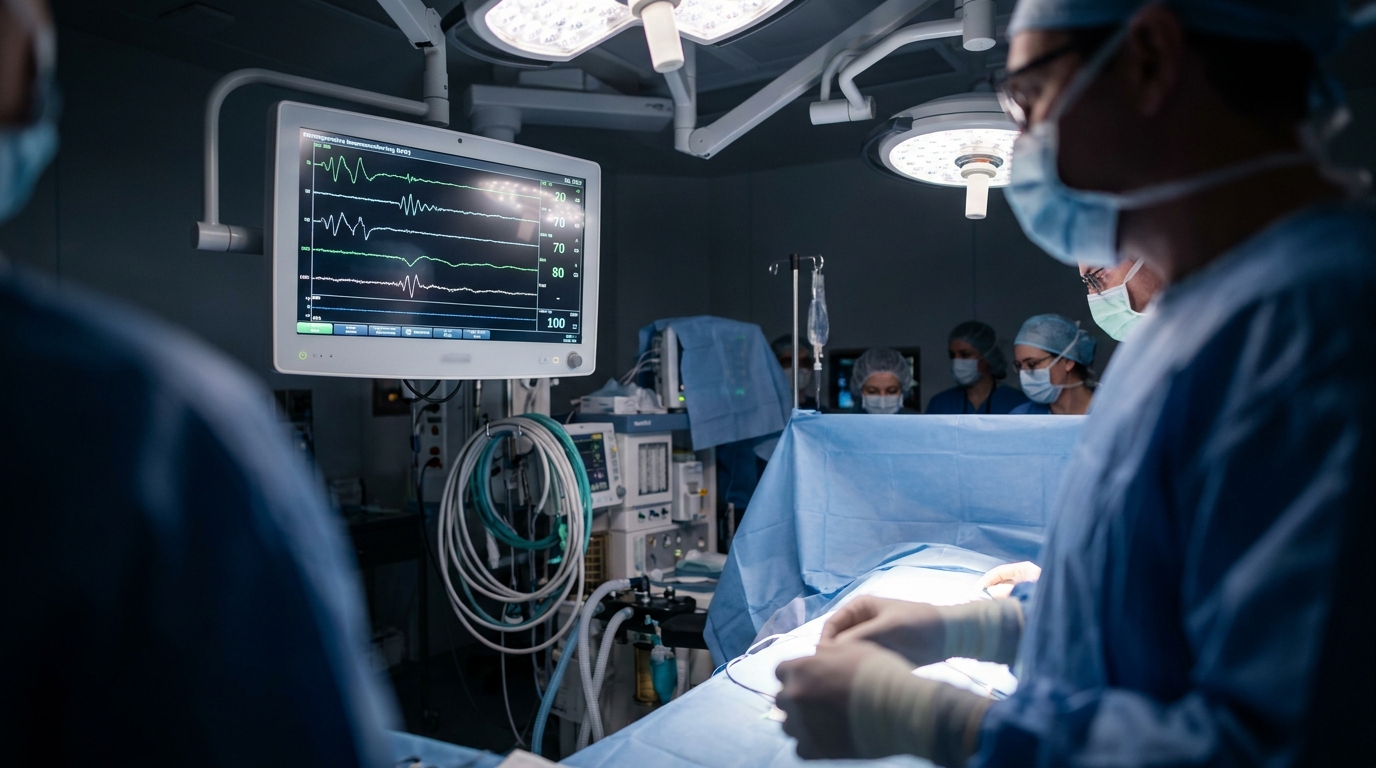
- Surgeons use intraoperative neuromonitoring to prevent bilateral vocal cord palsy, but the optimal stimulation sequence for identifying nerve injury remains debated.
- This retrospective study analyzed 353 nerves at risk in 240 patients undergoing thyroidectomy using systematic vagus nerve stimulation after dissection.
- Systematic vagus nerve stimulation achieved 100 percent sensitivity for postoperative palsy compared to 57.9 percent for recurrent laryngeal nerve stimulation alone.
- The researchers concluded that omitting systematic postdissection vagus nerve stimulation significantly reduces the sensitivity of intraoperative neuromonitoring for detecting vocal cord injury.
- Clinicians should adopt systematic vagus nerve stimulation as the standard protocol to minimize the risk of bilateral vocal cord paralysis.
Refining Neuromonitoring to Prevent Bilateral Vocal Cord Paralysis
Recurrent laryngeal nerve injury remains a significant concern in thyroid surgery, with iatrogenic trauma accounting for over 75% of bilateral vocal fold paralysis cases [1]. While intraoperative neuromonitoring was developed to mitigate this risk, meta-analyses offer conflicting evidence regarding its ability to reduce permanent nerve damage compared to visual identification alone [2, 3, 4]. The primary clinical utility of intermittent monitoring lies in its potential to prevent bilateral palsy by alerting the surgeon to a loss of signal on the first side, which prompts a transition from total thyroidectomy to a staged procedure [4, 5]. However, standard stimulation protocols focusing solely on the recurrent laryngeal nerve may overlook proximal injuries or conduction blocks occurring higher along the vagal pathway. A recent retrospective cross-sectional study investigates whether a systematic postdissection check of the vagus nerve provides a more reliable assessment of nerve integrity than distal stimulation alone.
Evaluating the Four-Step Stimulation Sequence
The study, conducted at an academic tertiary referral center between February 2024 and October 2025, evaluated the diagnostic accuracy of specific intraoperative neuromonitoring protocols. Researchers analyzed a cohort of 240 patients undergoing thyroidectomy, with a mean age of 50 years (standard deviation of 15 years), of whom 188 (78.3%) were female. The primary objective was to investigate the sensitivity of postdissection vagus nerve stimulation for identifying postoperative vocal cord palsy compared to postdissection recurrent laryngeal nerve stimulation alone. The clinical team evaluated 353 nerves at risk (each side of the thyroid representing one potential nerve injury) using a systematic four-step electrical stimulation sequence. This protocol involved V1 (predissection vagus nerve stimulation to establish a baseline), R1 (predissection recurrent laryngeal nerve stimulation), R2 (postdissection recurrent laryngeal nerve stimulation), and finally V2 (postdissection vagus nerve stimulation). To provide a benchmark, these findings were compared to a historical cohort of 1159 nerves at risk where vagal nerve stimulation was performed selectively at the surgeon's discretion. Strict inclusion criteria required all patients to undergo intermittent neuromonitoring and mandatory postoperative laryngoscopy (an endoscopic examination to visualize vocal cord movement). The primary outcome measure was vocal cord mobility assessed on the first postoperative day, providing a definitive clinical correlate to the intraoperative electrophysiological signals.
Identifying Proximal Injuries Missed by Distal Monitoring
During the procedures, researchers observed that loss of signal occurred in 43 of 353 nerves at risk (12.2%). Within this group, 33 cases (9.3%) were categorized as persistent loss of signal, meaning the electrophysiological response did not recover before the end of the surgery. These persistent events are clinically critical because they often correlate with postoperative nerve dysfunction, yet the specific location of the signal loss proved to be a vital variable. A major discrepancy emerged between distal and proximal stimulation sites: 9 instances (27.3% of the persistent cases) exhibited a loss of signal at the V2 vagus level despite no preceding loss of signal or electrophysiological events on the recurrent laryngeal nerve. This phenomenon indicates that traction injuries or conduction blocks can occur at a more proximal point along the neural pathway, such as the vagal trunk itself, which are entirely missed when surgeons only test the distal portion of the recurrent laryngeal nerve during the R2 step. The clinical implications of these missed proximal injuries were confirmed through postoperative laryngoscopy. Impaired vocal mobility was present in 7 of 9 cases (77.8%) where the R2 response was intact but the V2 response was absent. Without systematic vagal stimulation, nearly 80% of these patients with confirmed vocal cord impairment would have been incorrectly identified as having intact nerve function.
Clinical Implications for Intraoperative Decision-Making
The primary value of intraoperative neuromonitoring is its ability to guide real-time surgical decisions, specifically the choice between proceeding with a total thyroidectomy or halting the procedure after the first side to avoid devastating bilateral airway compromise. In this study, the identification of electrophysiological changes led to a direct modification of the surgical strategy for several patients. Specifically, in 6 patients originally planned for total thyroidectomy, the operative plan was changed to lobectomy only following intraoperative signal changes. By converting to a unilateral procedure, surgeons effectively eliminated the risk of immediate bilateral vocal cord paralysis in these individuals. The inclusion of the final V2 vagal stimulation step proved to be the decisive factor in a subset of these cases. Among the cohort, two of these surgical plan changes were prompted specifically by unexpected loss of signal at the V2 stimulation point. In these instances, the R2 stimulation falsely suggested the nerve was intact, but the V2 check revealed a proximal conduction failure. Without the systematic use of V2 stimulation, these two patients would likely have undergone the planned contralateral resection, placing them at high risk for bilateral palsy and potential tracheostomy.
Establishing a New Standard for Surgical Safety
The diagnostic accuracy of intraoperative neuromonitoring depends heavily on the stimulation site, as distal testing frequently fails to capture proximal nerve injuries. The researchers found that the sensitivity for detecting postoperative vocal cord palsy was only 57.9% when relying on R2 stimulation, which involves testing the recurrent laryngeal nerve after dissection. This low sensitivity means that nearly half of all nerve injuries could go undetected if surgeons only test the nerve at its most distal point near the larynx. By contrast, the diagnostic performance improved dramatically with the addition of a final vagal check. The sensitivity for detecting postoperative vocal cord palsy reached 100% when using systematic V2 stimulation, defined as stimulating the vagus nerve after the thyroid dissection is complete. This comprehensive approach ensured that every instance of postoperative vocal cord impairment was identified intraoperatively. These results represent a significant improvement over historical monitoring practices. In the earlier comparison cohort of 1159 nerves at risk, where surgeons utilized selective rather than systematic vagal nerve stimulation, the sensitivity of intraoperative neuromonitoring for impaired vocal cord mobility was 83.3%. Because V2 stimulation assesses the integrity of the vagus nerve proximal to the recurrent laryngeal nerve branching point, it detects traction injuries that distal R2 stimulation misses. The authors conclude that systematic V2 stimulation should be considered the criterion standard in thyroid surgery to minimize the risk of bilateral vocal cord palsy.
References
1. Lechien JR, Hans S, Mau T. Management of Bilateral Vocal Fold Paralysis: A Systematic Review. Otolaryngology. 2023. doi:10.1002/ohn.616
2. Cozzi A, Ottavi A, Lozza P, et al. Intraoperative Neuromonitoring Does Not Reduce the Risk of Temporary and Definitive Recurrent Laryngeal Nerve Damage during Thyroid Surgery: A Systematic Review and Meta-Analysis of Endoscopic Findings from 73,325 Nerves at Risk. Journal of Personalized Medicine. 2023. doi:10.3390/jpm13101429
3. Sanabria Á, Kowalski LP, Nixon IJ, et al. Methodological Quality of Systematic Reviews of Intraoperative Neuromonitoring in Thyroidectomy. JAMA Otolaryngology–Head & Neck Surgery. 2019. doi:10.1001/jamaoto.2019.0092
4. Henry BM, Graves MJ, Vikse J, et al. The current state of intermittent intraoperative neural monitoring for prevention of recurrent laryngeal nerve injury during thyroidectomy: a PRISMA-compliant systematic review of overlapping meta-analyses. Langenbeck s Archives of Surgery. 2017. doi:10.1007/s00423-017-1580-y
5. Bai B, Chen W. Protective Effects of Intraoperative Nerve Monitoring (IONM) for Recurrent Laryngeal Nerve Injury in Thyroidectomy: Meta-analysis. Scientific Reports. 2018. doi:10.1038/s41598-018-26219-5