
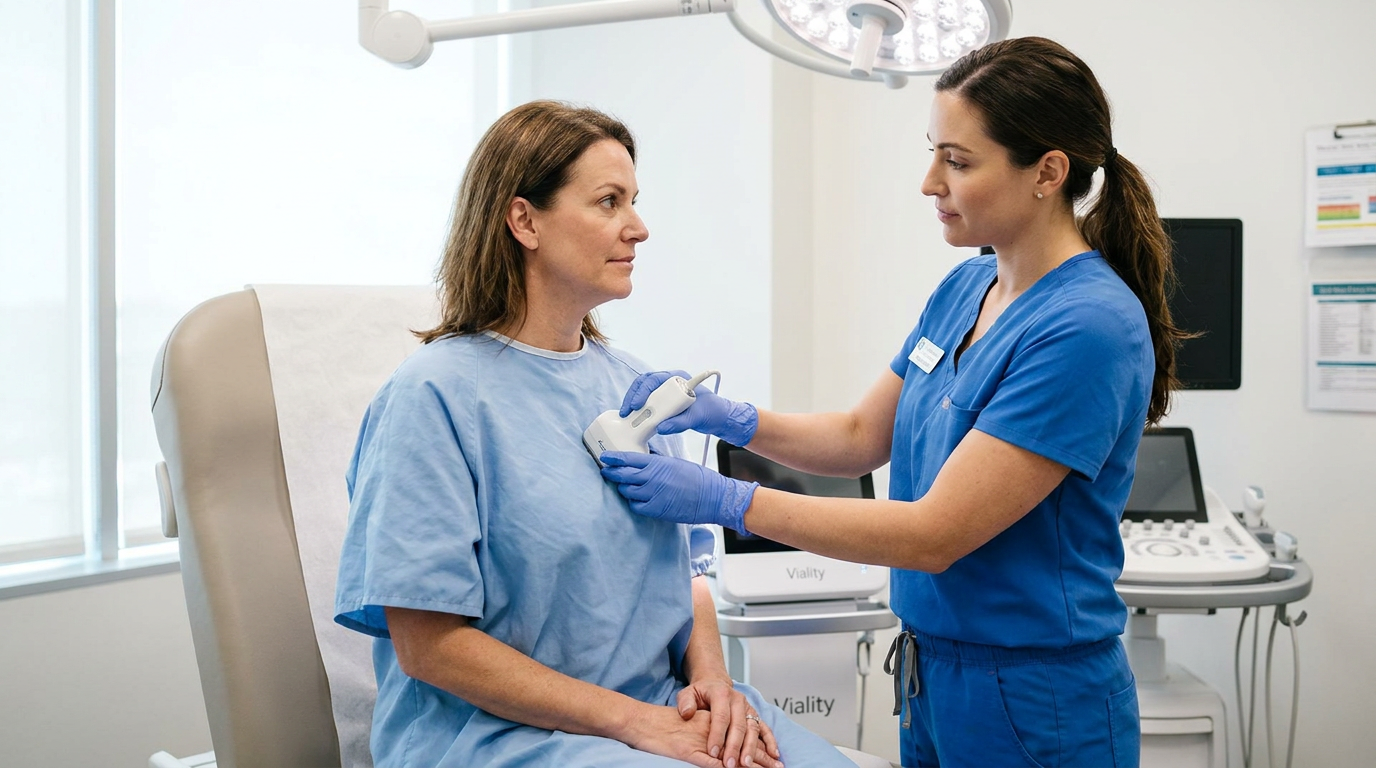
- Autologous fat transfer historically faces variable graft retention, impacting cosmetic and reconstructive breast procedures.
- This prospective, 14-center study enrolled 190 patients undergoing breast fat transfer using the Viality system.
- Mean 12-month graft retention was 84.8% (95% CI 83.2 to 86.5), significantly exceeding the 70% historical benchmark (P < .0001).
- The authors concluded the Viality system provides effective and predictable fat processing with sustained high volume retention.
- This suggests improved, consistent outcomes for patients undergoing autologous fat transfer for breast augmentation or reconstruction.
Optimizing Autologous Fat Transfer for Breast Procedures
Autologous fat transfer (AFT) is a foundational technique in both aesthetic and reconstructive breast surgery, utilized for primary augmentation, post-reconstruction symmetrization, and the correction of contour deformities [1, 2, 3, 4]. Despite its benefits, the procedure's utility has been historically limited by unpredictable and often poor graft retention, with resorption rates varying widely across studies [5, 6]. This inconsistency can necessitate multiple procedures to achieve the desired volume and may compromise patient satisfaction, representing a significant clinical challenge [2, 7]. While numerous fat processing and cell-enrichment strategies have been explored to improve graft survival, a definitive standard has remained elusive [8, 9]. A recent prospective study now provides data on a processing system designed to deliver more consistent and durable volumetric results.
Investigating a New Processing System for Fat Graft Viability
To address the long-standing issue of variable graft survival, researchers conducted a prospective, 14-center investigation (NCT05258305) of the Viality™ system (Tiger Aesthetics Medical, Conshohocken, PA). This is an FDA-cleared, in-line fat processing device, meaning it processes the harvested tissue within a sterile, closed circuit during the surgical procedure itself. The system is engineered to concentrate viable adipocytes by filtering out non-viable components like excess fluid, free lipids, and damaged cells, with the goal of improving subsequent graft retention. The study enrolled 190 patients, of whom 85 underwent AFT for cosmetic breast procedures and 105 for reconstructive purposes. In all cases, harvested fat was processed with the Viality™ system and an AuraClens™ surfactant wash. To objectively quantify outcomes, the investigators used 3D imaging for volumetric analysis at baseline and again at 1, 3, 6, and 12 months post-procedure. The primary endpoint was the percentage of fat volume retained at 12 months, while a secondary analysis sought to identify patient-specific factors that influence this long-term retention.
Sustained High Volume Retention Observed
The study demonstrated consistently high and stable fat graft retention over the 12-month follow-up period. Initial volume retention was high, with a mean (95% CI) of 86.6% (85.4 to 87.7) at month 1. This volume remained remarkably stable, measuring 83.1% (81.8 to 84.4) at month 3 and 84.1% (82.8 to 85.5) at month 6. Critically for long-term outcomes, mean retention at 12 months was 84.8% (95% CI: 83.2 to 86.5). The authors note that these retention rates were significantly greater than the historical benchmark of 70% at every timepoint (P <.0001), a benchmark below which clinical results are often considered suboptimal. Furthermore, the analysis revealed no statistically significant decline in graft volume between the 1-month and 12-month measurements, indicating that the graft reaches a steady state early and maintains it. This pattern of high, durable retention was observed consistently across both the cosmetic and reconstructive patient cohorts, suggesting the processing method yields predictable results across different clinical applications.
Factors Influencing Graft Survival
In addition to the overall high retention rates, the investigation identified several key variables that significantly correlated with 12-month graft survival. The analysis showed that fat transfer volume was a significant predictor of the final outcome (P <.0001), highlighting the importance of procedural planning. Post-operative patient weight change also had a highly significant impact on graft retention (P <.0001), reinforcing the clinical need to counsel patients on maintaining a stable weight to preserve their results, as transferred adipocytes will shrink or expand with overall body weight fluctuations. Finally, the graft-to-recipient breast volume ratio was also found to be a significant factor (P =.0187). This finding suggests that the characteristics of the recipient site, including its capacity to accommodate and vascularize the new tissue, are crucial for success. Overfilling a tight tissue envelope can compromise blood supply and, consequently, graft take. For clinicians, these findings provide actionable data for optimizing surgical technique, managing patient expectations, and providing specific post-operative guidance to maximize the durability of AFT outcomes.
Clinical Implications for Predictable Autologous Fat Transfer
The results of this multicenter study suggest a significant step toward making autologous fat transfer for breast procedures a more predictable and reliable operation. By addressing the historical challenge of inconsistent graft survival, the Viality™ processing system demonstrated both an early graft steady state and sustained high-percentage volume retention. The key clinical finding was a mean volume retention of 84.8% at 12 months, a figure significantly higher than the 70% historical benchmark (P <.0001). The consistency of these results across 190 patients in both cosmetic (n=85) and reconstructive (n=105) settings indicates a dependable performance profile. For the practicing physician, this level of predictability is paramount. The data suggest that using this processing modality may reduce the likelihood of requiring secondary touch-up procedures to correct for volume loss, allowing clinicians to better align surgical plans with patient expectations and achieve durable aesthetic and reconstructive goals with greater confidence.
References
1. Valente DS, Ely PB, Kieling L, et al. Breast fat grafting and cancer: a systematic review of the science behind enhancements and concerns.. Translational breast cancer research : a journal focusing on translational research in breast cancer. 2024. doi:10.21037/tbcr-23-54
2. Giannas E, Fritsch AM, Jeon H, et al. Fat survival following autologous fat transfer to the native breast: A systematic review and meta-analysis.. Journal of plastic, reconstructive & aesthetic surgery : JPRAS. 2026. doi:10.1016/j.bjps.2026.02.017
3. Wu Y, Hu F, Li X, Yin G. Autologous Fat Transplantation for Aesthetic Breast Augmentation: A Systematic Review and Meta-Analysis.. Aesthetic surgery journal. 2021. doi:10.1093/asj/sjaa364
4. Alessandri‐Bonetti M, Carbonaro R, Borelli F, et al. Outcomes in Hybrid Breast Reconstruction: A Systematic Review. Medicina. 2022. doi:10.3390/medicina58091232
5. Kim J, Jin H, Son J, Chung J. For Better Fat Graft Outcome in Soft Tissue Augmentation: Systematic Review and Meta-Analysis. Archives of Aesthetic Plastic Surgery. 2018. doi:10.14730/AAPS.2018.24.3.116
6. Leopardi D, Thavaneswaran P, Mutimer KLA, Olbourne NA, Maddern GJ. Autologous fat transfer for breast augmentation: a systematic review.. ANZ journal of surgery. 2014. doi:10.1111/ans.12202
7. Groen J, Negenborn VL, Twisk JWR, Ket JCF, Mullender MG, Smit JM. Autologous Fat Grafting in Cosmetic Breast Augmentation: A Systematic Review on Radiological Safety, Complications, Volume Retention, and Patient/Surgeon Satisfaction. Aesthetic Surgery Journal. 2016. doi:10.1093/asj/sjw105
8. Zhao J, Chen J, Xu C, Yang S, Guo S, Zhou B. The efficacy of cell-assisted versus conventional lipotransfer: A systematic review and meta-analysis.. Asian Journal of Surgery. 2022. doi:10.1016/j.asjsur.2022.04.031
9. Toyserkani NM, Quaade ML, Sørensen JA. Cell-Assisted Lipotransfer: A Systematic Review of Its Efficacy. Aesthetic Plastic Surgery. 2016. doi:10.1007/s00266-016-0613-1