
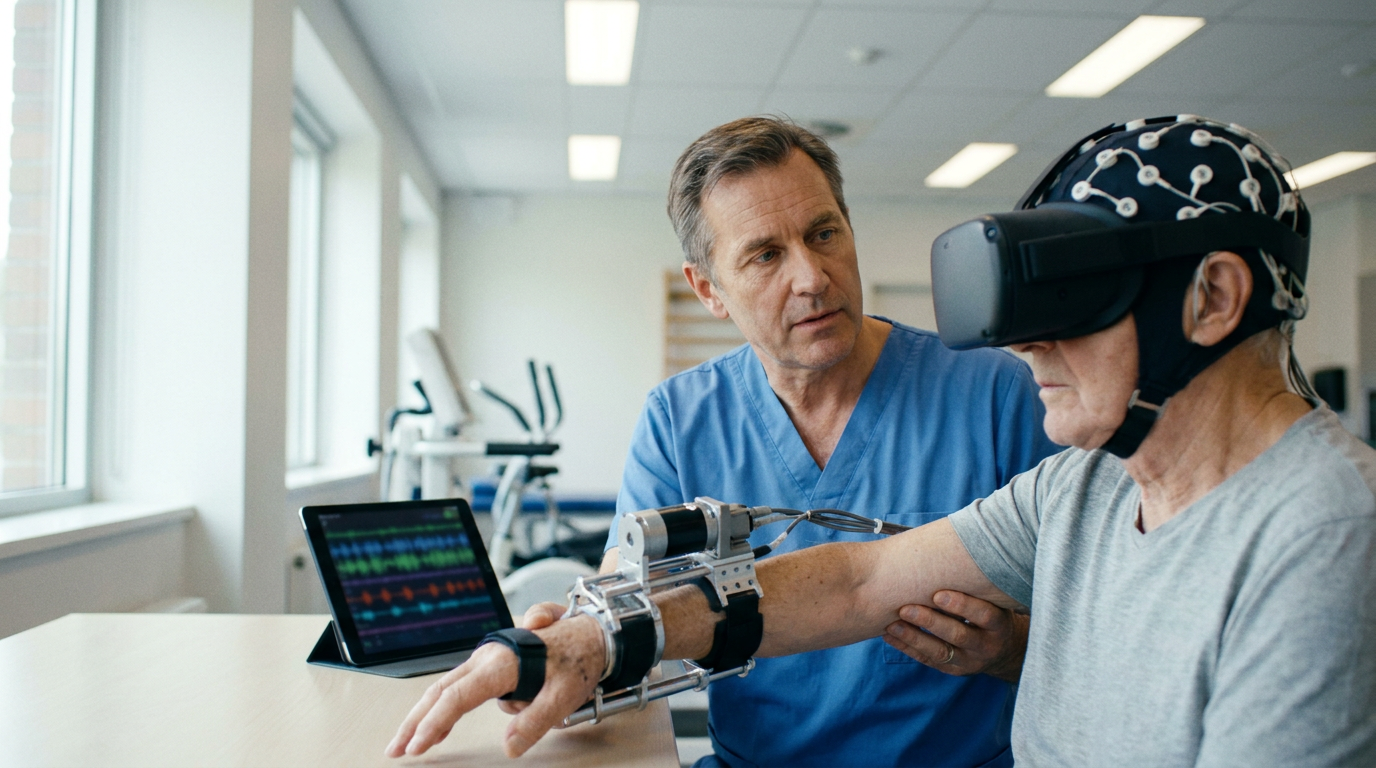
- This study investigated cortical activity during virtual reality-based mirror feedback tasks to understand their neurophysiological effects.
- Eighteen healthy participants performed robot-assisted wrist-extension movements under four mirror feedback conditions with electroencephalography.
- Congruent mirror feedback showed significantly greater high-beta event-related desynchronization in bilateral and left posterior parietal cortices.
- The authors concluded that virtual reality-based mirror feedback modulates brain oscillations, enhancing visuomotor integration and proprioception.
- These findings support integrating virtual reality-based mirror feedback into rehabilitation protocols for stroke patients to improve motor function.
Cortical Dynamics in Virtual Reality-Assisted Motor Rehabilitation
Motor impairments following stroke, especially in the upper extremities, frequently result in long-term disability and the adoption of compensatory movement patterns [1, 2]. While intensive, task-oriented physical therapy is a cornerstone of treatment [3], emerging technologies offer ways to augment its effects. Virtual reality (VR) has shown utility in improving upper limb dexterity and balance in post-stroke patients [4] and can influence outcomes in chronic pain management [5]. When combined with robotic-assisted devices, VR can create immersive and quantifiable training environments to enhance motor learning [6, 7]. A recent study provides a detailed neurophysiological map of how one such technique, VR-based mirror feedback, modulates cortical activity during robot-assisted movement, offering a clearer rationale for its use in rehabilitation [8].
Investigating Cortical Responses to Virtual Mirror Feedback
To delineate the brain activity underlying VR-based mirror feedback, researchers measured frequency-specific cortical responses during robot-assisted arm movements. The study employed electroencephalography (EEG) to capture real-time brain electrical activity while participants interacted with a VR mirror system. The cohort included eighteen healthy, right-handed participants who performed bimanual wrist-extension movements. A specialized robotic device drove the passive hand in synchrony with the active hand, allowing the investigators to precisely control the visual feedback presented. This setup enabled the systematic testing of four distinct visual conditions: congruent mirror feedback, where the virtual hand's movement matched the participant's; incongruent feedback, where it did not match; a static virtual hand for a non-moving visual cue; and a blank screen to serve as a baseline control.
Alpha and Low-Beta Band Activity: Mirror Neuron System and Proprioception
The EEG analysis identified distinct cortical signatures associated with mirror feedback. A primary finding was that both congruent and incongruent mirror feedback elicited sustained activation of the mirror neuron system. This was evidenced by prolonged event-related desynchronization (ERD) in the alpha frequency band. ERD, a decrease in the power of neural oscillations, is interpreted as a marker of increased cortical activation. The sustained alpha ERD suggests the mirror neuron system, which is critical for action observation and motor learning, remains highly engaged throughout the task, even when visual feedback is imperfect. In the low-beta frequency band (13-20 Hz), the findings indicated that mirror feedback tasks enhanced proprioceptive processing. This was demonstrated by stronger ERD in the centroparietal and parietal regions compared to the blank screen and static hand conditions. This effect, observed within the first 2000 milliseconds of movement, points to heightened activity in brain areas responsible for integrating the body's sense of position and movement. For clinicians, this suggests VR mirror feedback may directly engage and potentially strengthen the sensory feedback circuits essential for motor control, a mechanism of particular relevance for patients with post-stroke proprioceptive deficits.
High-Beta Modulation and Post-Movement Engagement
The study also provided insights into cortical activity immediately following movement. Under both mirror feedback conditions, the researchers observed an attenuation of the typical post-movement beta rebound in frontocentral and parietal regions. This beta rebound, an increase in beta-band power after a motor task concludes, is thought to signal a return to a cortical resting state. Its reduction suggests that mirror feedback promotes continued engagement of the motor cortex even after the physical movement has ceased, potentially extending the therapeutic window for motor learning. Furthermore, analysis of the high-beta band (20-30 Hz) revealed a specific effect tied to accurate feedback. The congruent mirror feedback condition produced significantly greater ERD in the bilateral and left posterior parietal cortices relative to the static hand and blank screen conditions. This heightened activation in regions vital for visuomotor transformation indicates enhanced integration of visual and motor information when the feedback is accurate. This finding underscores a key principle for clinical application: ensuring visual feedback is congruent with motor output may be critical for optimizing the neural processes that support motor recovery.
Clinical Implications for Rehabilitation Protocols
Taken together, these findings provide a detailed neurophysiological basis for incorporating VR-based mirror feedback into clinical rehabilitation. The study demonstrates that this technique sustains mirror neuron system activation, enhances proprioceptive feedback, modulates post-movement cortical dynamics, and facilitates visuomotor integration. The observed frequency-specific brain oscillations, from prolonged alpha ERD to attenuated beta rebound and enhanced high-beta ERD, offer objective evidence for the mechanisms at play. For physicians managing patients with stroke or other neurological injuries, this research provides a strong rationale for using VR-based mirror feedback. The data suggest that such protocols do not simply make therapy more engaging; they actively modulate specific cortical circuits involved in motor and sensory function. By leveraging these mechanisms, clinicians can design more targeted interventions aimed at improving functional outcomes, with the understanding that congruent visual feedback appears to be a key component for maximizing visuomotor integration and cortical engagement.
References
1. Wang X, Fu Y, Ye B, Babineau J, Ding Y, Mihailidis A. Technology-Based Compensation Assessment and Detection of Upper Extremity Activities of Stroke Survivors: Systematic Review. Journal of Medical Internet Research. 2022. doi:10.2196/34307
2. Veldema J, Nowak DA, Gharabaghi A. Resting motor threshold in the course of hand motor recovery after stroke: a systematic review. Journal of NeuroEngineering and Rehabilitation. 2021. doi:10.1186/s12984-021-00947-8
3. Veerbeek JM, Wegen EEHV, Peppen RV, et al. What Is the Evidence for Physical Therapy Poststroke? A Systematic Review and Meta-Analysis. PLoS ONE. 2014. doi:10.1371/journal.pone.0087987
4. Demeco A, Zola L, Frizziero A, et al. Immersive Virtual Reality in Post-Stroke Rehabilitation: A Systematic Review. Sensors. 2023. doi:10.3390/s23031712
5. Goudman L, Jansen J, Billot M, et al. Virtual Reality Applications in Chronic Pain Management: Systematic Review and Meta-analysis. JMIR Serious Games. 2022. doi:10.2196/34402
6. Kabir R, Sunny MSH, Ahmed HU, Rahman MH. Hand Rehabilitation Devices: A Comprehensive Systematic Review. Micromachines. 2022. doi:10.3390/mi13071033
7. Calabrò RS, Naro A, Russo M, et al. The role of virtual reality in improving motor performance as revealed by EEG: a randomized clinical trial. Journal of NeuroEngineering and Rehabilitation. 2017. doi:10.1186/s12984-017-0268-4
8. Yeh H, Kao Y, Chen H, et al. Modulation of sensorimotor cortical dynamics and proprioceptive processing induced by virtual reality-based mirror feedback during bilateral robot-assisted arm movement.. Brain research. 2026. doi:10.1016/j.brainres.2026.150379