
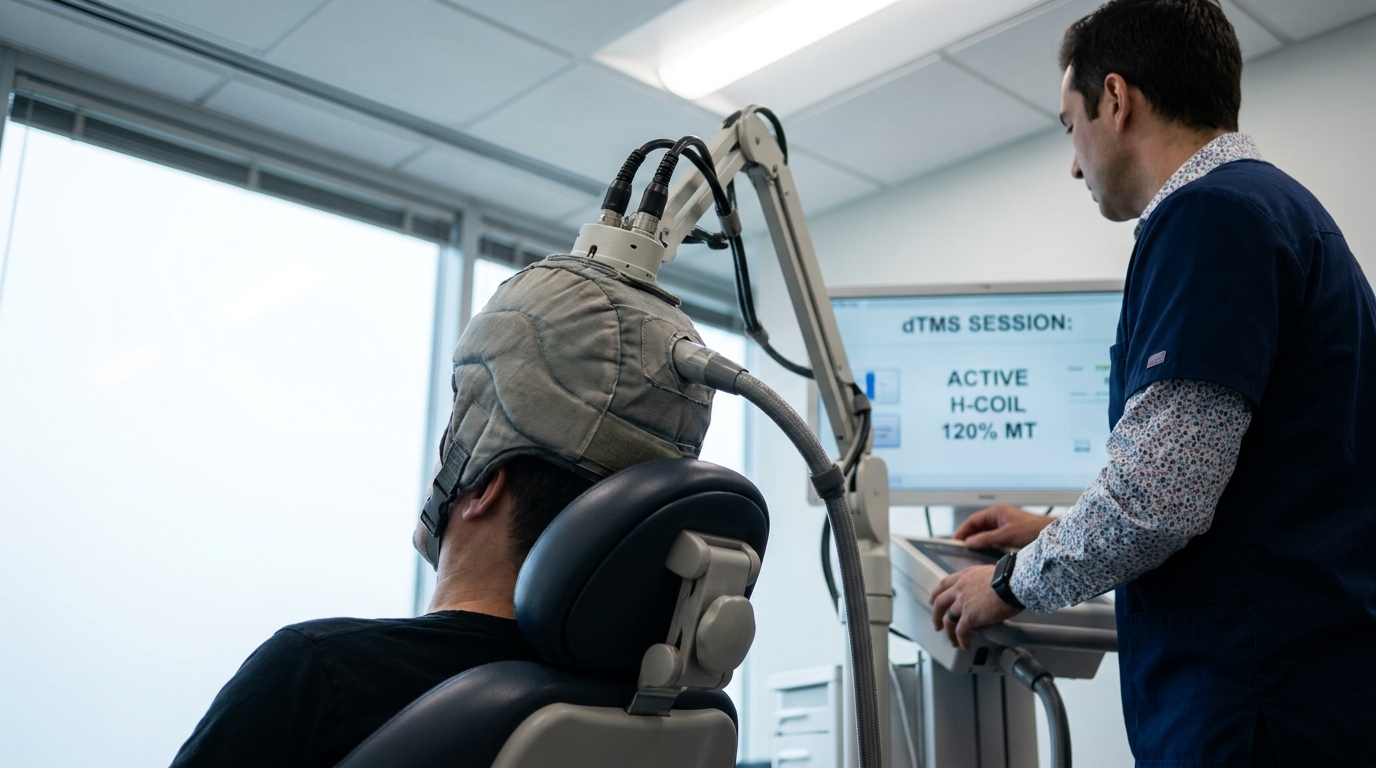
- Researchers investigated if accelerated intermittent theta burst stimulation provides comparable efficacy to standard 18-Hz accelerated deep transcranial magnetic stimulation for depression.
- This randomized controlled trial enrolled 73 patients with major depressive disorder to receive accelerated stimulation protocols or pharmacotherapy alone.
- The iTBS-dTMS group achieved an 85.7% response rate, significantly exceeding the 42.1% response rate observed in the medication-only group (p < 0.001).
- The study concludes that accelerated iTBS-dTMS demonstrates comparable clinical efficacy to 18-Hz protocols while inducing distinct neurophysiological changes in brain connectivity.
- These findings support using accelerated iTBS-dTMS as an efficient, evidence-based treatment option to improve patient adherence and clinical outcomes.
Efficiency and Efficacy in Accelerated Neuromodulation
Major depressive disorder remains a leading cause of global disability, with a substantial percentage of patients failing to achieve remission through standard pharmacotherapy alone [1, 2]. While repetitive transcranial magnetic stimulation has established itself as a safe and effective non-invasive intervention, traditional multi-week treatment schedules often pose significant logistical challenges for both clinics and patients [3, 4]. To address these barriers, researchers have developed accelerated protocols that deliver multiple sessions per day, aiming to compress the therapeutic window and expedite clinical response [5]. However, the comparative efficacy and neurophysiological impact of different stimulation patterns within these condensed frameworks require further clarification to optimize clinical workflows. A recent randomized controlled trial now provides data on how these accelerated protocols compare to each other and to conventional medication, offering insights that could help physicians select the most efficient neuromodulation strategies for treatment-resistant patients.
Comparing Accelerated Stimulation Protocols to Pharmacotherapy
The researchers conducted a randomized controlled trial involving 73 participants diagnosed with major depressive disorder to evaluate the efficacy of condensed treatment schedules. Participants were assigned to one of three intervention arms. The first group received 18-Hz repetitive transcranial magnetic stimulation delivered via an accelerated deep transcranial magnetic stimulation protocol (rTMS-dTMS). The second group received intermittent theta burst stimulation, a newer pattern of magnetic pulses designed to mimic the brain's natural rhythms, also delivered via accelerated deep transcranial magnetic stimulation (iTBS-dTMS). The third group served as a control, receiving pharmacotherapy alone. For both active neuromodulation arms, the protocols were administered twice daily over a 10-day period, specifically targeting the left lateral prefrontal cortex, including the dorsolateral region. This anatomical focus is a standard site for modulating the neural circuits associated with executive function and emotional regulation in depressive states. Clinical outcomes were measured using the Hamilton Depression Rating Scale (HAMD), a standard clinician-administered tool used to quantify the severity of depressive symptoms. In the iTBS-dTMS group, HAMD scores decreased from 22.5 ± 3.7 at baseline to 8.2 ± 4.1 after treatment (t = 15.900, p < 0.001). Similarly, the rTMS-dTMS group showed a significant reduction in symptom severity, with HAMD scores dropping from 21.3 ± 2.9 at baseline to 8.0 ± 3.8 following the 10-day protocol (t = 17.232, p < 0.001). While the pharmacotherapy-only group also demonstrated clinical improvement, the magnitude of change was less pronounced, as their HAMD scores decreased from 24.7 ± 6.8 at baseline to 14.0 ± 5.0 at the study's conclusion (t = 6.363, p < 0.001). For practicing psychiatrists, these data indicate that both accelerated deep transcranial magnetic stimulation protocols achieved a more substantial reduction in depressive symptoms within a two-week window compared to standard medication management.
Clinical Response and Remission Benchmarks
The clinical utility of these accelerated protocols is evidenced by the high rates of treatment response, which the researchers defined as a reduction of 50 percent or more in baseline symptom severity. In this trial, the treatment response rate was 85.7% in the iTBS-dTMS group and 76.9% in the rTMS-dTMS group. These figures represent a substantial increase over the outcomes observed in the control arm, where the treatment response rate for the drug group was 42.1%. These data suggest that the intensive 10-day neuromodulation schedule facilitates a more rapid and robust clinical improvement than conventional pharmacological management alone in patients with major depressive disorder. Beyond symptom reduction, the study evaluated the achievement of clinical remission, the ultimate goal of antidepressant therapy. The remission rate was 50.0% in the iTBS-dTMS group and 42.3% in the rTMS-dTMS group, both of which were markedly higher than the 10.5% remission rate for the drug group. When comparing the two active stimulation protocols, the study concluded that intermittent theta burst stimulation of accelerated deep transcranial magnetic stimulation demonstrates comparable efficacy and tolerability to the 18-Hz repetitive protocol. This finding is highly relevant for daily clinical practice, as intermittent theta burst stimulation typically requires significantly shorter session times than standard repetitive transcranial magnetic stimulation. For busy clinics, this means physicians can potentially treat more patients per day without compromising therapeutic outcomes or patient safety.
Protocol-Specific Neurophysiological Signatures
To understand the biological mechanisms driving these clinical improvements, the researchers utilized resting-state electroencephalography (EEG) analysis to evaluate functional connectivity, a measure of how synchronized the electrical activity is between different brain regions. The study identified that each stimulation protocol induced distinct neurophysiological changes despite their similar clinical efficacy. Specifically, the rTMS-dTMS group primarily exhibited weakened alpha-band functional connectivity within the fronto-occipital, fronto-temporal, and fronto-central networks following the 10-day treatment course. Alpha waves are typically associated with relaxed, resting brain states, and altering their synchronization may help disrupt the rigid neural patterns often seen in depression. In contrast, the iTBS-dTMS group predominantly demonstrated reduced theta-band functional connectivity within the fronto-parietal, fronto-occipital, and fronto-temporal pathways. Theta waves are heavily involved in cognitive control and emotional processing. These frequency-specific alterations suggest that while both protocols target the left lateral prefrontal cortex, they modulate the brain's intrinsic networks through entirely different electrophysiological channels. The clinical relevance of these network changes was further clarified by correlating the neurophysiological data with symptom improvement. In the rTMS-dTMS group, relative changes in functional connectivity between the frontal and temporal or precentral regions showed a significant negative correlation with Hamilton Depression Rating Scale score reduction rates. This indicates that greater decreases in connectivity between these specific regions were associated with more robust antidepressant responses. Conversely, for the iTBS-dTMS group, relative changes in functional connectivity between the frontal lobe and parietal lobe showed a significant positive correlation with the rate of Hamilton Depression Rating Scale score reduction. These divergent correlations highlight that the two accelerated deep transcranial magnetic stimulation protocols achieve their therapeutic effects by modulating distinct neural circuits. For practicing physicians, these findings raise the possibility that future diagnostic tools, such as baseline EEG, could eventually help match individual patients to the specific stimulation protocol most likely to correct their unique neurobiological deficits.
References
1. Hyde J, Carr H, Kelley NJ, et al. Efficacy of neurostimulation across mental disorders: systematic review and meta-analysis of 208 randomized controlled trials. Molecular Psychiatry. 2022. doi:10.1038/s41380-022-01524-8
2. Mutz J, Vipulananthan V, Carter B, Hurlemann R, Fu CH, Young AH. Comparative efficacy and acceptability of non-surgical brain stimulation for the acute treatment of major depressive episodes in adults: systematic review and network meta-analysis. BMJ. 2019. doi:10.1136/bmj.l1079
3. Wang W, Wang S, Hung H, Chen M, Juan C, Li C. Safety of transcranial magnetic stimulation in unipolar depression: A systematic review and meta-analysis of randomized-controlled trials.. Journal of affective disorders. 2022. doi:10.1016/j.jad.2022.01.047
4. Kishi T, Sakuma K, Matsuda Y, Kito S, Iwata N. Intermittent theta burst stimulation vs. high-frequency repetitive transcranial magnetic stimulation for major depressive disorder: A systematic review and meta-analysis.. Psychiatry research. 2023. doi:10.1016/j.psychres.2023.115452
5. Shi R, Wang Z, Yang D, et al. Short-term and long-term efficacy of accelerated transcranial magnetic stimulation for depression: a systematic review and meta-analysis.. BMC psychiatry. 2024. doi:10.1186/s12888-024-05545-1