
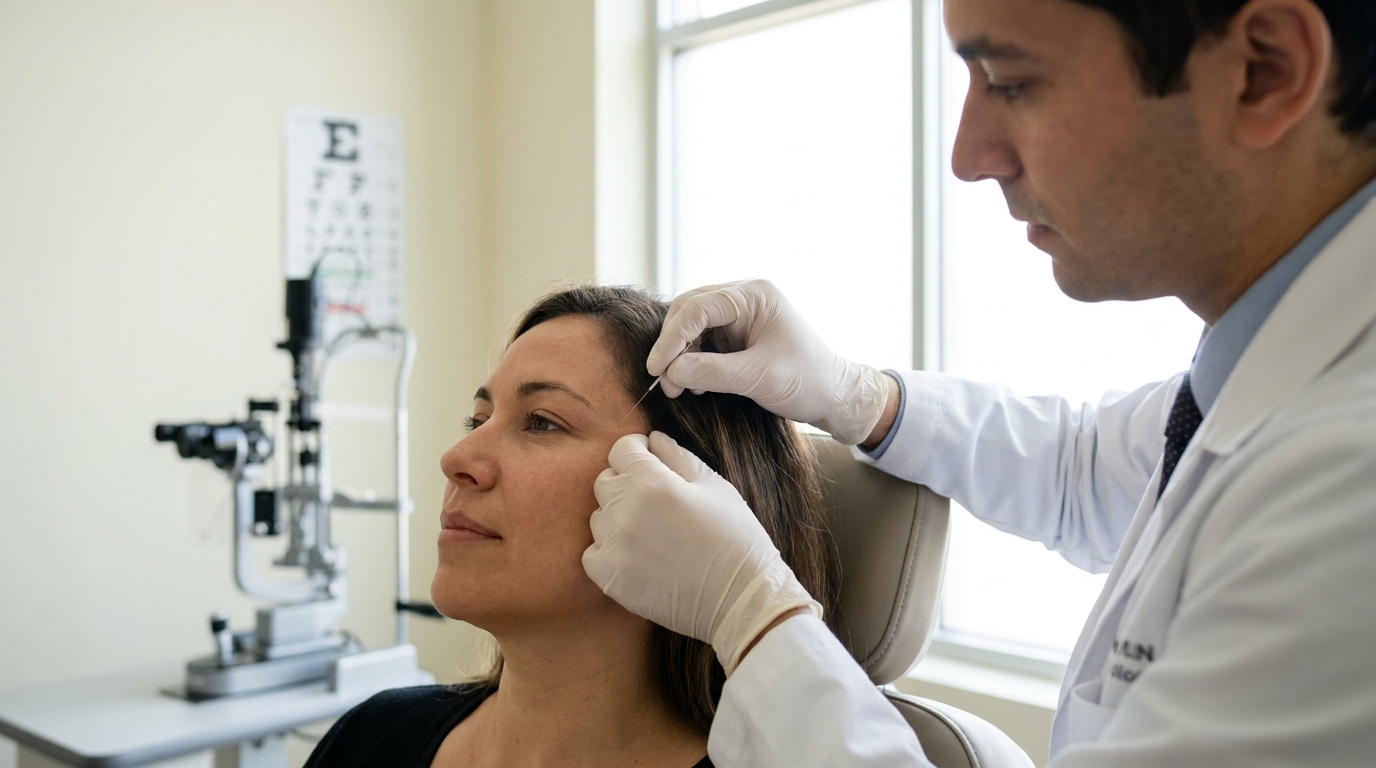
- Researchers investigated if acupuncture and Jieyu Huoxue Formula improve outcomes for optic atrophy compared to standard mecobalamin therapy.
- This randomized study enrolled 80 patients with optic atrophy, assigning 40 to mecobalamin and 40 to the combined intervention.
- The combined group showed significantly higher efficacy than controls, with only 11 non-responders versus 26 in the control group (p < 0.05).
- The researchers concluded that the combined therapy improves visual acuity and enhances retrobulbar blood flow (p < 0.05).
- These findings suggest that reducing blood viscosity through integrated therapy may offer neuroprotective benefits for patients with optic atrophy.
Hemodynamic Management in Progressive Optic Atrophy
Degenerative ocular diseases, including glaucoma and optic atrophy, remain leading causes of irreversible vision loss due to the progressive death of retinal ganglion cells [1]. While standard care often focuses on managing intraocular pressure (the fluid pressure within the eye), many patients continue to experience functional decline, prompting the investigation of strategies that target ocular blood flow and neuroprotection [2, 3]. Acupuncture has been studied as a potential adjunct for various ophthalmic conditions, with meta-analytic data indicating a significant improvement in total effective rate (OR = 3.52; 95% CI: 2.18 to 5.68; p < 0.00001) across several retinal pathologies [1, 4]. Furthermore, natural bioactive compounds are increasingly scrutinized for their ability to mitigate microcirculatory disturbances and inflammatory stress in neurodegenerative contexts [5, 6]. Despite these potential avenues, clinical evidence for specific combination protocols in optic atrophy has historically been limited by methodological inconsistencies [7, 2]. A new study [8] now evaluates whether a structured regimen of acupuncture and Jieyu Huoxue Formula (a traditional herbal compound) can alter the hemodynamic profile of the optic nerve to improve visual outcomes.
Comparative Trial Design and Patient Cohort
The study evaluated the clinical efficacy of a multi-modal intervention for 80 patients diagnosed with optic atrophy. Specifically, the researchers focused on patients with the liver depression and qi stagnation type, a traditional diagnostic classification often associated clinically with impaired microcirculation and systemic stress. To ensure a rigorous comparison, the researchers randomly assigned these participants into two equal cohorts of 40 patients per group. The control group received standardized treatment consisting of oral mecobalamin tablets, a methylcobalamin preparation frequently utilized in clinical practice to support neuronal health and peripheral nerve function. In the experimental arm, the combined treatment group received acupuncture in conjunction with the oral administration of Jieyu Huoxue Formula, an herbal compound formulated to address vascular resistance and improve blood circulation. The researchers utilized several objective comparison metrics to assess the impact of these interventions, including overall clinical efficacy and changes in visual acuity. Furthermore, the study tracked hemorheological parameters (the physical properties and flow dynamics of the blood) and retrobulbar blood flow (the velocity of blood circulating in the vessels directly behind the eye) to determine the treatment's effect on the ocular environment. For practicing ophthalmologists and neurologists, tracking these specific vascular metrics helps determine whether an intervention can physically alter the ischemic conditions driving optic nerve degeneration.
Clinical Efficacy and Visual Recovery
The analysis of therapeutic outcomes revealed a stark contrast between the two cohorts regarding their response to treatment. Following the intervention period, 26 patients in the control group exhibited no significant therapeutic response, representing a substantial portion of the 40 individuals receiving only mecobalamin. In comparison, only 11 patients in the combined treatment group exhibited no significant therapeutic response, suggesting that the addition of acupuncture and the Jieyu Huoxue Formula reached a broader segment of the study population. Consequently, the overall efficacy rate in the combined treatment group was significantly higher than that observed in the control group (p < 0.05). Functional recovery, measured by the clarity of vision at a distance, also favored the experimental arm. Post-treatment assessments showed that the combined treatment group demonstrated significantly greater improvement in visual acuity compared to the control group (p < 0.05). For clinicians managing optic atrophy, this improvement in visual acuity (the ability of the eye to perceive fine detail) represents a critical objective in preventing the progression toward legal blindness. These findings suggest that the integration of acupuncture and targeted herbal medicine with standard pharmacological support may offer a more effective strategy for stabilizing or partially reversing the vision loss associated with optic nerve degeneration.
Physiological Mechanisms of Neuroprotection
To understand the physiological drivers behind the clinical improvements, the researchers assessed associated changes in hemorheology (the study of blood flow properties) and retrobulbar blood flow (the circulation occurring in the space behind the eyeball). A primary finding of the study was that significant reductions in whole blood viscosity were observed in the combined treatment group relative to controls (p < 0.05). For the clinician, this reduction in viscosity indicates a decrease in the internal resistance of blood to flow, which likely facilitates improved perfusion through the microvascular networks that support the optic nerve head. The study also quantified the hemodynamics of the ocular vasculature to determine how the intervention influenced the speed of oxygen delivery. Significant increases in peak systolic velocity (the maximum speed of blood flow during a heart contraction) of retrobulbar blood flow were observed in the combined treatment group relative to controls (p < 0.05). By increasing the velocity of blood during the systolic phase, the combination of acupuncture and Jieyu Huoxue Formula appears to address the chronic ischemia often associated with degenerative ocular conditions. This enhancement in retrobulbar blood flow ensures that oxygen and essential nutrients are more efficiently delivered to the metabolically demanding tissues of the posterior segment. Collectively, the data demonstrate that the combined intervention improved visual acuity, reduced whole blood viscosity, and enhanced retrobulbar blood flow. These physiological shifts provide a mechanistic explanation for the observed clinical benefits. By optimizing the rheological environment and increasing the rate of perfusion, the findings indicate a protective effect on the optic nerve. For practicing physicians, these results suggest that targeting ocular microcirculation through integrated therapies may serve as a viable strategy to mitigate the progressive axonal loss characteristic of optic atrophy.
References
1. Chen K, Chan H, Chan C. Is acupuncture a viable therapeutic strategy for degenerative eye diseases? a systematic review and meta-analysis.. Complementary therapies in medicine. 2025. doi:10.1016/j.ctim.2025.103235
2. Zhou P, Sun P, Liu H, Meng Y. Acupuncture treatment for optic atrophy: A protocol for systematic review.. Medicine. 2019. doi:10.1097/MD.0000000000016879
3. Chen S, Chu L, Tao F, et al. [Acupuncture for glaucoma-induced optic atrophy: a randomized controlled trial].. Zhongguo zhen jiu = Chinese acupuncture & moxibustion. 2023. doi:10.13703/j.0255-2930.20220516-k0004
4. Huang H, Wang J, Li H, et al. Acupuncture for retinitis pigmentosa: study protocol for a randomised, sham-controlled trial. BMJ Open. 2021. doi:10.1136/bmjopen-2021-049245
5. Lai F, Ren Y, Lai C, et al. Acupuncture at Zusanli (ST36) for Experimental Sepsis: A Systematic Review. Evidence-based Complementary and Alternative Medicine. 2020. doi:10.1155/2020/3620741
6. Phang MWL, Lew SY, Chung I, Lim WK, Lim LW, Wong K. Therapeutic roles of natural remedies in combating hereditary ataxia: A systematic review. Chinese Medicine. 2021. doi:10.1186/s13020-020-00414-x
7. Zhi F, Liu J, Ma X, et al. Manual Acupuncture for Optic Atrophy: A Systematic Review and Meta-Analysis. Evidence-based Complementary and Alternative Medicine. 2019. doi:10.1155/2019/1735967
8. Ying W, Liu B, Liu J. Clinical outcomes of acupuncture combined with Jieyu Huoxue Formula in optic atrophy: effects on hemorheology and retrobulbar blood flow.. Brain research. 2026. doi:10.1016/j.brainres.2026.150381