
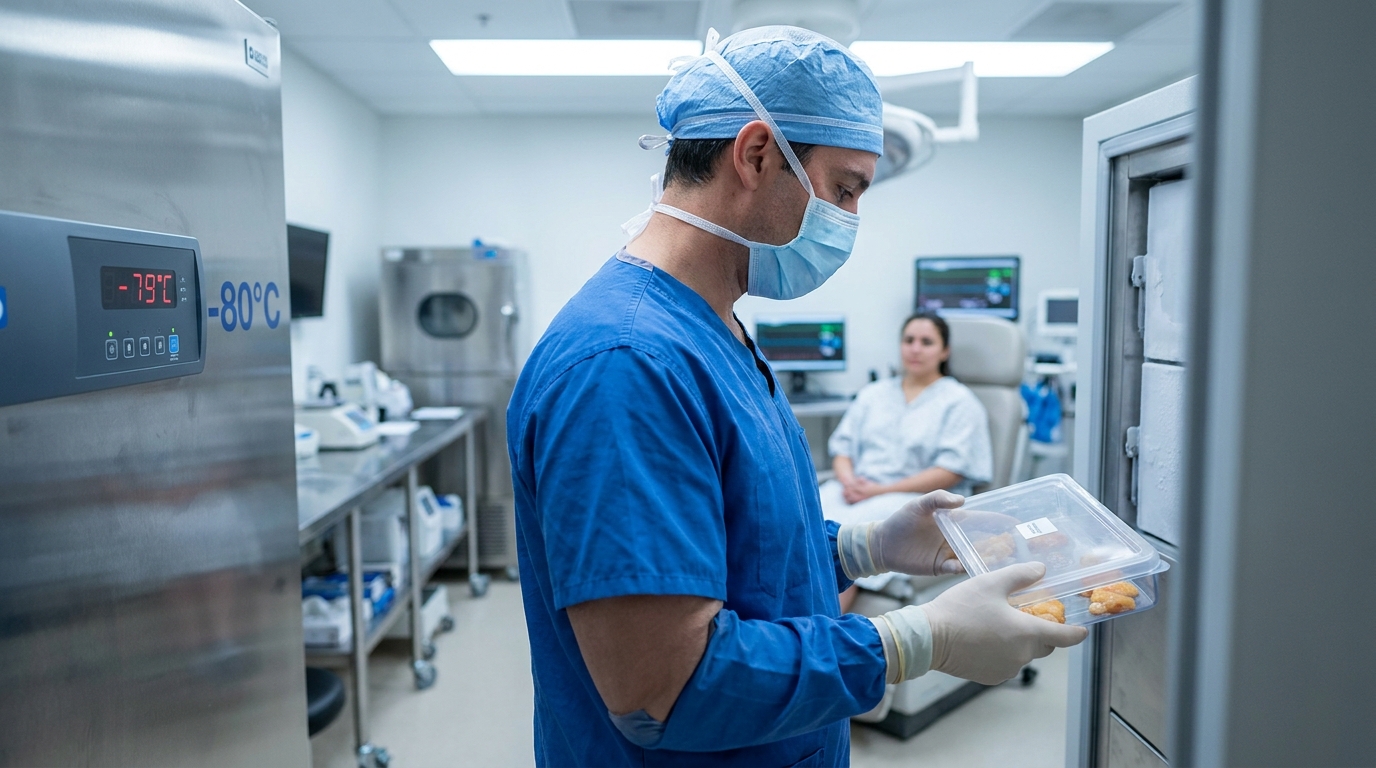
- Surgeons face unpredictable graft resorption and lack standardized protocols for long-term cryopreservation of adipose tissue in standard commercial freezers.
- Researchers analyzed adipose tissue from 22 donors across 284 experiments, comparing tissue blocks and lipoaspirates stored at -20 or -80 degrees Celsius.
- Storage at -80 degrees Celsius for four months retained 88 percent of stromal vascular fraction cells with 68 percent viability.
- The study concludes that tissue blocks stored at -80 degrees Celsius maintain multilineage differentiation potential better than samples kept at -20 degrees.
- Rapid thawing at 37 degrees Celsius provides a scalable, xeno-free method for preserving viable stem cells for future reconstructive procedures.
Optimizing Adipose Tissue Banking for Regenerative Medicine
Adipose tissue has become a cornerstone of regenerative medicine due to its high concentration of multipotent mesenchymal stem cells and the stromal vascular fraction, a heterogeneous collection of stem, endothelial, and immune cells [1, 2]. These cells are increasingly utilized in clinical trials for diverse applications, including the treatment of chronic skin wounds, soft tissue defects, and knee osteoarthritis [3, 4]. While autologous fat grafting is a standard surgical tool, unpredictable resorption rates often necessitate multiple harvesting procedures, which increases patient morbidity and surgical risk [5, 6]. Cryopreservation offers a potential solution by allowing clinicians to store harvested tissue for future use, yet maintaining cellular viability and differentiation potential remains a significant technical challenge [7]. Establishing standardized, accessible protocols for tissue banking is essential for the broader clinical adoption of these cell-based therapies [8, 9]. To address this gap, a recent study investigated a practical method for long-term storage using standard commercial freezing equipment, aiming to provide a reliable source of viable tissue for secondary reconstructive procedures.
Comparing Storage Temperatures and Tissue Architecture
The researchers evaluated the efficacy of different storage conditions using human adipose tissue harvested from 22 donors. To ensure statistical robustness, the team conducted 284 technically replicated experiments comparing various preservation methods. The study design focused on two primary variables: the physical architecture of the tissue and the storage temperature. Specifically, the adipose tissue was preserved either as intact tissue blocks or as lipoaspirates (fat tissue suctioned out through a cannula). These samples were stored in commercial freezers at either -20 °C or -80 °C for durations extending up to 4 months. To establish a baseline for cellular health and function, fresh adipose samples served as the control group. The choice of storage temperature proved to be a critical determinant of cellular viability and future therapeutic utility. While -20 °C is a common temperature for standard medical freezers, the study found it was insufficient for maintaining the regenerative properties of the tissue. Samples stored at -20 °C showed poor cellular adhesion, meaning the cells were unable to properly attach to surfaces, a prerequisite for growth and expansion in a clinical setting. Furthermore, these samples demonstrated no differentiation potential, failing to transform into the specialized cell types required for tissue repair. In contrast, storage at -80 °C preserved the essential characteristics of the stromal vascular fraction. For the practicing physician, these findings indicate that the utility of banked fat in secondary procedures depends heavily on avoiding the cellular damage associated with higher sub-zero temperatures, making -80 °C storage a clinical necessity.
Rapid Thawing and Mechanical Isolation Outcomes
The speed of the transition from a frozen to a liquid state emerged as a primary factor in maintaining the structural integrity of the adipose tissue. Among the tested protocols, rapid thawing at 37 °C (thawing method 3) proved most effective at protecting the cellular architecture. This specific method minimized oil leakage to 0.02 ml, a measurement that serves as a proxy for adipocyte rupture. For the clinician, low oil release indicates that the fat cells remained largely intact during the thawing process, which reduces the inflammatory potential of the graft and preserves the microenvironment necessary for cell survival. Beyond structural preservation, the thawing protocol significantly influenced the recovery of the regenerative cell population. After two months of storage at -80 °C, the use of rapid thawing at 37 °C better preserved stromal vascular fraction yield and viability, reaching 3.03 and 0.64 × 10^4 cells/ml respectively. These outcomes were notably superior in intact tissue blocks compared to lipoaspirates, suggesting that the preserved architecture of the block provides a protective buffer during freezing and thawing cycles. To ensure the protocol is suitable for immediate clinical application, the researchers utilized mechanical isolation of cells rather than enzymatic digestion. While enzymatic methods often involve bacterial collagenase, mechanical isolation relies on physical force to separate cells from the tissue matrix. This choice ensures the entire workflow is xeno-free (completely free of non-human animal products), which simplifies regulatory compliance and reduces the risk of immunogenic reactions in patients. The authors noted that this mechanical approach is scalable for clinical use, providing a practical pathway for hospitals to process and utilize stored adipose tissue without relying on complex laboratory reagents.
Long-term Cellular Viability and Multipotency
The longitudinal stability of cryopreserved adipose tissue is a critical factor for clinicians considering delayed autologous fat grafting or cell-based therapies. After four months of storage at -80 °C, the researchers found that the tissue blocks retained 88% of the stromal vascular fraction cells compared to fresh controls. The viability of these recovered cells remained clinically significant at 68%, a stark contrast to samples stored at -20 °C, which failed to maintain cellular integrity. To quantify the metabolic health of the tissue, the authors assessed mitochondrial activity using the XTT assay (a colorimetric test that measures cellular metabolic activity). This analysis, combined with measurements of oil release, confirmed that the metabolic machinery of the cells remained functional after long-term storage in standard commercial freezers. The quality of the preserved progenitor cells was further validated through trypan blue exclusion and flow cytometry (a laser-based technique used to detect specific cell populations). These assessments focused on the expression of surface markers that define adipose-derived stem cells. Samples stored at -80 °C demonstrated stronger expression of the markers CD73+, CD90+, and CD105+, with levels ranging from 70% to 80%. In comparison, samples stored at -20 °C showed significantly lower marker expression and poor cellular adhesion, rendering them unsuitable for clinical use. Beyond mere survival, the functional capacity of these stem cells to transform into different tissue types is the ultimate measure of their therapeutic utility. The researchers evaluated multilineage differentiation, the ability of a single stem cell to give rise to multiple specialized cell types. The cells harvested from the -80 °C tissue blocks successfully differentiated into adipogenic (fat), chondrogenic (cartilage), and osteogenic (bone) lineages. Conversely, the samples stored at -20 °C showed no such differentiation potential. For the practicing physician, these findings confirm that adipose tissue blocks stored at -80 °C maintain their regenerative capabilities, raising the prospect that hospitals could reliably bank a patient's own multipotent cells for future reconstructive or orthopedic interventions.
References
1. Gentile P, Garcovich S. Systematic Review: Adipose-Derived Mesenchymal Stem Cells, Platelet-Rich Plasma and Biomaterials as New Regenerative Strategies in Chronic Skin Wounds and Soft Tissue Defects. International Journal of Molecular Sciences. 2021. doi:10.3390/ijms22041538
2. Han X, Liao R, Li X, et al. Mesenchymal stem cells in treating human diseases: molecular mechanisms and clinical studies. Signal Transduction and Targeted Therapy. 2025. doi:10.1038/s41392-025-02313-9
3. Asch A, Kalbermatten DF, Madduri S. Clinical Safety and Efficacy of Allogeneic Adipose Stem Cells: A Systematic Review of the Clinical Trials. International Journal of Molecular Sciences. 2025. doi:10.3390/ijms26136376
4. Holiuk Y, Birsa R, Bukreieva T, et al. Effectiveness and safety of multiple injections of human placenta-derived MSCs for knee osteoarthritis: a nonrandomized phase I trial. BMC Musculoskeletal Disorders. 2025. doi:10.1186/s12891-025-08664-2
5. Arshad Z, Halioua-Haubold C, Roberts M, et al. Adipose-Derived Stem Cells in Aesthetic Surgery: A Mixed Methods Evaluation of the Current Clinical Trial, Intellectual Property, and Regulatory Landscape. Aesthetic Surgery Journal. 2017. doi:10.1093/asj/sjx093
6. Gentile P, Ossanna R, Sierra LAQ, Sbarbati A. Mechanical Purification of Lipofilling: The Relationship Between Cell Yield, Cell Growth, and Fat Volume Maintenance. Aesthetic Plastic Surgery. 2024. doi:10.1007/s00266-024-03870-0
7. Favaretto F, Compagnin C, Cogliati E, et al. Characterization of Human Subcutaneous Adipose Tissue and Validation of the Banking Procedure for Autologous Transplantation. International Journal of Molecular Sciences. 2023. doi:10.3390/ijms24098190
8. Zhao L, Ríos HF, Cochran DL. Emerging Regenerative Approaches for Periodontal Reconstruction: A Systematic Review From the AAP Regeneration Workshop. Journal of Periodontology. 2015. doi:10.1902/jop.2015.130689
9. Geraghty RJ, Capes‐Davis A, Davis JM, et al. Guidelines for the use of cell lines in biomedical research. British Journal of Cancer. 2014. doi:10.1038/bjc.2014.166