
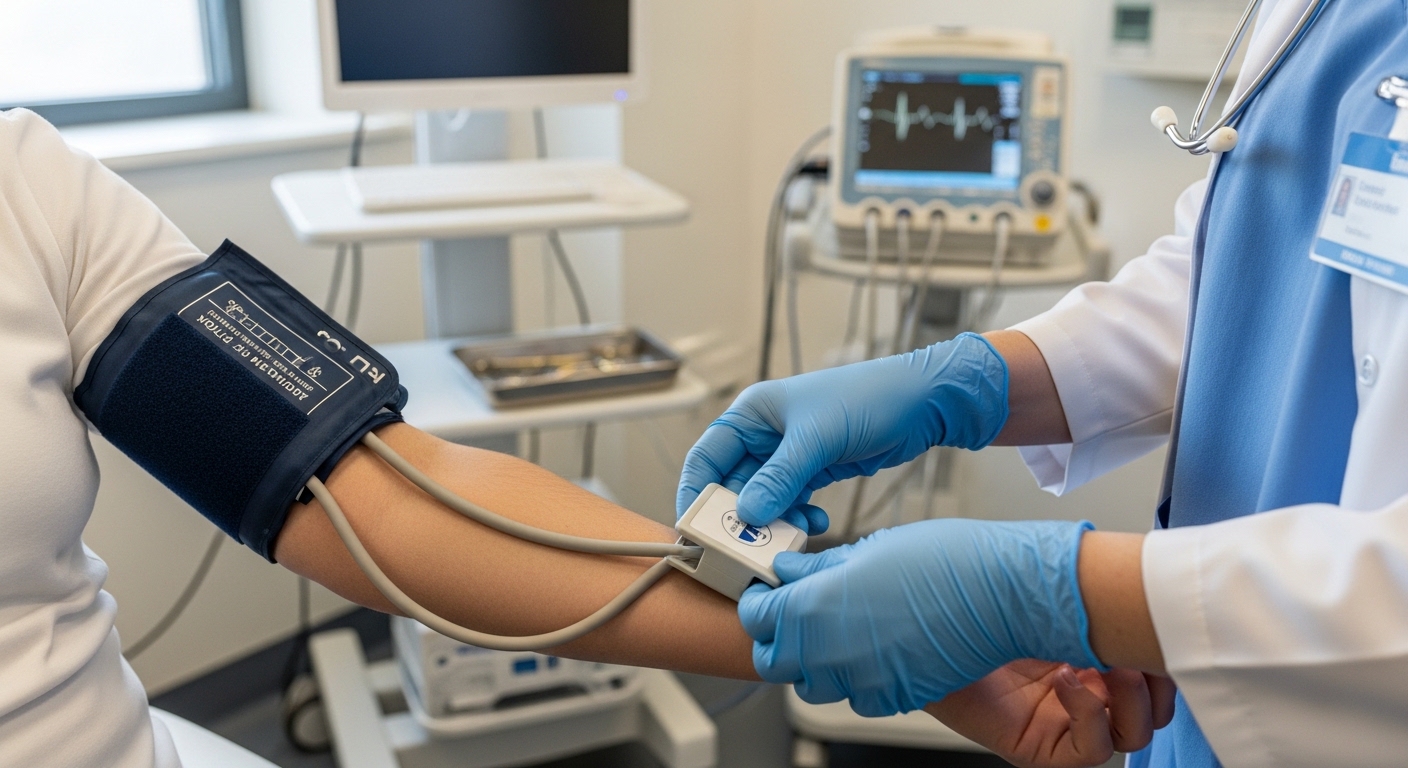
- This study compared exercise training modalities for reducing 24-hour ambulatory blood pressure in adults with hypertension.
- A systematic review and network meta-analysis included 31 trials with 1345 participants.
- Combined training reduced systolic BP by 6.18 mm Hg (95% CrI -11.45 to -1.21) versus control.
- The authors concluded aerobic and combined training significantly reduced 24-hour blood pressure.
- Clinicians can consider aerobic and combined training for ambulatory blood pressure management.
Exercise Modalities and Ambulatory Blood Pressure Control
Hypertension remains a primary driver of cardiovascular morbidity and mortality, with lifestyle interventions like physical activity serving as a cornerstone of management [1, 2, 3]. While exercise is known to lower office-based blood pressure, its effect on 24-hour ambulatory blood pressure, a more accurate predictor of cardiovascular events, is of increasing clinical interest [4, 5]. Previous analyses confirmed that exercise can reduce ambulatory blood pressure, even in patients with resistant hypertension [4, 5]. However, a persistent clinical question has been the comparative effectiveness of different exercise modalities. A recent network meta-analysis provides a clearer, data-driven answer to guide exercise prescriptions for adults with hypertension [6, 7, 8].
Study Design and Participant Cohort
This systematic review employed a network meta-analysis to compare the effects of various exercise training regimens on 24-hour ambulatory blood pressure in adults with hypertension. This statistical method is particularly useful for clinicians as it allows for indirect comparisons between interventions that have not been directly tested against each other in a head-to-head trial. Investigators conducted a systematic search of MEDLINE, Embase, Cochrane Central, and the Regional Portal of the Virtual Health Library for studies published between November 2024 and August 2025. The analysis included only randomized controlled trials with an intervention duration of at least four weeks that compared an exercise modality against a non-exercise control or another form of exercise. The final analysis synthesized data from 31 trials, which included 67 distinct intervention arms and a total of 1345 participants, forming a robust dataset for comparison.
Key Reductions in Systolic Ambulatory Blood Pressure
The analysis demonstrated clinically significant reductions in 24-hour systolic blood pressure for several common exercise modalities when compared with non-exercise controls. Combined training, which integrates both aerobic and resistance exercise, was associated with the largest mean reduction in 24-hour systolic blood pressure at -6.18 mm Hg (95% credible interval [CrI] -11.45 to -1.21). Standard aerobic training also produced a substantial effect, lowering systolic pressure by a mean of -4.73 mm Hg (95% CrI -7.53 to -2.01). Furthermore, high-intensity interval training (HIIT) yielded a similar benefit, with a mean reduction of -5.71 mm Hg (95% CrI -11.31 to -0.002). These specific figures provide clinicians with quantitative evidence to support recommendations for structured exercise, reinforcing that multiple approaches can achieve the meaningful blood pressure control necessary to lower cardiovascular risk.
Impact on Diastolic Ambulatory Blood Pressure
The benefits of exercise extended to 24-hour diastolic blood pressure, with several modalities showing significant improvements. Combined aerobic and resistance training produced a mean diastolic reduction of -3.94 mm Hg (95% CrI -6.47 to -1.34). Aerobic training alone was also effective, lowering diastolic pressure by a mean of -2.76 mm Hg (95% CrI -4.21 to -1.34). High-intensity interval training demonstrated a strong effect, with a mean reduction of -4.64 mm Hg (95% CrI -8.21 to -0.72). Interestingly, the analysis also found that pilates, a less conventional modality in hypertension management, was associated with a significant diastolic blood pressure reduction, showing a mean difference of -4.18 mm Hg (95% CrI -7.18 to -1.17). These findings affirm that a variety of structured physical activities can effectively lower diastolic pressure, a key target in comprehensive hypertension care.
Comparative Efficacy and Remaining Uncertainties
A central finding of this network meta-analysis for clinical practice is that exercise-versus-exercise comparisons were inconclusive regarding the superiority of any single modality. While combined training, aerobic training, and HIIT all effectively lowered ambulatory blood pressure, the evidence does not support recommending one over the others. This empowers clinicians to tailor exercise prescriptions to patient preferences and capabilities, which may improve long-term adherence. The study confirms that both continuous and interval-based aerobic training, as well as combined training, are well-supported strategies for reducing 24-hour blood pressure. However, the authors caution that the evidence for the isolated effects of dynamic and isometric resistance training remains uncertain. Similarly, while pilates showed an effect on diastolic pressure, data on it and other non-conventional activities like recreational sports are still too limited or imprecise to form definitive recommendations for ambulatory blood pressure management, highlighting areas for future investigation.
References
1. Bull F, Al-Ansari SS, Biddle S, et al. World Health Organization 2020 guidelines on physical activity and sedentary behaviour. British Journal of Sports Medicine. 2020. doi:10.1136/bjsports-2020-102955
2. Janssen I, LeBlanc AG. Systematic review of the health benefits of physical activity and fitness in school-aged children and youth. International Journal of Behavioral Nutrition and Physical Activity. 2010. doi:10.1186/1479-5868-7-40
3. Mancia G, Fagard R, Narkiewicz K, et al. 2013 ESH/ESC Guidelines for the management of arterial hypertension. European Heart Journal. 2013. doi:10.1093/eurheartj/eht151
4. Saco-Ledo G, Valenzuela PL, Ruiz-Hurtado G, Ruilope LM, Lucia A. Exercise Reduces Ambulatory Blood Pressure in Patients With Hypertension: A Systematic Review and Meta-Analysis of Randomized Controlled Trials.. Journal of the American Heart Association. 2020. doi:10.1161/JAHA.120.018487
5. Saco-Ledo G, Valenzuela PL, Ruilope LM, Lucia A. Physical Exercise in Resistant Hypertension: A Systematic Review and Meta-Analysis of Randomized Controlled Trials.. Frontiers in cardiovascular medicine. 2022. doi:10.3389/fcvm.2022.893811
6. Bersaoui M, Baldew SM, Cornelis N, Toelsie J, Cornelissen VA. The effect of exercise training on blood pressure in African and Asian populations: A systematic review and meta-analysis of randomized controlled trials.. European journal of preventive cardiology. 2020. doi:10.1177/2047487319871233
7. Loaiza-Betancur AF, Chulvi-Medrano I, Díaz-López VA, Gómez-Tomás C. The effect of exercise training on blood pressure in menopause and postmenopausal women: A systematic review of randomized controlled trials.. Maturitas. 2021. doi:10.1016/j.maturitas.2021.05.005
8. Cornelissen V, Smart NA. Exercise Training for Blood Pressure: A Systematic Review and Meta‐analysis. Journal of the American Heart Association. 2013. doi:10.1161/jaha.112.004473