For Doctors in a Hurry
- Clinicians currently rely on subjective grading systems for subarachnoid hemorrhage prognosis, which often suffer from significant inter-rater variability.
- The researchers evaluated a deep learning model using 863 patients across 11 hospitals to predict 90-day mortality from admission CT scans.
- The automated model achieved an area under the curve of 0.806, which was statistically comparable to traditional clinical models in external validation.
- The authors concluded that this automated tool provides objective risk stratification without requiring the manual data entry needed for conventional scoring.
- This fully automated tool offers a complementary decision-support method for clinicians by utilizing only routine imaging at the point of care.
Standardizing Prognosis in Aneurysmal Subarachnoid Hemorrhage
Aneurysmal subarachnoid hemorrhage remains a high-stakes neurological emergency where patient outcomes are contingent upon rapid triage and aggressive, expert-led management [1, 2]. Current prognostic frameworks rely heavily on clinical scales and radiological grading systems, yet these traditional methods are frequently hampered by significant inter-rater variability and the logistical burden of manual data entry [3]. While machine learning (a branch of computer science where algorithms identify patterns in complex datasets) has been proposed to refine these assessments, many existing models lack the rigorous external validation across diverse hospital systems necessary for clinical trust [4, 5]. Integrating automated tools into the acute workflow is a persistent challenge, as clinicians require objective, reproducible methods that streamline rather than complicate the cognitive load of emergency triage [6]. A recent multicenter study addresses this gap by evaluating an image-only deep learning approach to mortality prediction at the time of admission.
Automated Risk Stratification via Deep Learning
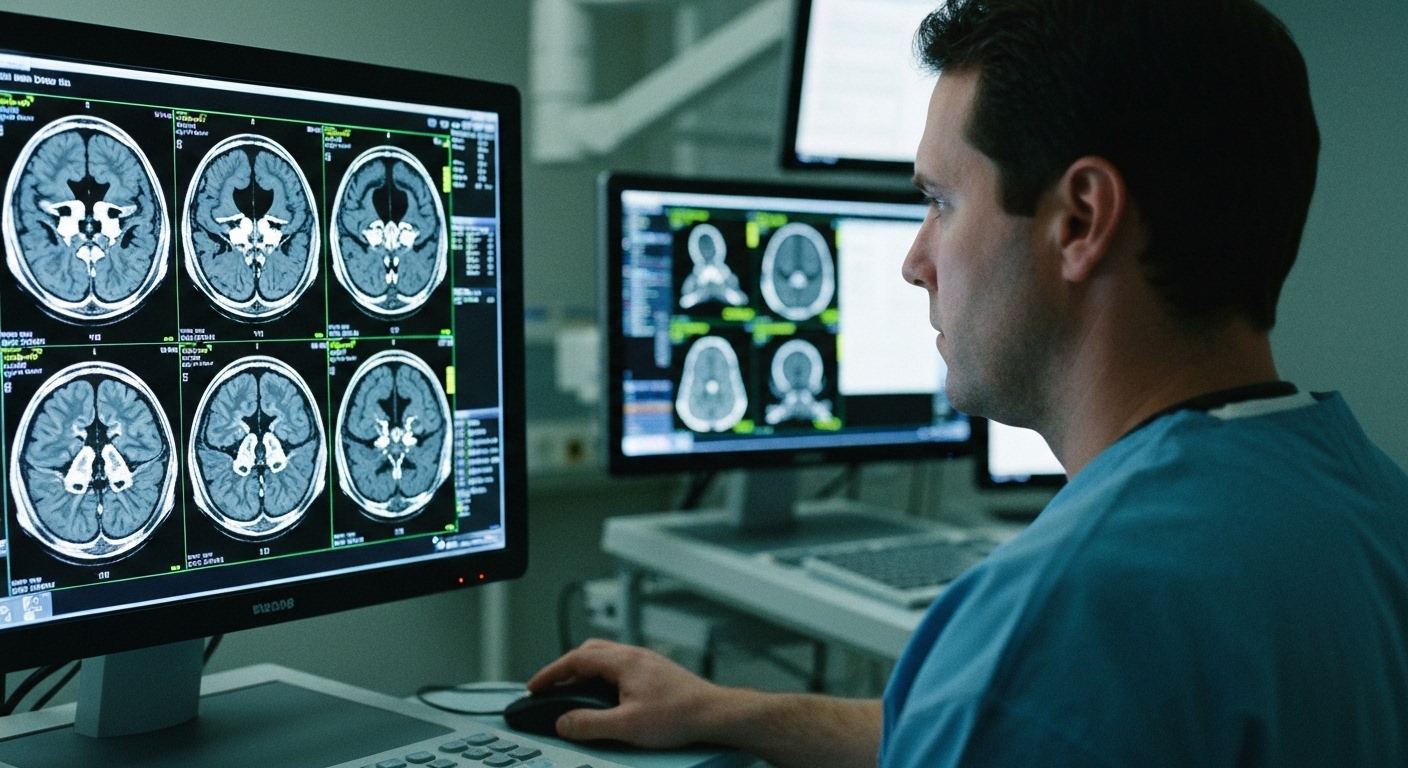
The researchers developed and validated a fully automated deep learning model designed to predict 90-day mortality using only admission noncontrast computed tomography (NCCT) scans. This approach seeks to provide objective, reproducible, image-only risk stratification that functions independently of subjective clinical assessments or manual radiological grading. By utilizing the admission scan as the sole input, the model bypasses the need for clinical variables like neurological status at presentation, which can be difficult to assess accurately in sedated or intubated patients. The technical foundation of the system is a 3-dimensional DenseNet-121 architecture, a specific type of deep neural network that connects each layer to every subsequent layer to maximize information flow from the imaging data. The model also utilized transfer learning (a process where an algorithm is pre-trained on a large dataset and then fine-tuned for a specific medical task), allowing it to recognize complex volumetric patterns in brain scans that may be imperceptible to the human eye. Because the system requires no manual input, it can be integrated directly into existing radiology workflows to provide immediate prognostic data at the point of care.
Multicenter Development and Model Comparison
To ensure the model's robustness, the researchers conducted a multicenter retrospective study involving 863 patients with aneurysmal subarachnoid hemorrhage. The development phase utilized data from 9 tertiary hospitals, creating a training cohort of 586 patients, while 147 patients were reserved for internal testing. The generalizability of the algorithm was then tested through external validation using data from 130 patients at 2 independent centers, ensuring the model could handle imaging data from institutions not involved in its initial training. The deep learning model was benchmarked against three logistic regression models: a Core model using age and World Federation of Neurosurgical Societies grade (a five-point scale categorizing severity based on the Glasgow Coma Scale), an Imaging model adding the modified Fisher grade (a four-point scale used to predict vasospasm risk based on blood distribution) and aneurysm characteristics, and a Full Clinical model that also included treatment modality.
In the internal testing phase, the deep learning model demonstrated high discrimination (the ability to correctly distinguish between patients who survived and those who died). The area under the curve (AUC) for the deep learning model was 0.855 (95% CI, 0.786 to 0.917), which was statistically comparable to the Core model (AUC 0.856; 95% CI, 0.790 to 0.913), the Imaging model (AUC 0.853; 95% CI, 0.780 to 0.916), and the Full Clinical model (AUC 0.844; 95% CI, 0.766 to 0.909). During external validation, the deep learning model maintained an AUC of 0.806 (95% CI, 0.724 to 0.876), while the Core, Imaging, and Full models produced AUCs of 0.823, 0.793, and 0.798, respectively. Statistical analysis confirmed that no significant performance differences existed between the deep learning model and conventional approaches (DeLong P > .05). Furthermore, all models demonstrated good calibration, meaning the predicted probabilities of mortality closely matched the actual observed outcomes, ensuring the model provides an accurate estimate of absolute risk rather than just a relative ranking of patients.
Clinical Utility and Decision Support
The clinical relevance of this automated approach lies in its ability to eliminate the inter-rater variability inherent in subjective scoring systems. Traditional tools require the integration of multiple clinical and radiological variables, a process that can be time-consuming in high-pressure emergency settings. To evaluate the practical value of the model, the researchers used decision-curve analysis (a statistical method that estimates clinical net benefit by weighing the value of correct predictions against the costs of false positives). This decision-curve analysis showed comparable net benefit across clinically relevant thresholds for the deep learning model and traditional clinical models. Because the model requires no data collection beyond routine admission imaging, it serves as a complementary decision-support tool that provides objective risk stratification at the point of care. This allows clinicians to facilitate more consistent prognostic discussions and management planning without increasing the administrative or cognitive burden on the medical team.
References
1. Connolly ES, Rabinstein AA, Carhuapoma JR, et al. Guidelines for the Management of Aneurysmal Subarachnoid Hemorrhage. Stroke. 2012. doi:10.1161/str.0b013e3182587839
2. Hoh BL, Ko N, Amin‐Hanjani S, et al. 2023 Guideline for the Management of Patients With Aneurysmal Subarachnoid Hemorrhage: A Guideline From the American Heart Association/American Stroke Association. Stroke. 2023. doi:10.1161/str.0000000000000436
3. Ohkuma H, Shimamura N, Naraoka M, Katagai T. Aneurysmal Subarachnoid Hemorrhage in the Elderly over Age 75: A Systematic Review. Neurologia medico-chirurgica. 2017. doi:10.2176/nmc.ra.2017-0057
4. Palermo M, D’Arrigo S, Olivi A, Doglietto F, Albanese A, Sturiale C. Machine Learning Models for Predicting Delayed Cerebral Ischemia Following Ruptured Intracranial Aneurysms: A Systematic Review and Meta-Analysis.. Journal of Stroke & Cerebrovascular Diseases. 2026. doi:10.1016/j.jstrokecerebrovasdis.2026.108592
5. Wang W, Kiik M, Peek N, et al. A systematic review of machine learning models for predicting outcomes of stroke with structured data. PLoS ONE. 2020. doi:10.1371/journal.pone.0234722
6. Hu P, Yan T, Xiao B, et al. Deep learning-assisted detection and segmentation of intracranial hemorrhage in noncontrast computed tomography scans of acute stroke patients: a systematic review and meta-analysis. International Journal of Surgery. 2024. doi:10.1097/js9.0000000000001266