For Doctors in a Hurry
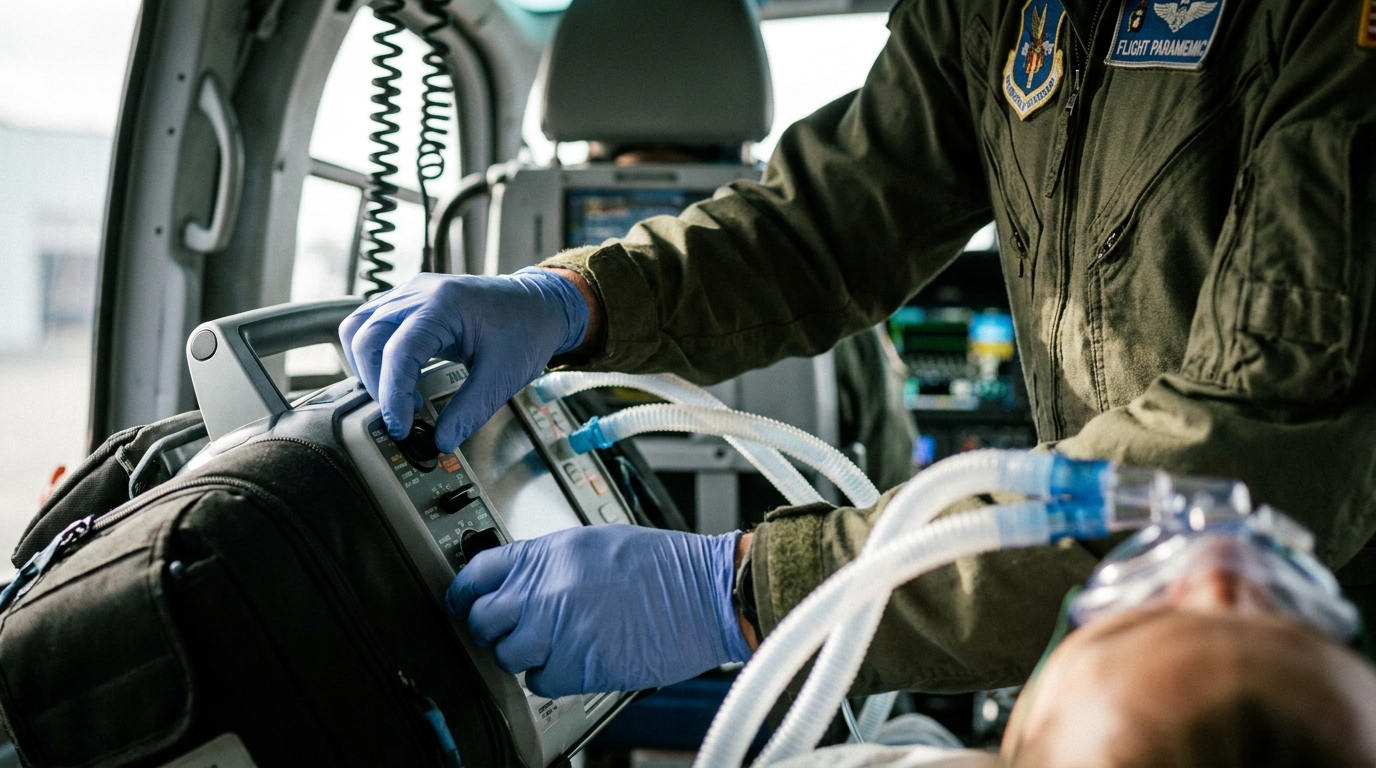
- Researchers investigated whether automated ventilation maintains better airway security and ventilation quality than manual methods during helicopter short-haul rescue missions.
- This prospective crossover simulation compared manual bag-valve-mask use to automated ventilators in nine static and six live helicopter scenarios.
- Automated ventilation achieved target minute ventilation in 100% of live tests compared to 33% for manual ventilation (p=0.12).
- The study authors concluded that automated ventilation consistently met ventilation targets while minimizing airway device movement and preventing circuit disconnections.
- Clinicians should consider automated ventilation to improve physiological stability and airway security when managing patients during high-risk helicopter extractions.
Optimizing Airway Management in High-Stakes Aeromedical Rescue
Critical care transport in remote environments requires a precise balance between physiological stabilization and the logistical constraints of medical evacuation [1]. In mountain rescue, multi-casualty incidents and complex extractions often necessitate advanced airway management under extreme environmental conditions [2]. While supraglottic devices (airway adjuncts that sit above the vocal cords) have simplified prehospital airway security, maintaining consistent ventilation remains a challenge during the physical turbulence of helicopter operations [3]. Failure to achieve target ventilation parameters can exacerbate secondary injuries, particularly in patients with neurological or respiratory compromise [4, 5]. A recent study evaluates whether automated ventilators can resolve the inherent limitations of manual bagging during these high-intensity rescue maneuvers.
Simulating the Rigors of Short-Haul Evacuation
To evaluate the efficacy of different ventilation strategies in extreme environments, researchers conducted a prospective simulation-based, non-randomized crossover study, a design where each participant serves as their own control by testing both methods. The study utilized a mid-fidelity Laerdal Quality Cardiopulmonary Resuscitation manikin equipped with a pre-inserted i-gel airway, a supraglottic device frequently used in prehospital settings to secure the airway without the complexity of endotracheal intubation. Stretcher attendants managed the manikin across two distinct environments: a simulated static scenario and a live helicopter short-haul scenario, where the patient and provider are suspended beneath the aircraft during transport. The primary outcome was the achievement of target minute ventilation (the total volume of gas entering the lungs per minute), defined for this study as a range of 5 to 7.2 L/min. To reach this target, attendants performed two tests in each scenario. The first test required manual ventilation using a pocket bag-valve-mask, while the second utilized an automated ventilator to deliver programmed breaths. The researchers also tracked secondary outcomes to assess clinical stability, including tidal volumes, breaths per minute, and post-test i-gel movement. Finally, they administered an operational usability survey to capture the clinicians' experience during the rescue maneuvers.
Ventilation Consistency Under Physical Stress
The study evaluated nine stretcher attendants who completed both ventilation methods in the static scenario, alongside six attendants who completed both methods during the live helicopter short-haul scenario. In the controlled environment of the static tests, target minute ventilation was achieved in 67% of manual ventilation trials, whereas the automated ventilator reached the target in 100% of trials. This performance gap widened significantly during the live helicopter trials, where the physical demands of being suspended beneath the aircraft severely impacted the attendants' ability to provide consistent breaths. In these live scenarios, target minute ventilation was achieved in only 33% of manual ventilation trials. Conversely, automated ventilation maintained a 100% success rate in the live environment. For practicing clinicians, this consistency is critical for maintaining stable carbon dioxide levels and oxygenation during high-risk transports where provider attention is divided. Statistical analysis reflected the small sample size of the simulation, with the difference in target achievement not reaching statistical significance in either the static scenario (p = 0.25) or the live scenario (p = 0.12). However, the researchers noted that all discordant outcomes favored the automated ventilator. In every instance where one method succeeded and the other failed for the same participant, the success was attributed to the automated device, suggesting the lack of statistical significance was a function of the low number of tests rather than a lack of clinical difference.
Device Stability and Provider Preference
Beyond the consistency of air delivery, the study evaluated the mechanical stability of the ventilation circuit during the physical rigors of transport. The researchers observed that manual ventilation resulted in four ventilation disconnects, occurring equally across the study environments with two disconnects in static scenarios and two in live scenarios. These interruptions in the breathing circuit represent a critical failure in airway management, particularly during a helicopter short-haul where physical access to the patient is severely restricted. In contrast, zero ventilation disconnects were observed during automated ventilation, indicating that the mechanical interface of the ventilator provides a more secure connection during the movement and vibration inherent in rescue operations. The stability of the supraglottic airway itself was also affected by the ventilation method. Measurements taken after each test indicated that manual ventilation resulted in greater i-gel movement compared to the automated method. This increased displacement is clinically significant because excessive movement can compromise the anatomical seal of the device over the laryngeal opening, potentially leading to gastric insufflation or inadequate oxygenation. Qualitative assessments from the rescue personnel reinforced these mechanical findings. In a post-simulation operational usability survey, participants reported a greater preference for automated ventilation over manual bagging. This preference likely reflects the reduced cognitive and physical load on the stretcher attendant, who must manage the patient while suspended beneath the aircraft. Given the combination of improved minute volume consistency, reduced airway displacement, and the elimination of circuit disconnections, the findings suggest that rescue teams should consider integrating automated ventilators into their short-haul airway management protocols.
References
1. Lentz T, Genty S, Gergereau A, Descatha A. Health Support for a Remote Industrial Site. Frontiers in Public Health. 2019. doi:10.3389/fpubh.2019.00180
2. Blancher M, Albasini F, Elsensohn F, et al. Management of Multi-Casualty Incidents in Mountain Rescue: Evidence-Based Guidelines of the International Commission for Mountain Emergency Medicine (ICAR MEDCOM). High Altitude Medicine & Biology. 2018. doi:10.1089/ham.2017.0143
3. Masi G, Amprimo G, Ferraris C, Priano L. Stress and Workload Assessment in Aviation—A Narrative Review. Sensors. 2023. doi:10.3390/s23073556
4. Mayuga KA, Fedorowski A, Ricci F, et al. Sinus Tachycardia: a Multidisciplinary Expert Focused Review. Circulation Arrhythmia and Electrophysiology. 2022. doi:10.1161/circep.121.007960
5. Sakr Y, Giovini M, Léone M, et al. Pulmonary embolism in patients with coronavirus disease-2019 (COVID-19) pneumonia: a narrative review. Annals of Intensive Care. 2020. doi:10.1186/s13613-020-00741-0