
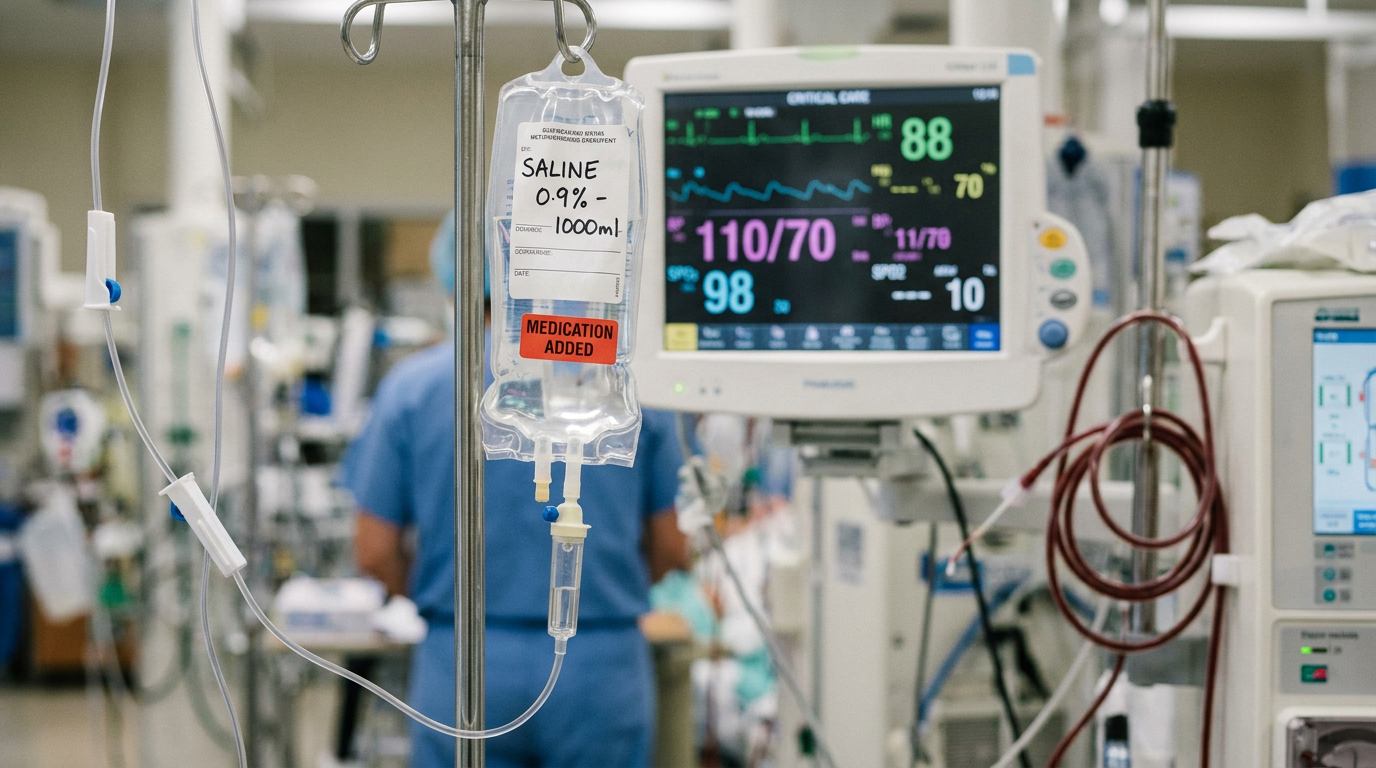
- This study investigated the effects of sodium bicarbonate in critically ill adults with acute metabolic acidosis.
- Researchers performed a meta-analysis of four randomized controlled trials, including 1,111 critically ill patients.
- Sodium bicarbonate significantly reduced renal replacement therapy use, with a risk ratio of 0.69 (95% CI, 0.61-0.78).
- The authors concluded that sodium bicarbonate significantly reduces renal replacement therapy requirements in these patients.
- Larger randomized controlled trials are needed to confirm any potential mortality benefit of sodium bicarbonate.
Navigating Acute Metabolic Acidosis in Critical Care
Acute metabolic acidosis is a common and consequential complication in critically ill adults, often driven by severe underlying conditions like sepsis or acute kidney injury [1, 2]. This physiological derangement complicates patient management and is typically addressed with volume replacement, targeted therapies, and, in some cases, renal replacement therapy [3]. While sodium bicarbonate has long been available to correct severe acidosis, its clinical utility has been debated due to inconsistent evidence and concerns about potential adverse effects [4, 5]. This uncertainty is reflected in clinical guidelines for conditions such as sepsis and diabetic ketoacidosis, which often provide equivocal recommendations on bicarbonate's role [6, 7]. A recent meta-analysis now provides a clearer, more statistically robust assessment of sodium bicarbonate's effects in this setting.
Re-evaluating Bicarbonate's Role: Study Design and Scope
To resolve lingering questions about bicarbonate's utility, researchers conducted a systematic meta-analysis of recent evidence, including findings from the BICARICU-1 and BICARICU-2 trials. The investigation focused on randomized controlled trials (RCTs) sourced from PubMed, Embase, Medline, and the Cochrane Library that compared sodium bicarbonate to placebo in critically ill adults with acute metabolic acidosis. The primary outcome was the requirement for renal replacement therapy (RRT). Secondary outcomes included mortality, intensive care unit (ICU) length of stay, and ventilator-free and vasopressor-free days. The analysis incorporated several sophisticated statistical methods to ensure robustness. The authors used Hartung-Knapp random-effects models, which account for variability between trials, and trial sequential analysis (TSA), a statistical technique that determines whether the accumulated evidence is sufficient to reach a firm conclusion. For sensitivity, they also performed Bayesian random-effects meta-analyses, which calculate the probability of an outcome based on the data. The final analysis synthesized data from four trials enrolling a total of 1,111 patients.
Clear Benefit for Renal Support, Unclear Mortality Impact
The analysis yielded a definitive finding regarding renal outcomes. The administration of sodium bicarbonate was associated with a significant reduction in the use of renal replacement therapy, with a risk ratio of 0.69 (95% CI, 0.61-0.78). This result suggests that patients receiving bicarbonate were approximately 31% less likely to require dialysis or hemofiltration. The strength of this conclusion was reinforced by the trial sequential analysis (TSA), which indicated that the data provided firm evidence of this benefit. A complementary Bayesian analysis further supported this, estimating a 94.6% posterior probability that bicarbonate reduces the need for RRT, lending high confidence to this specific outcome. This finding is clinically significant, as avoiding RRT spares patients an invasive, resource-intensive procedure with its own risks of complications.
In contrast, the effect of sodium bicarbonate on mortality remains inconclusive. The data showed a nonsignificant trend toward lower mortality (risk ratio, 0.84; 95% CI, 0.55-1.30). The TSA confirmed that the cumulative patient sample was too small to make a definitive judgment on survival, meaning the current evidence is insufficient. However, the Bayesian analysis offered a different perspective, estimating a 90.4% probability that sodium bicarbonate confers some degree of mortality reduction (defined as a risk ratio < 1). This suggests a signal of potential benefit that did not meet the threshold for statistical significance in the conventional frequentist analysis. Findings for other secondary outcomes, such as ICU length of stay and ventilator-free days, were imprecise, although a trend toward more vasopressor-free days was noted, hinting at a possible improvement in hemodynamic stability.
Clinical Implications and Future Directions
For practicing clinicians, this meta-analysis provides a key actionable insight: sodium bicarbonate administration in critically ill adults with acute metabolic acidosis significantly reduces the need for renal replacement therapy. The robust statistical support for this finding, with a risk ratio of 0.69 (95% CI, 0.61-0.78), suggests that bicarbonate can be considered a tool to potentially mitigate the progression to RRT dependency in this population. The high probability of benefit (94.6%) estimated by the Bayesian analysis strengthens the case for its use with the specific goal of preserving renal function and avoiding dialysis.
The question of a survival benefit, however, is not yet answered. While the Bayesian analysis points to a high probability (90.4%) of some mortality reduction, the conventional statistical analysis remains inconclusive due to an insufficient sample size. Clinicians should interpret this as a potential signal of benefit that requires further confirmation, not as a proven effect. The authors conclude, and the data support, that larger randomized controlled trials or high-quality real-world studies are needed to definitively establish whether the use of sodium bicarbonate translates into a clear survival advantage for these critically ill patients.
References
1. Evans L, Rhodes A, Alhazzani W, et al. Surviving Sepsis Campaign: International Guidelines for Management of Sepsis and Septic Shock 2021. Critical Care Medicine. 2021. doi:10.1097/ccm.0000000000005337
2. Nadim MK, Forni LG, Mehta RL, et al. COVID-19-associated acute kidney injury: consensus report of the 25th Acute Disease Quality Initiative (ADQI) Workgroup. Nature Reviews Nephrology. 2020. doi:10.1038/s41581-020-00356-5
3. Chen J, Lee T, Chang C, Lai P, Tu Y, Huang Y. Sodium Bicarbonate for Acute Metabolic Acidosis in Critically Ill Adults: A Meta-Analysis of Randomized Clinical Trials.. Critical care medicine. 2026. doi:10.1097/CCM.0000000000007179
4. Fujii T, Udy A, Licari E, Romero L, Bellomo R. Sodium bicarbonate therapy for critically ill patients with metabolic acidosis: A scoping and a systematic review.. Journal of critical care. 2019. doi:10.1016/j.jcrc.2019.02.027
5. Chua H, Schneider A, Bellomo R. Bicarbonate in diabetic ketoacidosis - a systematic review. Annals of Intensive Care. 2011. doi:10.1186/2110-5820-1-23
6. Rhodes A, Evans L, Alhazzani W, et al. Surviving Sepsis Campaign: International Guidelines for Management of Sepsis and Septic Shock: 2016. Critical Care Medicine. 2017. doi:10.1097/ccm.0000000000002255
7. Jung B, Martinez M, Claessens Y, et al. Diagnosis and management of metabolic acidosis: guidelines from a French expert panel. Annals of Intensive Care. 2019. doi:10.1186/s13613-019-0563-2