
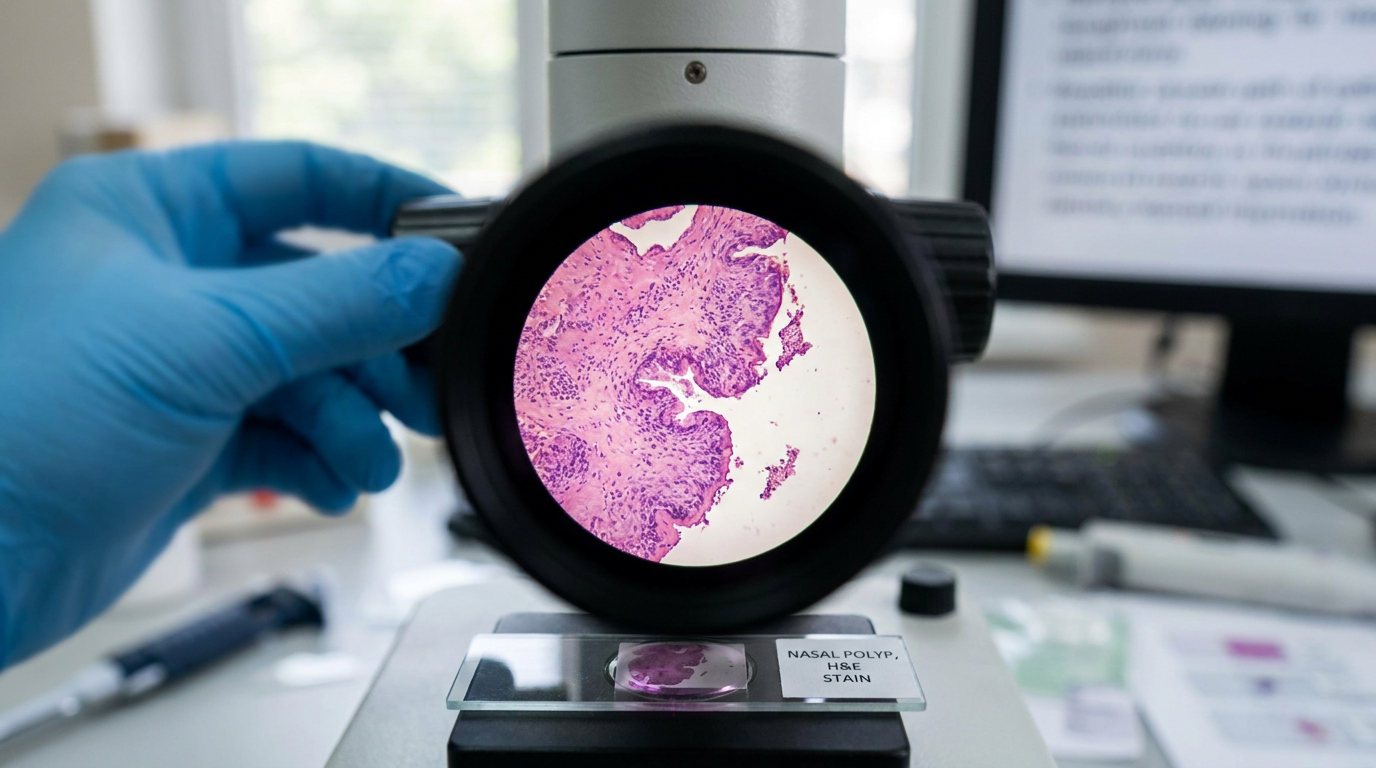
- Current therapies for chronic rhinosinusitis with nasal polyps (CRSwNP) are suboptimal, necessitating identification of new therapeutic targets and biomarkers.
- Researchers performed Mendelian randomization analyses using 8,496 nasal polyp patients and 371,520 controls, followed by multi-omic validation.
- The study identified cathepsin S (CTSS) as causally linked to nasal polyp risk, showing significant upregulation in nasal polyp tissue.
- The authors concluded that CTSS may contribute to CRSwNP pathogenesis by modulating tissue remodeling and serves as a biomarker.
- This suggests CTSS could be a diagnostic biomarker and a potential therapeutic target for CRSwNP management.
Unraveling Tissue Remodeling in Chronic Rhinosinusitis with Nasal Polyps
Chronic rhinosinusitis with nasal polyps (CRSwNP) represents a significant clinical challenge, characterized by persistent inflammation, epithelial dysfunction, and prominent tissue remodeling within the nasal and paranasal sinus mucosa [1, 2]. This complex condition often leads to considerable morbidity, with many patients experiencing refractory or relapsing disease despite conventional treatments, including local and systemic corticosteroids or surgical interventions [3]. The heterogeneous nature of CRSwNP, encompassing various molecular endotypes and inflammatory profiles, underscores the ongoing need for a deeper understanding of its underlying pathogenesis to develop more effective, targeted therapies [4, 5]. While type 2 inflammation is a recognized driver in many cases, the precise mechanisms orchestrating tissue changes and disease severity remain an active area of investigation [6]. For instance, recent work highlights the role of microRNAs in influencing inflammatory pathways and tissue remodeling [7], while other studies point to hypoxia-related genes as potential diagnostic biomarkers [8]. A new study now offers fresh insights into a potential molecular contributor to this persistent inflammatory and remodeling process.
Identifying Molecular Drivers of CRSwNP
Chronic rhinosinusitis with nasal polyps (CRSwNP) presents a persistent clinical challenge, recognized as a refractory, relapsing upper airway inflammatory disorder. A hallmark of CRSwNP is its prominent tissue remodeling, which contributes to the disease's chronic nature and often leads to significant patient morbidity. Despite various interventions, current therapeutic options for CRSwNP remain suboptimal, highlighting an unmet need for more effective treatments. To address this, the researchers undertook a comprehensive investigation, with the explicit aim to identify novel potential targets and biomarkers that could lead to improved diagnostic and therapeutic strategies for CRSwNP. This identification process was conducted using an integrative multi-omics approach, combining diverse molecular data sets to gain a holistic understanding of the disease's underlying biology.
The initial phase of this multi-omics investigation involved Mendelian randomization (MR) analyses. This statistical method leverages genetic variants as instrumental variables to infer causal relationships between exposures, such as gene or protein expression, and disease outcomes, thereby minimizing confounding factors inherent in observational studies. The MR analyses integrated several large-scale genetic datasets: blood expression quantitative trait loci (eQTL) from eQTLGen, which links genetic variations to gene expression levels; plasma protein quantitative trait loci (pQTL) from deCODE, which connects genetic variants to protein abundance in plasma; and nasal polyps (NP) genome-wide association study data. This NP genome-wide association study data was particularly extensive, encompassing 8,496 NP patients and a substantial control group of 371,520 individuals, providing robust statistical power for identifying genetic associations with nasal polyp risk.
Cathepsin S Emerges as a Key Player
The initial Mendelian randomization (MR) analyses, which integrated genetic data from eQTLGen, deCODE, and the extensive nasal polyps genome-wide association study, successfully identified 6 distinct molecular targets causally linked to nasal polyp (NP) risk. Crucially, these 6 targets were consistently identified in both the expression quantitative trait loci (eQTL) and plasma protein quantitative trait loci (pQTL) analyses, reinforcing their potential causal role in disease pathogenesis. Among these, cathepsin S (CTSS) emerged as a particularly significant finding. The study determined that cathepsin S (CTSS) increased the risk of NP, indicating a direct association between higher levels or activity of this enzyme and the likelihood of developing nasal polyps.
Further investigation into the specificity of these findings revealed that CTSS exclusively demonstrated colocalization with NP. This means that genetic variants influencing CTSS expression or protein levels were also associated with NP risk through a shared underlying causal mechanism, distinguishing CTSS from other identified targets. This unique colocalization suggests a more direct and specific involvement of CTSS in the disease process. Initial validation efforts further supported its relevance, showing that CTSS exhibited significant upregulation in NP tissue compared to control tissue, providing a direct biological link between the genetic findings and observable changes in affected patients.
Cellular Localization and Clinical Associations
To validate the initial Mendelian randomization findings and further characterize cathepsin S (CTSS), the researchers employed a comprehensive suite of molecular techniques. Significant targets, including CTSS, underwent validation via bulk RNA sequencing, providing a broad overview of gene expression changes. More granular insights were obtained through single-cell RNA sequencing, which allowed for the identification of specific cell types expressing CTSS. Further, the spatial distribution and protein levels of CTSS within nasal polyp tissue were confirmed using immunohistochemistry and immunofluorescence.
The single-cell RNA sequencing data revealed that CTSS mainly expresses in monocyte/macrophages, a critical finding given the established role of these immune cells in inflammation and tissue remodeling within chronic rhinosinusitis with nasal polyps (CRSwNP). This cellular localization suggests CTSS's direct involvement in the inflammatory milieu. Consistent with its potential pathogenic role, CTSS-high subsets were enriched in CRSwNP versus control tissues, indicating an increased presence or activity of CTSS-expressing cells in affected individuals. Both immunohistochemistry and immunofluorescence further confirmed high CTSS expression in nasal polyp tissue, corroborating the upregulation observed in earlier analyses and reinforcing its presence at the protein level within the diseased tissue. Clinically, CTSS expression correlated with tissue remodeling pathways, directly linking this enzyme to the structural changes characteristic of CRSwNP. Moreover, CTSS expression also associated with CRSwNP clinical severity, suggesting its potential utility as a marker for disease progression or as a prognostic indicator for patient outcomes.
Implications for Diagnosis and Treatment
The comprehensive multi-omics investigation into chronic rhinosinusitis with nasal polyps (CRSwNP) provides significant insights into the disease's underlying mechanisms and potential clinical applications. The researchers concluded that cathepsin S (CTSS) may contribute to the pathogenesis of CRSwNP by modulating tissue remodeling. This finding is particularly relevant given the prominent tissue remodeling observed in CRSwNP, which often leads to persistent symptoms and a refractory course. Understanding CTSS's role in this process could open avenues for interventions that specifically target the structural changes characteristic of the disease, moving beyond broad anti-inflammatory approaches.
Furthermore, the study identified that CTSS is a biomarker for CRSwNP. For practicing physicians, this designation suggests several potential utilities. As a biomarker, CTSS could aid in the diagnosis of CRSwNP, particularly in differentiating it from other forms of chronic rhinosinusitis or in cases where clinical presentation is ambiguous. Its association with CRSwNP clinical severity, as noted in the previous section, also implies its potential for monitoring disease progression or assessing treatment response. Identifying patients with high CTSS expression might allow for a more personalized approach to therapy, potentially guiding the selection of future targeted treatments that specifically inhibit CTSS activity or its downstream pathways. This molecular specificity represents a step toward more effective therapeutic strategies for a condition where current options remain suboptimal.
References
1. Gelardi M. Nasal Cytology as a Cellular Window into Epithelial Dysfunction and Type 2 Inflammation: From Mechanisms to Translational Implications.. Cells. 2026. doi:10.3390/cells15040323
2. Ostrovska DA. Remodeling of nasal mucosa depending on the phenotype of chronic rhinosinusitis and endoprotease expression. OTORHINOLARYNGOLOGY. 2024. doi:10.37219/2528-8253-2024-1-22
3. Corso ED, Bellocchi G, Benedetto MD, et al. Biologics for severe uncontrolled chronic rhinosinusitis with nasal polyps: a change management approach. Consensus of the Joint Committee of Italian Society of Otorhinolaryngology on biologics in rhinology. Acta Otorhinolaryngologica Italica. 2021. doi:10.14639/0392-100x-n1614
4. Gao Y, Liu G, An C, et al. Chronic Rhinosinusitis with Nasal Polyps: A "Module-First" Review of Murine Models and Chemical Interventions.. Molecules (Basel, Switzerland). 2026. doi:10.3390/molecules31050781
5. Piazzetta GL, Lobello N, Agostino SD, et al. Mucosal Remodeling in Chronic Rhinosinusitis with Nasal Polyps: The Role of Innate Lymphoid Cells and Reprogramming Under IL-4Rα Blockade.. International journal of molecular sciences. 2026. doi:10.3390/ijms27041992
6. Wechsler ME, Munitz A, Ackerman SJ, et al. Eosinophils in Health and Disease: A State-of-the-Art Review. Mayo Clinic Proceedings. 2021. doi:10.1016/j.mayocp.2021.04.025
7. Gatsounia A, Schinas G, Danielides G, et al. Epigenetic Mechanisms in CRSwNP: The Role of MicroRNAs as Potential Biomarkers and Therapeutic Targets.. Current issues in molecular biology. 2025. doi:10.3390/cimb47020114
8. Song L, Zhou S, Wang L, et al. Identification of hypoxia-related gene signatures and molecular subtypes in chronic rhinosinusitis with nasal polyps.. Brazilian journal of otorhinolaryngology. 2026. doi:10.1016/j.bjorl.2026.101788