
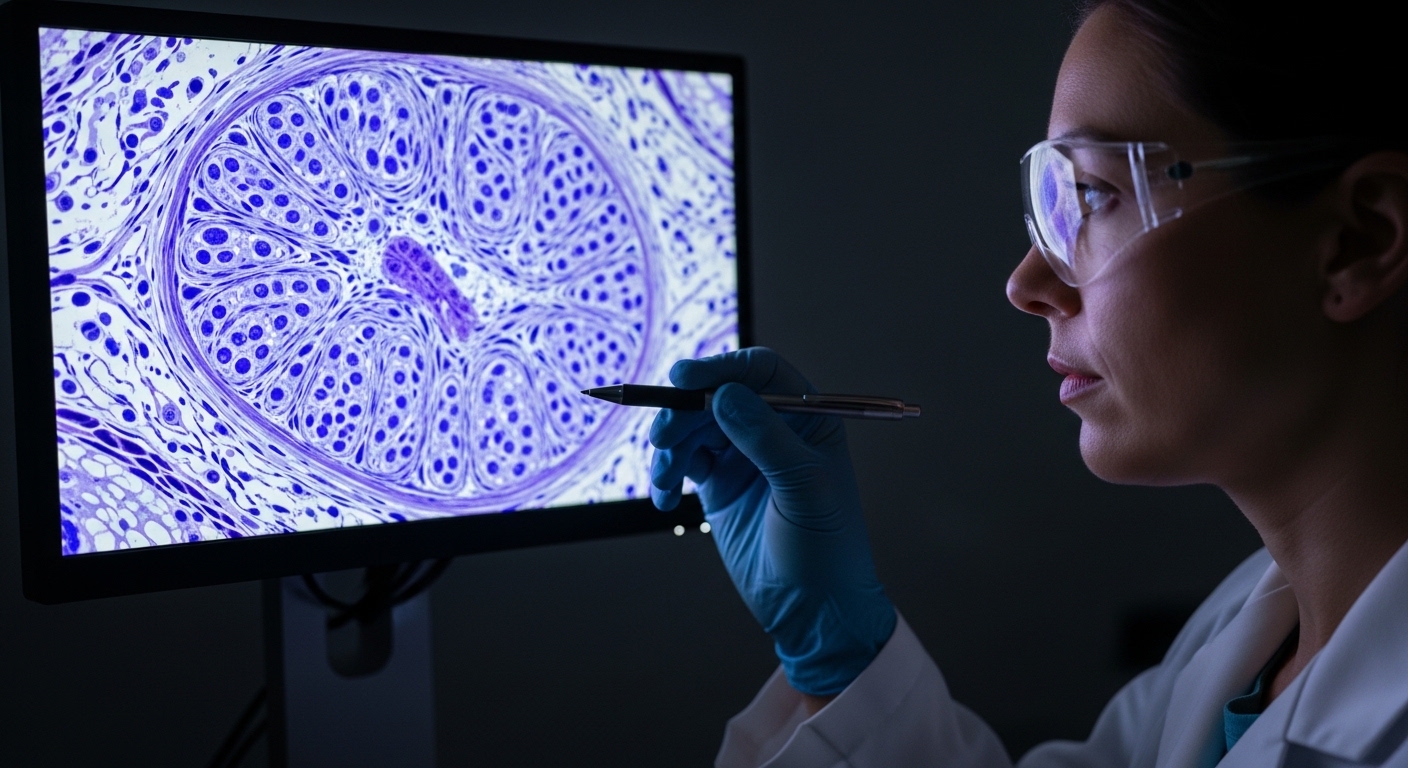
- The study investigated how cerebellar molecular layer interneuron inhibition is suppressed to permit error-driven motor learning.
- Researchers combined connectomics, functional recordings, computational modeling, and behavioral manipulations in mice.
- They found climbing fibers target a specific molecular layer interneuron subtype, creating serial disinhibition that enables plasticity.
- The authors concluded that population synchrony of climbing fibers selectively enables Purkinje cell plasticity via disinhibitory networks.
- This mechanism reveals how the cerebellum precisely controls when and how motor learning and adaptation occur.
Cerebellar Circuitry: Gating Motor Learning and Adaptation
The cerebellum's role in fine-tuning movement is well established, with its capacity for synaptic plasticity considered a cornerstone of motor learning [1, 2, 3]. This process allows the brain to adapt movements based on error signals, a function critical for daily activities and for recovery after neurological injury [4]. However, a central question has persisted: how does the cerebellum distinguish a genuine, instructive error signal from the constant background of neural activity to enable learning at the right moment? Recent work has pointed toward the importance of specific circuit interactions, such as disinhibitory mechanisms that support plasticity [5, 6]. A new study provides a detailed answer, delineating a specific microcircuit that acts as a gate, ensuring the cerebellum learns only when it is supposed to. This mechanism has implications for a range of conditions involving cerebellar dysfunction, from ataxias to autism spectrum disorders [2, 7].
The Cerebellum's Intricate Learning Mechanism
Motor learning depends on instructive signals that trigger adaptive changes in neural circuits following an error. In the cerebellum, climbing fibers (CFs) convey these signals to Purkinje cells (PCs). A physiological puzzle, however, is that CFs fire continuously, even without errors. To prevent this constant input from causing chaotic and maladaptive changes, the activity of molecular layer interneurons (MLIs) provides a steady inhibitory brake on the PCs. This background inhibition is essential for stability, but it raises the question of how the circuit overrides this brake to permit learning when a true error occurs. To answer this, a recent investigation in a mouse model used a multi-modal strategy to deconstruct the system. The researchers combined connectomics, which involves creating detailed maps of neural connections at the synaptic level; functional recordings to measure the activity of specific neurons in real time; computational modeling to simulate and test hypotheses about network behavior; and behavioral manipulations to assess how circuit changes affect motor learning in the whole animal.
Unveiling a Serial Disinhibitory Pathway
The investigation revealed a sophisticated circuit architecture that governs Purkinje cell (PC) activity. A primary discovery was that climbing fibers (CFs) form synapses not only with Purkinje cells but also with a specific subtype of molecular layer interneuron (MLI). This finding expands the known influence of CFs within the cerebellar cortex. The researchers then determined the precise function of this MLI subtype: it selectively inhibits other MLIs, specifically the ones that directly inhibit PCs. This wiring diagram creates a pathway of serial disinhibition, a two-step process where an inhibitory neuron is used to silence another inhibitory neuron, ultimately releasing the final target cell from its inhibitory brake. The study also found that these specific disinhibitory MLIs receive and integrate inputs from multiple, distinct climbing fibers. This anatomical convergence is functionally significant, as it means the disinhibitory MLIs are more strongly activated when multiple CFs fire at the same time, a signal that represents a salient motor error.
Synchrony-Dependent Gating of Plasticity
The functional consequence of this serial disinhibitory circuit is a highly selective gating mechanism. The researchers demonstrated that the stronger disinhibitory drive, which occurs only during synchronous climbing fiber (CF) firing, permits larger CF-evoked calcium responses within the Purkinje cells (PCs). This elevation in intracellular calcium is a well-known trigger for the long-term synaptic changes that underlie motor learning. To confirm that this circuit is not merely correlated with but essential for learning, the team performed a crucial experiment. They found that selective disruption of the inhibition between molecular layer interneurons (MLI-to-MLI) prevents CF-instructed motor learning. This result provides direct evidence for the necessity of this disinhibitory pathway for motor adaptation. The findings show that population synchrony selectively enables CF-driven plasticity through these disinhibitory network interactions. Therefore, the instructive signal for learning is not the firing of a single CF, but rather a product of circuit-level processing that interprets the synchrony of the CF population as a high-priority error message.
Clinical Implications: How the Cerebellum 'Decides' to Learn
This study's integration of connectomics (neural mapping), physiology, and behavioral analysis provides a clear mechanical explanation for how the cerebellum 'decides' when to learn. For the practicing physician, this refined model of cerebellar function offers a new lens through which to view motor disorders. The core finding is that synchronized climbing-fiber error signals lift an inhibitory signal gate on Purkinje cells, opening a brief window for adaptation. When multiple CFs fire together, signaling a significant mismatch between intended and actual movement, they activate the disinhibitory circuit. This action overcomes the baseline inhibition that normally stabilizes Purkinje cells, thereby enabling the synaptic plasticity and motor adaptation required to correct the error. This detailed mechanism, where learning is gated by signal synchrony, provides a more specific framework for investigating cerebellar pathologies. Conditions characterized by ataxia or impaired motor learning could involve dysfunction at any point in this disinhibitory pathway, suggesting that future diagnostic and therapeutic strategies might focus on the specific circuit elements that regulate this critical learning gate.
References
1. Ito M. Cerebellar Long-Term Depression: Characterization, Signal Transduction, and Functional Roles. Physiological Reviews. 2001. doi:10.1152/physrev.2001.81.3.1143
2. Mitoma H, Buffo A, Gelfo F, et al. Consensus Paper. Cerebellar Reserve: From Cerebellar Physiology to Cerebellar Disorders. The Cerebellum. 2019. doi:10.1007/s12311-019-01091-9
3. Caligiore D, Pezzulo G, Baldassarre G, et al. Consensus Paper: Towards a Systems-Level View of Cerebellar Function: the Interplay Between Cerebellum, Basal Ganglia, and Cortex. The Cerebellum. 2016. doi:10.1007/s12311-016-0763-3
4. Voss V. Plasticity of brain networks in a randomized intervention trial of exercise training in older adults. Frontiers in Aging Neuroscience. 2010. doi:10.3389/fnagi.2010.00032
5. Geminiani A, Casellato C, Boele H, Pedrocchi A, Zeeuw CID, D'Angelo E. Mesoscale simulations predict the role of synergistic cerebellar plasticity during classical eyeblink conditioning.. PLoS computational biology. 2024. doi:10.1371/journal.pcbi.1011277
6. Park C, Gim J, Bahn S, et al. A cerebellar disinhibitory circuit supports synaptic plasticity. bioRxiv. 2023. doi:10.1101/2023.09.15.557147
7. Miterko LN, Baker KB, Beckinghausen J, et al. Consensus Paper: Experimental Neurostimulation of the Cerebellum. The Cerebellum. 2019. doi:10.1007/s12311-019-01041-5