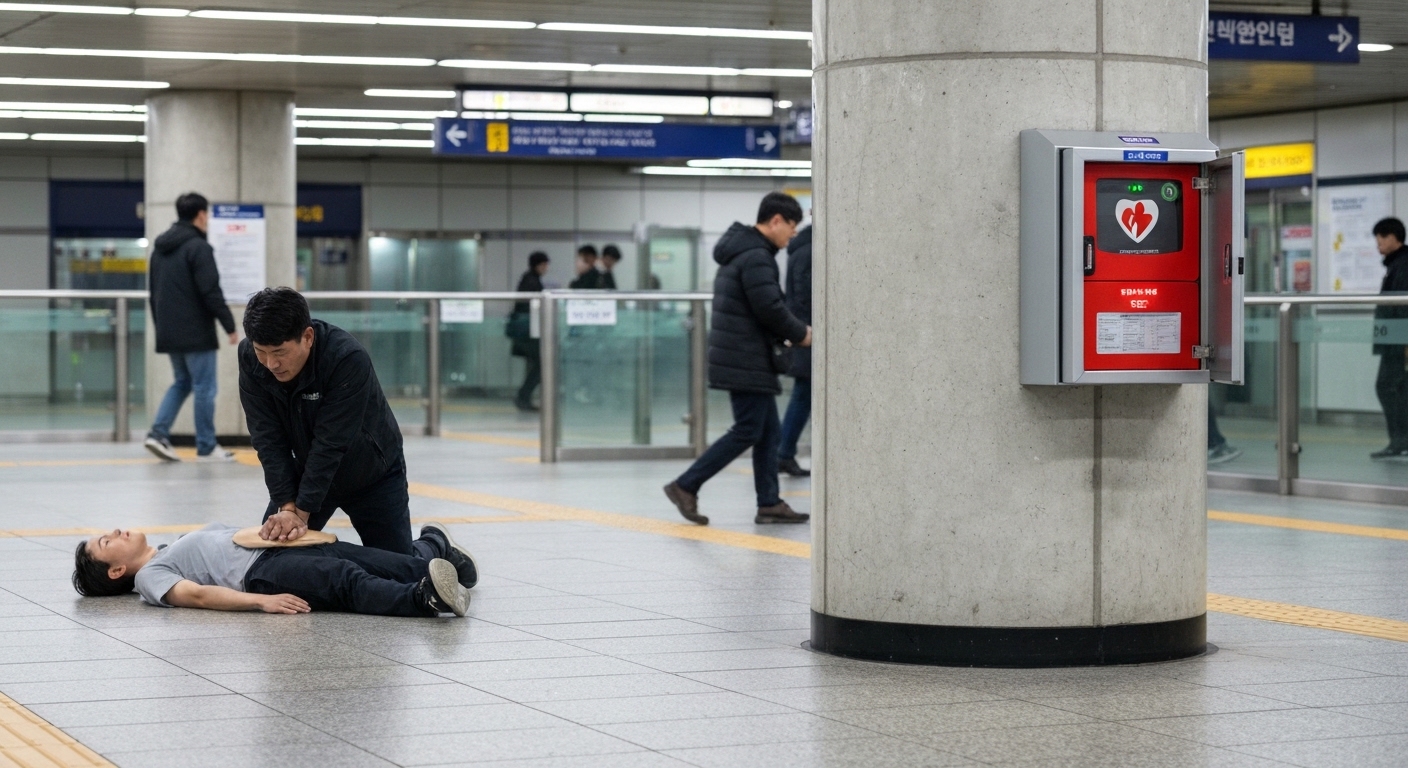
For Doctors in a Hurry
- Researchers investigated how community basic life support training and automated external defibrillator availability influence bystander intervention during cardiac arrest.
- The study analyzed 6,280 witnessed out-of-hospital cardiac arrest cases across 25 administrative districts in Seoul between 2017 and 2021.
- Communities with the highest training rates showed 56% higher odds of bystander cardiopulmonary resuscitation (adjusted odds ratio 1.56, 95% confidence interval 1.14-2.14).
- The authors concluded that higher training rates increase bystander cardiopulmonary resuscitation, but neither training nor device coverage improved automated external defibrillator use.
- Clinicians should prioritize community training programs to improve resuscitation rates, as device availability alone does not ensure bystander utilization.
Out-of-hospital cardiac arrest remains a primary driver of global mortality, with survival outcomes tied directly to the speed of bystander intervention [1]. Although the clinical benefits of immediate cardiopulmonary resuscitation and rapid defibrillation are well-documented, real-world rates of bystander action remain low in many urban environments [2]. Even in developed healthcare systems, automated external defibrillators are applied by laypeople in fewer than 4% of cases, representing a significant missed opportunity for early rhythm correction [3]. Multiple factors influence this reluctance, including a lack of self-efficacy among bystanders and persistent fears regarding legal liability or accidental injury [4]. A new study now evaluates how the saturation of community training and the physical proximity of devices impact these life-saving interventions.
Quantifying Training and Device Accessibility
The researchers conducted a retrospective analysis of 6,280 witnessed out-of-hospital cardiac arrest cases that occurred in Seoul, South Korea, between 2017 and 2021. To evaluate the impact of local resources on emergency response, the study defined communities as the 25 administrative districts of Seoul, a geographic framework that allowed the authors to correlate specific neighborhood characteristics with the likelihood of bystander intervention. Community basic life support training rates were estimated using nationally representative survey data that tracked residents who had received CPR training within the previous two years. This metric served as a proxy for the density of trained laypeople available to respond to a cardiac event, providing a measure of the "educational dose" delivered to a specific population. To quantify the physical accessibility of life-saving equipment, the researchers defined automated external defibrillator (AED) coverage as the proportion of a district's total area located within 100 meters of an AED. This specific distance reflects the critical window for retrieving a device during a resuscitation attempt, as the probability of survival declines by approximately 7% to 10% for every minute defibrillation is delayed. The study then employed distinct statistical models to account for the varying frequencies of bystander actions. A mixed-effects logistic regression (a statistical model that accounts for both fixed factors, such as training rates, and random variations across different districts) was used to evaluate associations with bystander CPR, which occurred in 67.0% of cases. Because bystander AED use was extremely rare, occurring in only 0.7% of the total cases, the researchers utilized Firth's penalized logistic regression, a specialized statistical method used to reduce bias and provide reliable estimates in models where the outcome event is infrequent. Beyond assessing training and device proximity as independent variables, the authors examined the interaction between basic life support training rates and AED coverage specifically for bystander AED use. This analysis was designed to determine if the presence of more trained individuals in a community would amplify the utility of available devices, testing the hypothesis that education and hardware must coexist to change clinical outcomes.
Training Saturation Drives Chest Compressions
The analysis of 6,280 witnessed out-of-hospital cardiac arrest cases revealed a stark contrast between the initiation of chest compressions and the application of defibrillation technology. The researchers found that 67.0% of the patients (4,207 out of 6,280) received bystander cardiopulmonary resuscitation without the use of an automated external defibrillator. This high rate of manual intervention suggests that while the public is increasingly prepared to perform basic life support, there remains a significant barrier to integrating medical devices into the immediate response chain. For the practicing clinician, these figures underscore that the majority of patients arriving via emergency services after a witnessed arrest have received some form of circulatory support, yet almost none have benefited from early defibrillation in the field, which is the only definitive treatment for ventricular fibrillation. The study further quantified how the density of trained individuals within a community influences the likelihood of intervention. When the 25 administrative districts were categorized by their basic life support training saturation, a clear gradient emerged. The lowest quartile of community training rates ranged from 19.0% to 25.8%, representing areas with the least educational penetration. In contrast, the highest quartile of community basic life support training rates ranged from 31.4% to 37.5%. This difference in community education levels translated directly into clinical action. Patients who suffered a cardiac arrest in the highest training quartile districts had 56% higher odds of receiving bystander cardiopulmonary resuscitation compared to those in the lowest quartile districts (adjusted odds ratio: 1.56, 95% CI=1.14-2.14). These data indicate that reaching a community training threshold of approximately one third of the population can significantly improve the chances of a patient receiving immediate chest compressions before professional medical help arrives, potentially serving as a target metric for public health officials.
The Failure of Device Utilization
The researchers focused on two primary outcomes to measure the effectiveness of community response: bystander cardiopulmonary resuscitation (CPR) and bystander automated external defibrillator (AED) use. While the initiation of chest compressions showed a positive correlation with training saturation, the data revealed a profound deficit in device utilization. Only 0.7% of the 6,280 witnessed out-of-hospital cardiac arrest cases (47 out of 6,280) received bystander CPR combined with AED use. This statistic highlights a critical failure in the transition from manual chest compressions to the application of life-saving technology, even in a metropolitan setting like Seoul. For the practicing clinician, these figures indicate that the current public health emphasis on basic life support training is successfully translating into manual intervention but is failing to bridge the gap to defibrillation in the field. The study investigated whether community-level factors influenced these low rates of device deployment. Surprisingly, the researchers found that community basic life support training rates were not associated with bystander AED use. Even in districts with the highest educational penetration, the likelihood of a bystander retrieving and applying a defibrillator did not increase. Furthermore, AED coverage, defined as the geographic density or the proportion of a district area within 100 meters of a device, was not associated with bystander AED use. These findings suggest that simply increasing the number of trained individuals or the physical availability of devices is insufficient to change bystander behavior regarding defibrillation. To ensure statistical rigor given the rarity of device deployment, the authors utilized Firth's penalized logistic regression, a statistical method used to provide reliable estimates in datasets with very few outcome events. The analysis showed that no significant interaction was observed between community training rates and AED coverage regarding bystander AED use. This lack of interaction means that even in areas where high device density coincided with a highly trained population, there was no combined effect that improved the odds of a patient being defibrillated. For physicians managing post-arrest care, these results suggest that the barriers to AED use are likely psychological or procedural rather than a simple lack of equipment or general knowledge, necessitating a reevaluation of how bystander response protocols are taught and implemented.
References
1. Yan S, Gan Y, Jiang N, et al. The global survival rate among adult out-of-hospital cardiac arrest patients who received cardiopulmonary resuscitation: a systematic review and meta-analysis. Critical Care. 2020. doi:10.1186/s13054-020-2773-2
2. Elhussain MO, Ahmed FK, Mustafa NM, et al. The Role of Automated External Defibrillator Use in the Out-of-Hospital Cardiac Arrest Survival Rate and Outcome: A Systematic Review.. Cureus. 2023. doi:10.7759/cureus.47721
3. Scquizzato T, Gamberini L, D’Arrigo S, et al. Incidence, characteristics, and outcome of out-of-hospital cardiac arrest in Italy: A systematic review and meta-analysis. Resuscitation Plus. 2022. doi:10.1016/j.resplu.2022.100329
4. Daud A, Nawi AM, Aizuddin AN, Yahya MF. Factors and Barriers on Cardiopulmonary Resuscitation and Automated External Defibrillator Willingness to Use among the Community: A 2016-2021 Systematic Review and Data Synthesis.. Global heart. 2023. doi:10.5334/gh.1255