For Doctors in a Hurry
- Researchers investigated whether repetitive transcranial magnetic stimulation effectively treats burdensome neurogenic overactive bladder symptoms in 60 stroke survivors.
- This randomized, assessor-blinded, sham-controlled trial assigned participants to receive either active or sham brain stimulation thrice weekly for four weeks.
- Active treatment significantly improved symptom scores by 1.81 points (95% confidence interval 1.42 to 2.20, p less than 0.001) versus sham.
- The researchers concluded that this intervention is clinically effective and cost-saving, yielding higher quality-adjusted life years than sham procedures.
- Clinicians may consider this non-invasive therapy for post-stroke bladder dysfunction, although larger trials with active comparators are still required.
Addressing the Burden of Post-Stroke Urinary Dysfunction
Neurogenic overactive bladder represents a prevalent and incapacitating pelvic floor disorder among patients recovering from upper motor neuron syndromes [1]. In stroke survivors, this condition frequently manifests as distressing urinary urgency and incontinence, significantly hindering functional independence and overall quality of life [2]. While traditional management relies on pharmacological interventions or invasive procedures, these approaches frequently yield inconsistent results or carry burdensome side effects [3]. Recent advances in neuromodulation have explored the use of magnetic fields to influence the neural circuitry governing the micturition cycle [4, 5]. A newly published randomized controlled trial provides rigorous data on the clinical efficacy and economic viability of using repetitive transcranial magnetic stimulation, a non-invasive method of cortical stimulation, to manage these refractory urinary symptoms.
Targeted Neuromodulation Protocol and Patient Demographics
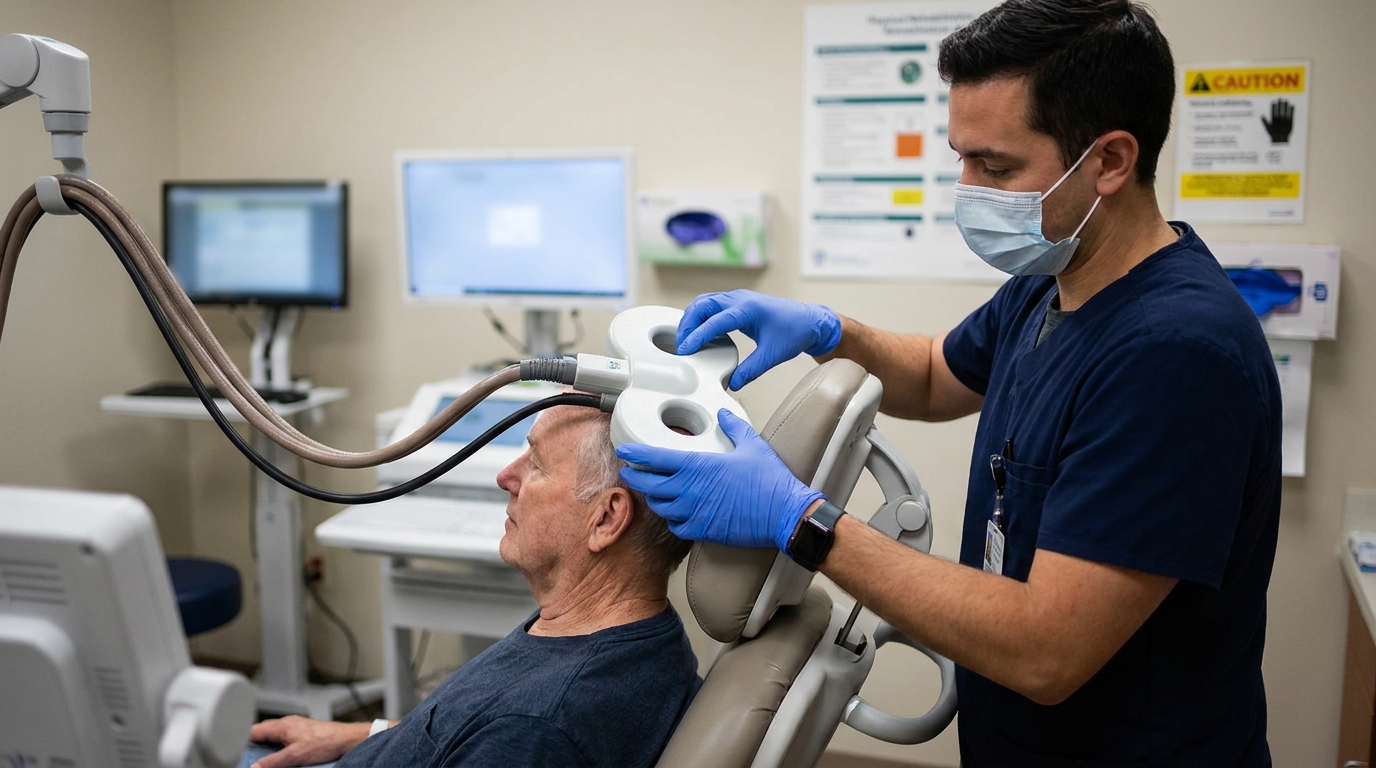
The researchers conducted a randomized, assessor-blinded, sham-controlled trial to evaluate the impact of low-frequency repetitive transcranial magnetic stimulation (rTMS) on urinary dysfunction. Registered in the federal clinical trials database under the reference number NCT05557175, the study enrolled 60 stroke survivors diagnosed with neurogenic overactive bladder. This rigorous design ensured that the clinicians evaluating the outcomes remained unaware of the treatment assignments, reducing potential bias in the assessment of subjective urinary symptoms and quality of life metrics. The intervention specifically targeted the contralateral primary motor cortex, a brain region critical for the neural regulation of the micturition cycle. Participants in the active group received 1200 pulses at an intensity of 80% of the resting motor threshold (RMT). The RMT is the minimum magnetic field strength required to elicit a visible muscle twitch, serving as a personalized baseline to calibrate the stimulation dosage. Conversely, the sham group received stimulation at a sub-therapeutic level of 20% RMT. Both cohorts underwent these sessions thrice weekly for a duration of 4 weeks, providing a consistent schedule to measure the cumulative effects of cortical stimulation. The study population was divided into two balanced cohorts of 30 patients each. The active rTMS group (n = 30) had a mean age of 62.1 ± 9.5 years and was 60% male. The sham group (n = 30) presented similar characteristics, with a mean age of 61.7 ± 8.3 years and a 47% male distribution. These demographic profiles reflect the typical age range and sex distribution of stroke survivors seen in clinical practice, ensuring that the findings regarding treatment tolerability and symptom relief are directly relevant to the broader population of patients managing post-stroke neurogenic overactive bladder.
Sustained Clinical Improvements in Urinary Function
The researchers evaluated the clinical impact of the intervention using three primary metrics. They utilized the Overactive Bladder Symptom Score (OABSS) to quantify urinary frequency and urgency, the Incontinence Quality of Life (I-QOL) scale to assess the psychosocial impact of bladder dysfunction, and the Brief Resilience Scale (BRS) to measure an individual's ability to recover from illness or adversity. These measurements were recorded at baseline, week 4, and week 8, allowing the authors to track both immediate post-treatment effects and the durability of the intervention over a follow-up period. Analysis of the primary outcomes showed that active rTMS significantly improved OABSS compared to the sham group, with a mean difference of 1.81 points (95% CI [1.42 to 2.20], P < .001). This reduction in symptom severity was accompanied by a substantial increase in patient well-being, as the active rTMS group demonstrated a significant improvement in I-QOL scores with a mean difference of 17.48 points (95% CI [14.18 to 20.79], P < .001). Notably, these improvements in OABSS and I-QOL were sustained at both the week 4 and week 8 assessments, suggesting that the four-week stimulation protocol induces lasting changes in the neural pathways governing bladder control. Beyond physical symptoms, the study also identified positive shifts in the psychological state of the participants. The active rTMS group showed a significant improvement in BRS scores compared to the sham cohort, yielding a mean difference of 0.25 points (95% CI [0.09 to 0.41], P = .002). This improvement in resilience was also maintained through the week 8 follow-up, indicating that the reduction in urinary symptoms may contribute to a broader recovery of psychological coping mechanisms in stroke survivors. For the practicing clinician, these data suggest that cortical stimulation provides a multi-dimensional benefit, addressing both the physiological urgency of neurogenic overactive bladder and the secondary impact on patient quality of life.
Economic Viability and Patient Acceptability
The researchers conducted a cost-utility analysis to determine the economic impact of the intervention, utilizing societal costs and quality-adjusted life years (QALYs). In this context, QALYs serve as a standardized metric that quantifies the burden of disease by weighing the duration of life against its quality, where a score of one represents a year of perfect health. The analysis demonstrated that active rTMS was associated with lower societal costs of HK$1267.3, whereas the sham group incurred higher costs of HK$1839.0. Furthermore, the active rTMS group achieved higher QALYs at 0.691 compared to 0.571 in the sham cohort. These findings suggest that the intervention not only improves clinical outcomes but also reduces the overall economic burden associated with post-stroke urinary care, potentially through reduced reliance on secondary health services or incontinence supplies. Beyond the quantitative metrics, the study explored the patient experience through focus groups involving 12 participants from the active treatment arm. This qualitative assessment provided insight into the practical implementation of the protocol from the survivor's perspective. The qualitative data indicated excellent tolerability, symptom relief, and high levels of acceptability among the participants. For clinicians, these results provide evidence that low-frequency cortical stimulation is a feasible and well-received addition to the rehabilitative regimen. It offers a cost-effective alternative to traditional pharmacological or behavioral management strategies for neurogenic overactive bladder, raising the prospect that future stroke recovery programs could routinely incorporate targeted neuromodulation to improve both functional independence and healthcare resource utilization.
References
1. Manaila AI, Roman N, Baseanu ICC, et al. The Efficiency of Rehabilitation Therapy in Patients Diagnosed with Neurogenic Bladder: A Systematic Review. Medicina. 2024. doi:10.3390/medicina60071152
2. Jiang W, Tang W, Song Y, et al. Effectiveness of repetitive transcranial magnetic stimulation against poststroke urinary incontinence: a study protocol for a randomized controlled trial. Trials. 2022. doi:10.1186/s13063-022-06535-y
3. Ali MU, Kwan C, Fong KN, Kranz GS, Winser SJ, Kannan P. Evaluating repetitive transcranial magnetic stimulation for neurogenic overactive bladder management in stroke survivors: A randomized sham-controlled trial protocol.. European journal of obstetrics, gynecology, and reproductive biology. 2024. doi:10.1016/j.ejogrb.2024.07.034
4. Salazar B, Hoffman KA, Lincoln JA, et al. Evaluating noninvasive brain stimulation to treat overactive bladder in individuals with multiple sclerosis: a randomized controlled trial protocol. BMC Urology. 2024. doi:10.1186/s12894-023-01358-8
5. Müller C, Kaufmann A. The Neuroanatomical Correlates of Bladder Filling: An Activation Likelihood Estimation Meta-Analysis of Functional Neuroimaging Studies. Neurology International. 2025. doi:10.3390/neurolint17100156