
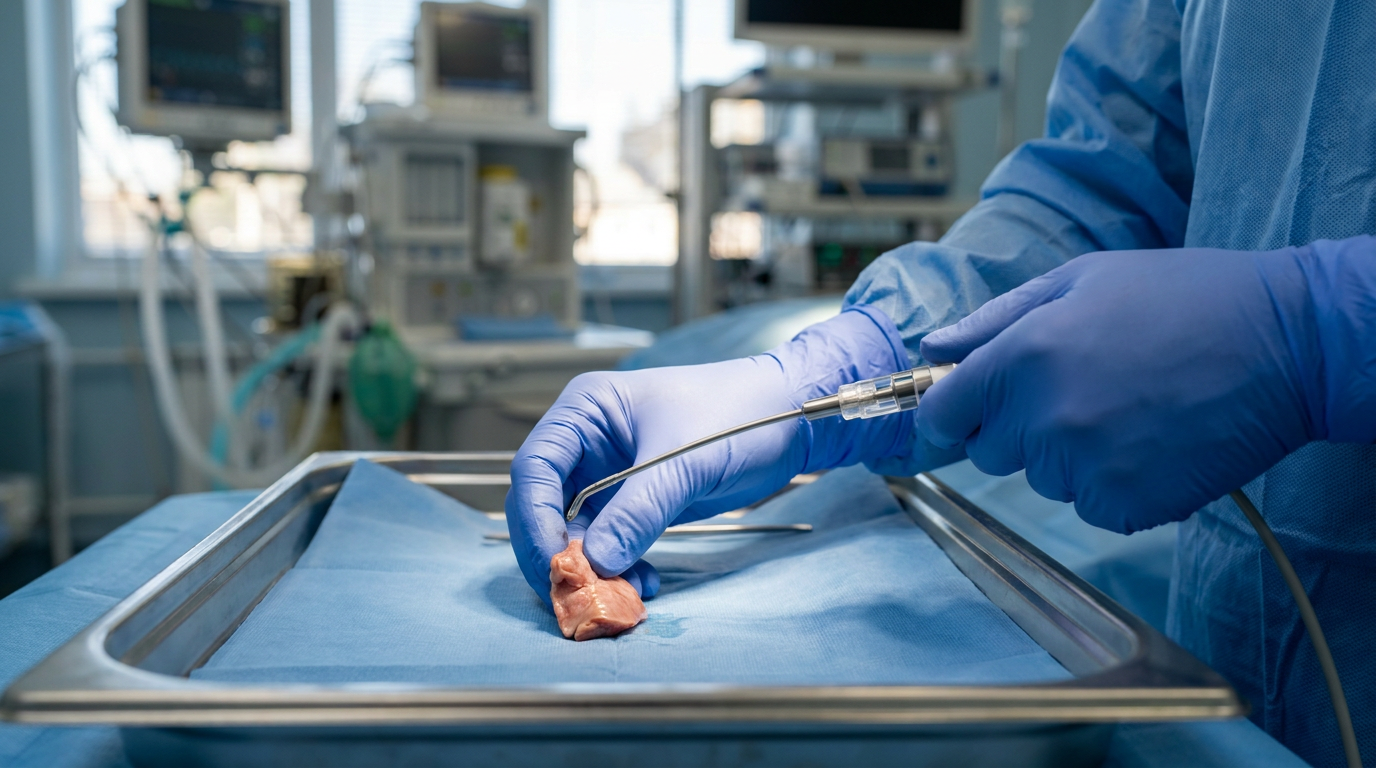
- The study addressed whether a 1.1-mm cryoprobe improves diagnostic yield over conventional forceps for transbronchial biopsy.
- This multicenter randomized clinical trial included 500 patients undergoing transbronchial biopsy for various lung conditions.
- The cryoprobe group achieved a significantly higher diagnostic yield of 88.6% versus 78.8% for forceps (absolute difference, 9.8%; P = .003).
- The authors concluded that the 1.1-mm cryoprobe provides a superior diagnostic yield compared to 2.0-mm forceps.
- This suggests that cryoprobe transbronchial biopsy may enhance diagnostic accuracy for lung nodules, masses, and transplant patients.
Optimizing Transbronchial Biopsy for Lung Disease Diagnosis
Obtaining adequate tissue is crucial for diagnosing pulmonary conditions ranging from lung nodules to diffuse parenchymal lung diseases (DPLD) and post-transplant complications [1, 2, 3]. Conventional transbronchial biopsy with forceps is often limited by small specimen size and crush artifact, which can impede histologic interpretation and lower diagnostic yield [4, 5, 6]. Cryoprobes, which use localized freezing to adhere to and extract larger, more intact tissue samples, have been developed to address these shortcomings [7]. While prior analyses suggested a benefit, particularly in DPLD, a large-scale, prospective, randomized trial comparing cryoprobes directly to forceps across a range of common indications was needed to guide clinical practice [5, 8, 9]. The FROSTBITE-2 trial, a multicenter randomized clinical trial, was designed to fill this evidence gap by directly comparing a 1.1-mm cryoprobe with standard 2.0-mm forceps in 500 patients [10].
Cryoprobe vs. Forceps: Addressing Specimen Quality
The fundamental difference between the two biopsy techniques lies in their mechanism of tissue acquisition. Standard forceps rely on a cutting and tearing action, which can compress and damage delicate lung parenchyma, leading to the crush artifact that complicates pathologic assessment. This mechanical disruption often results in smaller, fragmented specimens that may not be sufficient for a definitive diagnosis. In contrast, the cryoprobe operates on a principle of cryo-adhesion. The probe's tip is cooled rapidly, causing it to freeze to the adjacent tissue. When the probe is withdrawn, it brings with it a larger, structurally intact sample that has not been mechanically compressed. The central hypothesis of this study was that this superior specimen integrity would translate into a higher rate of definitive diagnoses, or diagnostic yield, when compared directly with conventional forceps.
Trial Design and Patient Cohort
To rigorously test this hypothesis, investigators conducted an open-label, outcome assessor–masked, multicenter randomized clinical trial across nine US medical centers. This design, where pathologists were unaware of the biopsy method, is critical for preventing bias in the assessment of the primary outcome. Enrollment occurred between February 2023 and September 2024. The study included 500 patients aged 18 or older requiring transbronchial biopsy for suspected lung nodules or masses, lung transplant surveillance, or diffuse parenchymal lung disease. Participants were randomized 1:1 to undergo biopsy with either a 1.1-mm cryoprobe (n = 250) or standard 2.0-mm forceps (n = 250). After screening 774 individuals and obtaining consent from 609, a final cohort of 490 patients was included in the primary analysis. The cohort had a mean age of 62.6 years and was evenly split by sex (50.4% male). The primary outcome was diagnostic yield, defined as the ability to establish a specific histologic diagnosis.
Cryoprobe Demonstrates Superior Diagnostic Yield
The trial met its primary endpoint, showing a clear advantage for the cryoprobe technique. The diagnostic yield was significantly higher in the cryoprobe group, with a specific diagnosis achieved in 217 of 245 patients (88.6%), compared to 193 of 245 patients (78.8%) in the forceps group. This corresponds to an absolute difference of 9.8% (95% CI, 3.3% to 16.3%; P = .003). For clinicians, this nearly 10-point increase in diagnostic success is a meaningful improvement. Achieving a definitive diagnosis in the initial procedure can prevent the clinical uncertainty, patient anxiety, and additional risks and costs associated with repeat bronchoscopies or more invasive surgical biopsies. The data suggest that for every 10 patients biopsied with a cryoprobe instead of forceps, one additional patient will receive a conclusive diagnosis.
Condition-Specific Diagnostic Performance
A deeper analysis of the data revealed that the cryoprobe's benefit was most pronounced in specific clinical scenarios. For patients with pulmonary nodules or masses, a common and often urgent diagnostic challenge, the cryoprobe's diagnostic yield was 83.2% (79 of 95) versus 70.1% (68 of 97) for forceps, an absolute difference of 13.1% (95% CI, 1.0% to 24.6%; P = .04). A significant advantage was also observed in the lung transplant population, where surveillance biopsies are routine. The cryoprobe achieved a 96.0% yield (120 of 125) compared to 88.7% for forceps (110 of 124), an absolute difference of 7.3% (95% CI, 0.6% to 14.4%; P = .03). In contrast, for patients with diffuse parenchymal lung disease, the difference in yield was not statistically significant, with the cryoprobe at 72.0% (18 of 25) and forceps at 62.5% (15 of 24) (P = .55). The wide confidence interval for this subgroup (−16.0% to 33.6%) and the small sample size may have limited the power to detect a true difference in this specific population.
Safety Profile of Cryoprobe vs. Forceps
An evaluation of procedural safety is essential when considering the adoption of a new technique. The secondary safety analysis provided a reassuring profile for the 1.1-mm cryoprobe. The most notable difference in complications was the rate of pneumothorax requiring intervention. Four patients in the forceps group (1.6%) developed a pneumothorax that required chest tube placement, whereas no patients in the cryoprobe group had this complication. This finding is clinically significant, as iatrogenic pneumothorax can lead to prolonged hospitalization and patient morbidity. Furthermore, the study reported no instances of significant bleeding or respiratory failure in either group. This favorable safety profile, particularly the absence of pneumothoraces requiring chest tube placement, complements the cryoprobe's superior diagnostic efficacy.
Clinical Implications for Transbronchial Biopsy
The results of this large, multicenter randomized trial provide compelling evidence to inform clinical practice. The study demonstrated that transbronchial biopsy with a 1.1-mm cryoprobe provides a significantly higher overall diagnostic yield compared to standard 2.0-mm forceps (88.6% vs 78.8%; P = .003). This benefit was particularly evident in the evaluation of pulmonary nodules or masses and in lung transplant recipients. The ability to secure a definitive diagnosis more often on the first attempt is a critical advantage, potentially reducing the need for subsequent, more invasive procedures. When this increased efficacy is combined with the favorable safety data, specifically the zero incidence of pneumothorax requiring chest tube placement in the cryoprobe arm compared to 1.6% in the forceps arm, a strong case emerges for its preferential use. For practicing pulmonologists and thoracic surgeons, these findings suggest that the 1.1-mm cryoprobe is a more effective and potentially safer tool for transbronchial lung biopsy in the studied populations.
References
1. Korevaar DA, Colella S, Fally M, et al. European Respiratory Society guidelines on transbronchial lung cryobiopsy in the diagnosis of interstitial lung diseases. European Respiratory Journal. 2022. doi:10.1183/13993003.00425-2022
2. Raghu G, Rémy‐Jardin M, Ryerson CJ, et al. Diagnosis of Hypersensitivity Pneumonitis in Adults: An Official ATS/JRS/ALAT Clinical Practice Guideline. American Journal of Respiratory and Critical Care Medicine. 2020. doi:10.1164/rccm.202005-2032st
3. McCarthy C, Bonella F, O’Callaghan M, et al. European Respiratory Society guidelines for the diagnosis and management of pulmonary alveolar proteinosis. European Respiratory Journal. 2024. doi:10.1183/13993003.00725-2024
4. Thiboutot J, Latifi A, Illei P, et al. A randomized controlled trial of cryoprobe versus forceps for transbronchial biopsy (FROSTBITE-2): Study protocol for a multi-center pragmatic clinical trial.. Contemporary clinical trials. 2026. doi:10.1016/j.cct.2026.108251
5. Dhooria S, Sehgal IS, Aggarwal AN, Behera D, Agarwal R. Diagnostic Yield and Safety of Cryoprobe Transbronchial Lung Biopsy in Diffuse Parenchymal Lung Diseases: Systematic Review and Meta-Analysis. Respiratory Care. 2016. doi:10.4187/respcare.04488
6. Thiboutot J, Illei P, Maldonado F, et al. Safety and Feasibility of a Sheath Cryoprobe for Bronchoscopic Transbronchial Biopsy: The FROSTBITE Trial. Respiration. 2022. doi:10.1159/000526876
7. Lentz RJ, Argento AC, Colby TV, Rickman OB, Maldonado F. Transbronchial cryobiopsy for diffuse parenchymal lung disease: a state-of-the-art review of procedural techniques, current evidence, and future challenges. Journal of Thoracic Disease. 2017. doi:10.21037/jtd.2017.06.96
8. Sryma P, Mittal S, Madan NK, et al. Efficacy of Radial Endobronchial Ultrasound (R-EBUS) guided transbronchial cryobiopsy for peripheral pulmonary lesions (PPL’s): A systematic review and meta-analysis. Pulmonology. 2021. doi:10.1016/j.pulmoe.2020.12.006
9. Iftikhar IH, Alghothani L, Sardi A, Berkowitz D, Musani AI. Transbronchial Lung Cryobiopsy and Video-assisted Thoracoscopic Lung Biopsy in the Diagnosis of Diffuse Parenchymal Lung Disease. A Meta-analysis of Diagnostic Test Accuracy. Annals of the American Thoracic Society. 2017. doi:10.1513/annalsats.201701-086sr
10. Thiboutot J, Kapp CM, Illei P, et al. Cryobiopsy vs Forceps for Bronchoscopic Lung Biopsy: The FROSTBITE-2 Randomized Clinical Trial.. JAMA. 2026. doi:10.1001/jama.2026.7908