
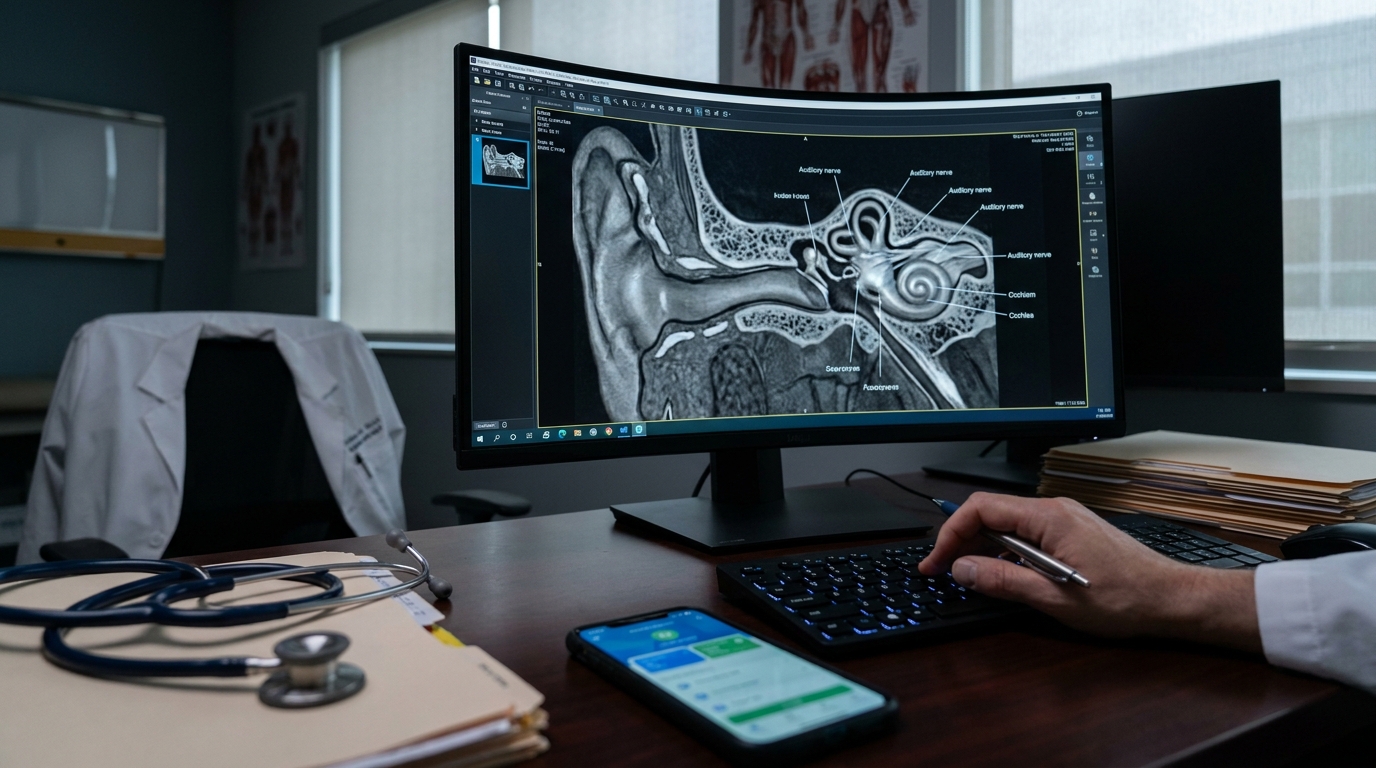
- Clinicians face limited access to cognitive behavioral therapy for chronic tinnitus, necessitating scalable digital interventions to reduce patient distress.
- This double-blind, sham-controlled randomized trial evaluated a therapeutic mobile app in 60 participants with mild to severe chronic tinnitus.
- At 16 weeks, the therapeutic group showed greater improvement in Tinnitus Handicap Inventory scores (between-group difference, -20.4; 95% CI, -28.2 to -12.6).
- The researchers concluded that the digital therapeutic provides substantial and lasting relief from tinnitus-related distress and functional impairment.
- This mobile application may offer a standardized, accessible intervention for managing chronic tinnitus symptoms in primary and specialty care settings.
Digital Interventions for the Management of Chronic Tinnitus
Chronic tinnitus represents a substantial global health burden, contributing significantly to years lived with disability and frequently presenting with comorbid anxiety, depression, and sleep disturbances [1, 2, 3]. While cognitive behavioral therapy (a psychological intervention focused on modifying negative thought patterns and behaviors) is a recognized standard for managing tinnitus-related distress, limited clinical resources and high costs often restrict patient access to these services [4, 5]. Recent shifts toward telerehabilitation and internet-delivered cognitive behavioral therapy have sought to address these barriers by providing scalable, automated alternatives to traditional face-to-face counseling [4, 6, 2]. A randomized clinical trial of 187 participants using a smartphone-based application demonstrated a statistically significant reduction in Tinnitus Questionnaire scores (p<0.001) with a large effect size (Cohen's d = 1.1) compared to a delayed-treatment control group [5]. Furthermore, data from 105 adults suggest that tinnitus-specific chatbots can produce clinically meaningful reductions in distress while simultaneously improving comorbid insomnia and anxiety [2]. For practicing clinicians, these findings indicate that digital interventions may provide a standardized, accessible alternative for patients suffering from persistent tinnitus when traditional counseling is unavailable.
Trial Design and Digital Intervention Parameters
To evaluate the efficacy of a prototype digital therapeutic mobile application, researchers conducted a double-blind, sham-controlled randomized clinical trial between September 2023 and February 2025. The intervention was designed to deliver educational counseling and cognitive behavioral therapy elements, which are psychological strategies aimed at reframing a patient's reaction to tinnitus sounds and reducing associated emotional distress. The study enrolled 60 participants with a median age of 58.5 years (interquartile range, 52.0 to 64.0 years) who were diagnosed with mild to severe chronic tinnitus. These individuals were randomized into two equal groups of 30. The intervention group received the active therapeutic app, while the control group received a sham application that lacked therapeutic functions but provided a similar interface to control for the placebo effect of using a digital tool.
The trial structure consisted of a 16-week treatment phase followed by an 8-week follow-up phase to assess the durability of the clinical response. During the initial 16 weeks, participants in the intervention arm engaged with the app's educational and cognitive behavioral therapy modules. Upon completion of the treatment phase, the study entered an 8-week follow-up period where the therapeutic functions of the app were blocked. During this final stage, only the recording function remained available to the participants, allowing researchers to determine if improvements in tinnitus-related distress and functional impairment would persist after the active intervention had ceased.
Patient Demographics and Clinical Baseline
Chronic tinnitus is a highly prevalent condition with no known cure, often leading to severe impairment in a patient's quality of life. While clinical evidence indicates that patients with chronic tinnitus and comorbid hearing loss show some improvement when treated with cognitive behavioral therapy and hearing aid therapy, the practical application of these interventions is frequently hindered by limited access to specialized providers. To address this gap, researchers recruited a cohort of 60 participants diagnosed with mild to severe chronic tinnitus to evaluate a digital delivery model. This study population was split equally into two cohorts, with 30 participants assigned to the therapeutic app group and 30 participants assigned to the sham-control group.
The study cohort had a median age of 58.5 years, with an interquartile range of 52.0 to 64.0 years, and included 33 female participants, representing 55 percent of the total sample. At the start of the trial, researchers established a clinical baseline using the Tinnitus Handicap Inventory, a validated assessment tool used to quantify the impact of tinnitus on daily life and emotional well-being. The overall mean baseline Tinnitus Handicap Inventory score was 41.3 with a standard deviation of 16.9, reflecting a population with significant baseline distress and functional impairment. These demographic and clinical characteristics provided a standardized foundation for measuring the efficacy of the digital intervention over the subsequent 24 weeks.
Primary and Secondary Clinical Outcomes
The primary outcome of the trial was the change from baseline to week 16 in the Tinnitus Handicap Inventory score, an index used to quantify tinnitus-related distress and functional impairment. At the 16-week mark, the therapeutic app group demonstrated a significantly greater improvement in Tinnitus Handicap Inventory scores compared with the sham-control group. Specifically, the between-group difference in the change of scores was -20.4, with a 95 percent confidence interval ranging from -28.2 to -12.6. For practicing physicians, this reduction indicates a substantial, clinically meaningful improvement in patients receiving cognitive behavioral therapy elements via the mobile application compared to those using the sham version.
Beyond the primary metric, the study tracked several secondary outcomes to provide a broader view of the clinical impact. These measures included the Tinnitus Functional Index (a tool for measuring treatment-related changes in tinnitus burden) and numeric rating scales for both tinnitus loudness and the patient's perceived control over the sound. To assess comorbid psychological and physiological factors, researchers utilized the Hospital Anxiety and Depression Scale and the Athens Insomnia Scale. Furthermore, the Patient Global Impression of Improvement, a scale that allows patients to subjectively rate how much their condition has changed since the start of treatment, was employed to capture the patient's perspective on the intervention's utility. Collectively, these secondary outcomes supported the primary findings, suggesting that the digital therapeutic positively influenced multiple dimensions of the patient experience, from auditory perception to emotional and sleep-related health.
Durability of Effect and Safety Profile
A critical consideration for prescribing digital therapeutics is whether the clinical benefits persist after the active treatment phase concludes. Following the initial 16-week intervention, researchers conducted an 8-week follow-up period during which the therapeutic functions of the app were disabled, leaving only the recording function active. The data indicate that the therapeutic effect was maintained up to week 24, demonstrating that the coping skills acquired through the digital cognitive behavioral therapy provided lasting relief. At this 24-week mark, the mean between-group difference in Tinnitus Handicap Inventory scores remained substantial at -18.3, with a 95 percent confidence interval of -26.4 to -10.1. This sustained improvement suggests that the intervention induces durable changes in how patients process and react to tinnitus, rather than providing only transient symptomatic relief while the app is in active use.
The safety profile of the mobile application was a secondary focus of the trial, particularly regarding the potential for digital interventions to inadvertently increase symptom salience by drawing attention to the condition. Throughout the study, no serious adverse events or device malfunctions with the potential for health hazards were observed, suggesting the tool is safe for independent patient use. While the therapeutic group showed consistent improvement, researchers noted that tinnitus symptoms worsened in one patient within the sham-control app group. Overall, the lack of significant complications or technical failures indicates that this digital therapeutic could serve as a standardized, low-risk intervention for the long-term management of chronic tinnitus distress in everyday clinical practice.
References
1. Ferrari AJ, Santomauro D, Aali A, et al. Global incidence, prevalence, years lived with disability (YLDs), disability-adjusted life-years (DALYs), and healthy life expectancy (HALE) for 371 diseases and injuries in 204 countries and territories and 811 subnational locations, 1990–2021: a systematic analysis for the Global Burden of Disease Study 2021. The Lancet. 2024. doi:10.1016/s0140-6736(24)00757-8
2. Jackson JG, Yeates F, Morris B, Hollands S, Drybrough G. App-based conversational agents for tinnitus distress and mental health: A randomised controlled trial. Internet Interventions. 2026. doi:10.1016/j.invent.2026.100944
3. Trpchevska N, Freidin MB, Broer L, et al. Genome-wide association meta-analysis identifies 48 risk variants and highlights the role of the stria vascularis in hearing loss. The American Journal of Human Genetics. 2022. doi:10.1016/j.ajhg.2022.04.010
4. Demoen S, Kerchove EV, Timmermans A, Rompaey VV, Michiels S, Gilles A. Effectiveness of Telerehabilitation Interventions for Self-Management of Tinnitus: Update of a Systematic Review. Journal of Medical Internet Research. 2026. doi:10.2196/83529
5. Walter U, Pennig S, Kottmann T, Bleckmann L, Röschmann-Doose K, Schlee W. Randomized controlled trial of a smartphone-based cognitive behavioral therapy for chronic tinnitus. PLOS Digital Health. 2023. doi:10.1371/journal.pdig.0000337
6. Haaf R, Schefft C, Krämer R, Klein JP, Köhler S. Working alliance and its link to guidance in an internet-based intervention for depressive disorders: a secondary analysis of a randomized controlled trial. Frontiers in Psychiatry. 2024. doi:10.3389/fpsyt.2024.1448823