
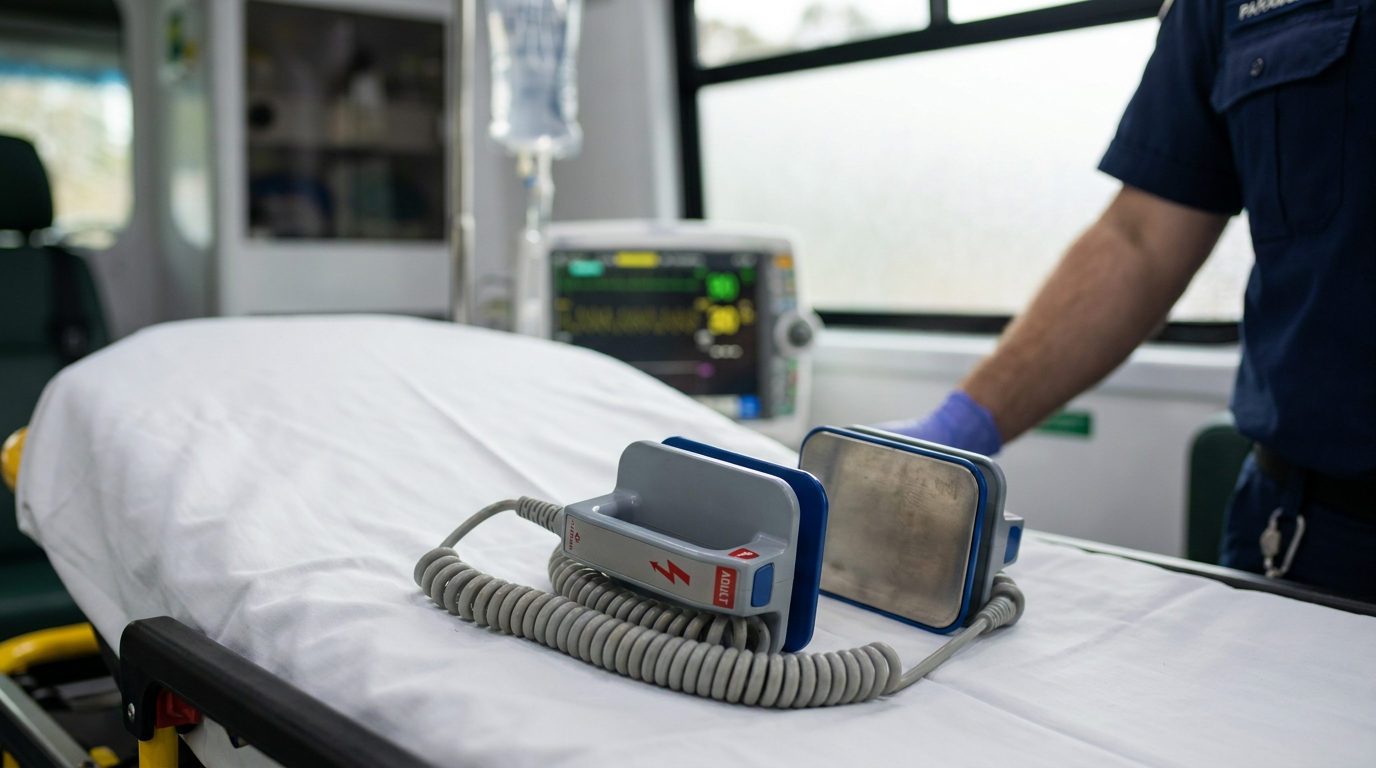
- The clinical question addressed was the usage, adherence to guidelines, and clinical impact of double sequential defibrillation (DSD) for refractory ventricular fibrillation and ventricular tachycardia in Aotearoa New Zealand Emergency Medical Services.
- This retrospective cohort study analyzed 1,401 patients across two 18-month periods, comparing pre- and post-DSD implementation, including subgroups of DSD versus no-DSD patients.
- Adjusted models showed lower odds of return of spontaneous circulation with any-DSD (aOR 0.59, 95%CI 0.41-0.85) and late-DSD (aOR 0.46, 95%CI 0.30-0.71) compared to no-DSD.
- The authors concluded that no survival benefit was observed after DSD implementation, suggesting lower survival among DSD patients may reflect confounding due to its use in patients with the poorest prognosis.
- Further research is needed to clarify the optimal timing and specific drivers of double sequential defibrillation use in refractory cardiac arrest.
Navigating Refractory Ventricular Fibrillation: The Evolving Role of Advanced Defibrillation
Out-of-hospital cardiac arrest (OHCA) from ventricular fibrillation (VF) or pulseless ventricular tachycardia (VT) remains a formidable clinical challenge, particularly when the arrhythmia becomes refractory to initial defibrillation attempts [1, 2]. Even with high-quality cardiopulmonary resuscitation, a significant number of patients persist in VF, which has driven the search for alternative electrical strategies [3]. Interventions such as double sequential external defibrillation (DSED), which uses two defibrillators to deliver near-simultaneous shocks, and vector-change (VC) defibrillation, which alters pad placement to change the electrical pathway, have been investigated for these cases [4, 3]. While some randomized trials have suggested a survival benefit with these advanced techniques [5, 6], other systematic reviews have not found a consistent advantage [7, 2]. This ongoing debate highlights a critical need for real-world data to clarify the role and proper application of these strategies in clinical practice.
Real-World Implementation of Double Sequential Defibrillation in Aotearoa New Zealand
The introduction of double sequential defibrillation (DSD) by Aotearoa New Zealand Emergency Medical Services (EMS) in October 2023 represented a policy change for managing refractory VF and VT. This adoption, however, raised immediate clinical questions: How frequently would paramedics use DSD, how closely would they adhere to protocols, and what would be the ultimate impact on patient survival? To investigate these uncertainties, researchers conducted a retrospective cohort study comparing a period before DSD implementation with a period after. The study was designed to analyze patient characteristics and survival outcomes, with a specific focus on comparing patients who received DSD to those who did not (NDSD) after its introduction. Furthermore, the authors sought to determine if the timing of the intervention, whether early or late in the resuscitation, influenced its effect on prognosis.
Study Design and Patient Cohort
This retrospective cohort study analyzed patient data across two 18-month intervals. The pre-period, from April 2022 to September 2023, established a baseline before DSD was available. The post-period, from January 2024 to June 2025, captured data following its implementation. The study focused specifically on the most difficult cases by including all cardiac arrest patients who required more than three prehospital defibrillation shocks. Within the post-period cohort, patients were stratified into those who received DSD and those who did not (NDSD). The DSD group was further subdivided by timing: early-DSD was defined as intervention after three or fewer standard shocks, while late-DSD was defined as intervention after more than three shocks. To analyze the data, the researchers used Chi-Square and Mann-Whitney U tests to compare baseline group characteristics and applied logistic regression, a statistical method for assessing the relationship between an intervention and a binary outcome, to evaluate the association between DSD and survival. The final analysis included a robust cohort of 1,401 patients, with 663 in the pre-period and 738 in the post-period.
Clinical Outcomes: No Overall Survival Improvement
The primary population-level comparison yielded a null result. The study found no statistically significant difference in either return of spontaneous circulation (ROSC) or 30-day survival when comparing the entire pre-DSD implementation period to the post-DSD period (p>0.05). This top-line finding suggests that the system-wide introduction of the DSD protocol did not, by itself, improve outcomes for the overall population of patients with refractory VF or VT. During the post-implementation period, DSD was used in a substantial portion of eligible cases, with 43% of patients receiving the intervention. Despite this uptake, the overall analysis concluded that no survival benefit was observed at the cohort level after DSD became available.
Subgroup Analysis Reveals Reduced Odds with DSD
A more granular analysis within the post-implementation period revealed a counterintuitive association. After using adjusted models to control for other clinical variables, the researchers found that patients receiving any form of DSD had significantly lower odds of achieving ROSC compared to similar patients who did not receive DSD (adjusted odds ratio [aOR] 0.59, 95% confidence interval [CI] 0.41-0.85). This association was even more pronounced when the intervention was delayed; patients in the late-DSD group had markedly lower odds of ROSC (aOR 0.46, 95% CI 0.30-0.71). The findings for 30-day survival mirrored these results, showing similarly reduced odds for patients in the any-DSD and late-DSD groups. In contrast, early-DSD, administered after three or fewer shocks, was not associated with a significant change in odds for either ROSC or 30-day survival, pointing to the critical influence of timing and clinical context.
Interpreting the Findings and Future Directions
The finding of lower survival in patients who received DSD does not necessarily indicate harm from the procedure itself. The authors propose that these results likely reflect a strong confounding by indication, a situation where an intervention is selectively used on patients with the most severe conditions. In this context, paramedics likely reserved DSD for the most challenging resuscitations where multiple standard shocks had already failed, skewing the DSD group toward patients with an intrinsically poorer prognosis. The lack of an association with early-DSD further supports this interpretation, suggesting that when used earlier, its effect may be neutral, while its use later is a marker of a highly resistant arrest. These findings underscore that DSD is not a simple fix for refractory VF. The authors conclude that further research is essential to identify the specific patient subgroups and clinical scenarios, if any, where DSD might be beneficial. Clarifying the optimal timing and the clinical drivers for its use is a necessary next step for refining prehospital cardiac arrest protocols.
References
1. Deakin CD, Morley P, Soar J, Drennan IR. Double (dual) sequential defibrillation for refractory ventricular fibrillation cardiac arrest: A systematic review.. Resuscitation. 2020. doi:10.1016/j.resuscitation.2020.06.008
2. Cheskes S, Verbeek PR, Drennan IR, et al. Defibrillation Strategies for Refractory Ventricular Fibrillation. New England Journal of Medicine. 2022. doi:10.1056/nejmoa2207304
3. Drennan IR, Dorian P, McLeod S, et al. DOuble SEquential External Defibrillation for Refractory Ventricular Fibrillation (DOSE VF): study protocol for a randomized controlled trial. Trials. 2020. doi:10.1186/s13063-020-04904-z
4. Alexandrou K, Khattab E, Asimakopoulou E. Enhancing Patient Safety in Refractory Ventricular Fibrillation: A Systematic Review of Double Sequential and Vector Change Defibrillation Barriers. Healthcare. 2025. doi:10.3390/healthcare13202645
5. Ali R, Barsoum B, Lago R. Abstract Mo035: Double (Dual) Sequential Defibrillation Versus Standard Defibrillation for Refractory Ventricular Fibrillation: A Systematic Review and Meta-Analysis. Circulation Research. 2024. doi:10.1161/res.135.suppl_1.mo035
6. Abuelazm M, Ghanem A, Katamesh BE, et al. Defibrillation strategies for refractory ventricular fibrillation out‐of‐hospital cardiac arrest: A systematic review and network meta‐analysis. Annals of Noninvasive Electrocardiology. 2023. doi:10.1111/anec.13075
7. Yu J, Yu Y, Liang H, et al. Defibrillation strategies for patients with refractory ventricular fibrillation: A systematic review and meta-analysis.. American Journal of Emergency Medicine. 2024. doi:10.1016/j.ajem.2024.07.059