For Doctors in a Hurry
- Researchers investigated if gut microbiota alterations contribute to the cognitive and behavioral symptoms, such as autism, seen in Neurofibromatosis type 1.
- This study used a heterozygous germline knockout mouse model to evaluate behavioral phenotypes alongside anatomical, functional, and microbial sequencing.
- Affected mice showed increased brain size and significant alterations in Clostridium, Blautia, and Lachnospiraceae abundance compared to controls.
- The researchers identified a host-microbial signature in males that links gut composition to brain size and behavioral abnormalities.
- These findings identify the gut microbiome as a potential therapeutic target for treating cognitive and behavioral symptoms in this population.
The Intestinal Landscape of Neurodevelopmental Pathology
Neurofibromatosis type 1 (NF1) is a complex multisystem disorder in which cognitive impairment and autism spectrum behaviors frequently complicate clinical management. While the genetic etiology is well defined, the significant phenotypic variability in neurological symptoms suggests that systemic factors beyond the germline mutation influence disease expression [1]. Recent evidence highlights the gut-brain-immune axis as a critical regulator of neurodevelopment and behavior, with microbial dysbiosis (an imbalance in the intestinal bacterial community) implicated in various neurodevelopmental conditions [2]. In related oncological contexts, the intestinal microbiota has already been shown to modulate the growth of optic gliomas in patients with this condition [3]. Furthermore, sex-dependent differences in gut-brain signaling appear to play a significant role in the manifestation of social and behavioral deficits [4]. To better understand these mechanisms, researchers recently examined how specific microbial populations might drive the structural brain changes and behavioral phenotypes characteristic of this genetic syndrome, raising the possibility of eventually targeting the microbiome to manage cognitive symptoms.
Behavioral and Structural Phenotypes in NF1 Models
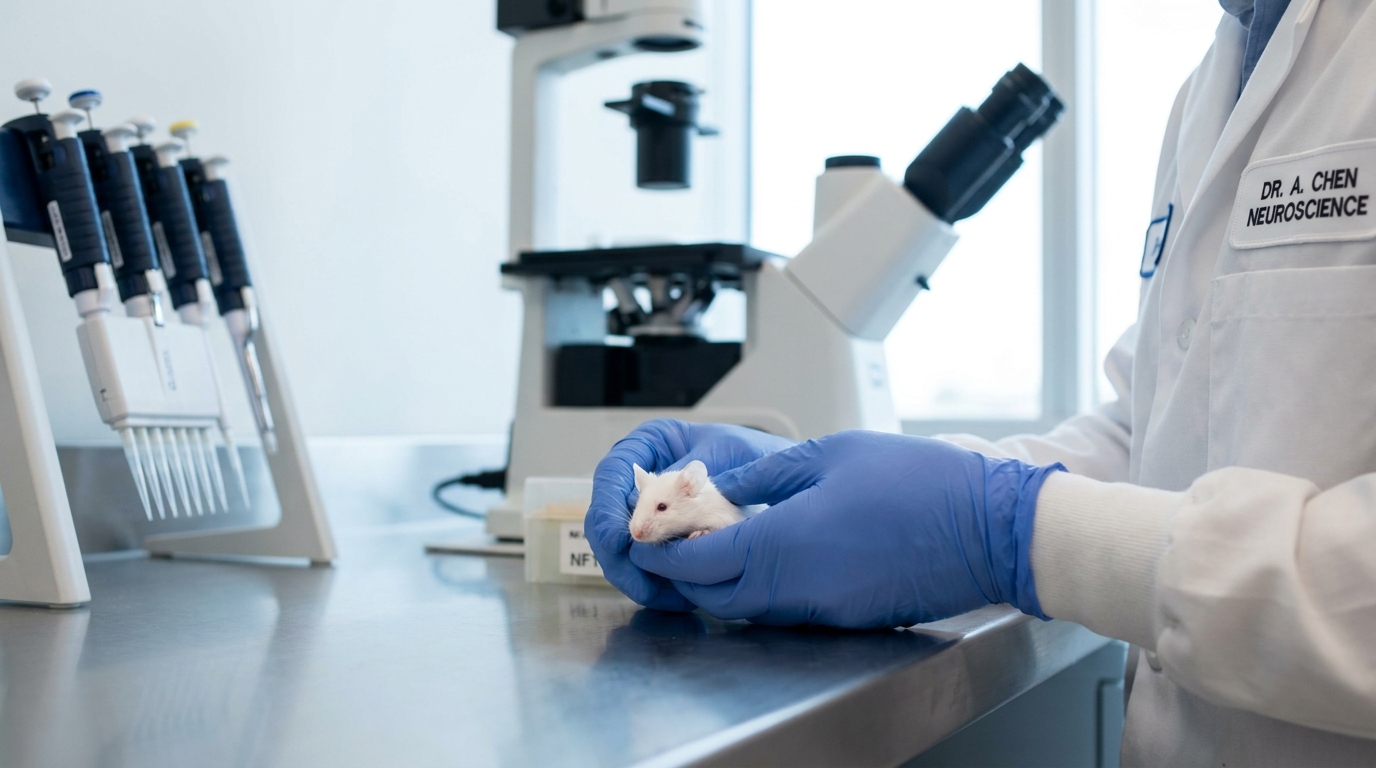
To investigate the neurological underpinnings of NF1, researchers utilized a heterozygous germline knockout mouse model (Nf1 +/-), an animal model engineered to carry a single functional copy of the Nf1 gene to mimic the human genetic condition. These subjects underwent a comprehensive battery of behavioral evaluations designed to assess learning, memory, social interaction, anxiety, depression, and stereotypy (repetitive, invariant behaviors common in autism). The results demonstrated that Nf1 +/- mice exhibit a distinct cognitive and autism-like behavioral phenotype that closely mirrors the clinical presentation often observed in human patients. The researchers paired these behavioral assessments with detailed anatomical and functional evaluations of both the brain and the gastrointestinal tract. A primary finding was a striking increase in relative brain size in Nf1 +/- mice when compared to Nf1 +/+ wild-type controls. This manifestation of macrocephaly (an abnormally large brain volume) is highly relevant to daily clinical practice, as it is a frequent physical finding in children diagnosed with NF1. Crucially, the researchers identified that brain size in Nf1 +/- mice was significantly correlated with behavior, suggesting a direct mechanistic link between structural neuroanatomy and functional outcomes. For clinicians, this correlation indicates that the degree of macrocephaly might eventually serve as a biological marker for the severity of the cognitive and autism-like phenotype. By documenting these concurrent changes in brain structure and social behavior, the findings provide a foundation for understanding how the Nf1 mutation drives systemic developmental alterations across both the central nervous system and the gastrointestinal environment.
Sex-Specific Dysbiosis and Microbial Signatures
To characterize the internal microbial environment associated with this genetic mutation, the researchers performed the first investigation of gut microbiota composition in the Nf1 +/- mouse model using full-length 16S rRNA sequencing. This high-resolution genetic technique identifies and quantifies bacterial species by sequencing a specific ribosomal RNA gene that serves as a unique taxonomic barcode. The analysis revealed that Nf1 +/- mice exhibit significant alterations in gut microbiota composition when compared to Nf1 +/+ wild-type controls. While the global composition of associated functional pathways was not altered across the entire cohort, the researchers identified that Nf1 +/- mice showed significant changes in a pyrimidine deoxynucleotide biosynthesis pathway, suggesting a specific metabolic shift in the gut environment linked to the Nf1 mutation. The study further identified a genotype-specific host-microbial signature that was uniquely evident in male subjects. In male Nf1 +/- mice, the researchers documented significant changes to the species abundance of the Clostridium and Blautia genera, as well as the Lachnospiraceae family. These specific taxonomic findings are highly relevant to pediatric and neurological practice because they partially overlap with the microbial dysbiosis observed in both preclinical and clinical autism spectrum disorder. By establishing these sex-specific microbial signatures, the findings suggest that the gut microbiome could eventually represent a modifiable therapeutic target for addressing the cognitive and behavioral symptom clusters that frequently complicate the clinical management of NF1.
The researchers extended their analysis beyond bacterial taxonomy to examine the functional capacity of the gut microbiome, a measure of the collective metabolic activities and biochemical pathways encoded by the microbial genes. While the composition of associated functional pathways was not globally altered across the gut microbiome of the study subjects, targeted analysis revealed localized metabolic disruptions. Specifically, the Nf1 +/- mice showed significant changes in a pyrimidine deoxynucleotide biosynthesis pathway, a metabolic sequence essential for the production of the fundamental building blocks of DNA. This finding suggests that while the overall functional potential of the microbiome remains largely intact, the Nf1 mutation induces specific shifts in microbial metabolism that could influence host physiology and cellular signaling. Furthermore, the genotype-specific host-microbial signature uniquely present in male Nf1 +/- mice highlights a distinct interaction between the host genetic status and intestinal flora. This signature is clinically significant because it points toward a mechanistic link between gut microbiome composition and brain size, specifically the macrocephaly observed in this model. For the practicing clinician, these findings suggest that the structural brain changes and cognitive phenotypes associated with NF1 might not be driven solely by intrinsic neural factors, but could be actively modulated by the gut-brain axis. By identifying these specific microbial and metabolic markers, the researchers establish the microbiome as a highly relevant area of investigation and a potential therapeutic target for managing the complex neurological and behavioral manifestations of the disorder.
References
1. Wang W, Pan D, Liu Q, Chen X, Wang S. L-Carnitine in the Treatment of Psychiatric and Neurological Manifestations: A Systematic Review. Nutrients. 2024. doi:10.3390/nu16081232
2. Puricelli C, Rolla R, Gigliotti CL, et al. The Gut-Brain-Immune Axis in Autism Spectrum Disorders: A State-of-Art Report. Frontiers in Psychiatry. 2022. doi:10.3389/fpsyt.2021.755171
3. Chatterjee J, Qi X, Ouyang M, et al. TMIC-15. GUT MICROBIOTA CONTROLS NEUROFIBROMATOSIS-1 (NF1) OPTIC GLIOMA GROWTH THROUGH IMMUNE CIRCUIT MODULATION. Neuro-Oncology. 2024. doi:10.1093/neuonc/noae165.1193
4. Martins B, Martins J, Castelo‐Branco M, Gonçalves J. Sex-dependent dysregulation of the gut-brain NPYergic system in a mouse model of autism spectrum disorder. Scientific Reports. 2026. doi:10.1038/s41598-026-42601-0