For Doctors in a Hurry
- Clinicians require effective rehabilitation strategies to address persistent naming deficits in patients suffering from chronic post-stroke aphasia.
- The researchers conducted a randomized controlled trial involving 102 patients with non-fluent aphasia assigned to virtual reality or conventional therapy.
- The virtual reality group demonstrated significantly higher gains in naming (p=0.001), oral motor function (p=0.005), and patient enjoyment (p=0.002).
- The authors concluded that immersive virtual reality therapy improves language performance, quality of life, and patient engagement more effectively than conventional methods.
- Future clinical investigations should evaluate the long-term durability of these language gains and the feasibility of home-based virtual reality applications.
Expanding the Boundaries of Aphasia Rehabilitation
Chronic post-stroke aphasia remains a significant barrier to patient independence, often requiring intensive, long-term interventions that are difficult to sustain in traditional clinical settings [1]. While virtual reality has established efficacy in motor recovery for upper and lower limbs, its application in cognitive and linguistic rehabilitation is still an evolving area of clinical practice [2, 3]. Traditional speech-language therapy often faces challenges with patient adherence and the potential for a generalization gap, which is the difficulty patients face when trying to apply linguistic gains made in a clinic to functional, real-world communication [1, 4]. Recent efforts have explored digital platforms to increase therapy dosage, yet the search for immersive environments that maximize patient engagement and enjoyment continues [5]. A new randomized controlled trial now evaluates how immersive virtual reality environments (digital simulations that fully surround the user to mimic real-world interactions) might address these persistent gaps in chronic aphasia management.
Trial Design and Immersive Protocol
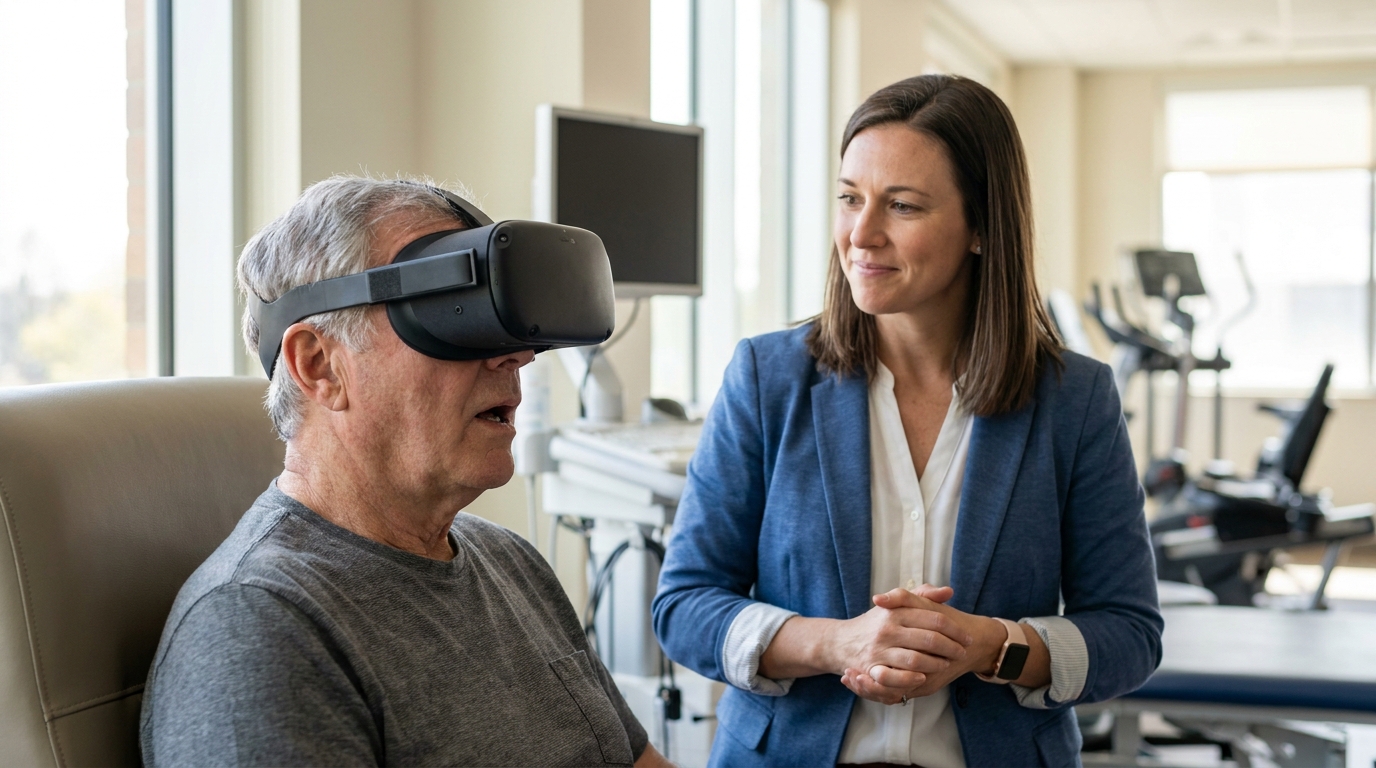
The researchers conducted a randomized, single-blind, parallel-group, and controlled trial at the Bolu Abant Izzet Baysal University Physical Medicine and Rehabilitation Hospital to evaluate the efficacy of digital interventions in speech recovery. The study cohort included 102 individuals with non-fluent aphasia, a clinical profile characterized by labored speech production despite relatively preserved auditory comprehension. These participants, who were between 40 and 80 years of age, were randomly assigned to two treatment arms with 51 individuals in each group. This structured design allowed for a direct comparison between a technology-driven approach and traditional rehabilitation methods in a controlled clinical setting. The experimental group received virtual reality-based self-managed naming therapy in an immersive environment, while the control group received conventional therapy, which consisted of the standard face-to-face intervention typically provided in clinical practice. To ensure a high dosage of treatment, both interventions were delivered 5 times per week over a duration of 8 weeks. This intensive schedule was designed to leverage the principles of neuroplasticity in chronic post-stroke recovery, where frequent repetition is often necessary to achieve functional gains in communication.
The primary outcome of the study was language performance, which the researchers measured using the Gulhane Aphasia Test, a standardized tool for assessing linguistic deficits. To capture a more comprehensive view of patient recovery, the researchers also tracked secondary outcomes. These included the Stroke and Aphasia Quality of Life Scale, which evaluates the impact of the condition on a patient's daily functioning and well-being, and a specific measure of patient enjoyment. By including these metrics, the study aimed to determine not only the linguistic efficacy of immersive therapy but also its impact on patient engagement and overall life satisfaction. For the practicing clinician, these secondary measures are vital, as they often correlate more closely with long-term treatment adherence than standardized linguistic scores alone.
Comparative Linguistic and Quality of Life Outcomes
At the study's inception, the researchers confirmed that the two cohorts were well-matched, as baseline demographics and clinical measures showed no significant differences between the groups (p > 0.05). Following the eight-week intervention period, both the immersive virtual reality group and the conventional therapy group demonstrated therapeutic benefit. Specifically, both groups achieved significant improvements in their scores on the Gulhane Aphasia Test and the Stroke and Aphasia Quality of Life Scale (p < 0.05). These results indicate that both intensive digital and traditional face-to-face protocols can drive recovery in chronic non-fluent aphasia, though the extent of these gains varied significantly between the two modalities. A granular analysis of the primary language outcomes revealed distinct differences in the breadth of recovery. The virtual reality group demonstrated significant improvements across every subscale of the Gulhane Aphasia Test (p < 0.05), suggesting a comprehensive impact on linguistic processing.
In contrast, the control group did not show gains in the subscales of listening comprehension (the ability to process and understand spoken language) and repetition. This discrepancy suggests that the immersive environment may provide unique stimuli or higher levels of engagement necessary to address these specific receptive and productive deficits that traditional methods failed to move in this patient population. Beyond linguistic metrics, the impact on patient well-being was more extensive in the experimental arm. The researchers noted that improvements in the subscales of the Stroke and Aphasia Quality of Life Scale were broader in the virtual reality group compared to the control group. When comparing the two interventions directly, the immersive protocol demonstrated statistically superior efficacy in key functional areas. Between-group comparisons indicated significantly higher gains in the virtual reality group for oral motor function (p = 0.005), which involves the coordination of muscles necessary for speech, and naming (p = 0.001). These findings suggest that the immersive nature of the therapy may better facilitate the motor and cognitive pathways required for word retrieval and speech production in chronic stroke survivors.
Clinical Implications for Patient Engagement
A critical component of long-term rehabilitation success is patient adherence, which is often driven by the subjective experience of the therapy. In this trial, the researchers assessed patient enjoyment as a secondary outcome to determine if the digital interface influenced participant motivation. Between-group comparisons indicated significantly higher gains in the virtual reality group for enjoyment (p = 0.002). This increased level of satisfaction likely contributed to the overall efficacy of the intervention. Ultimately, the study concluded that therapy based on immersive virtual reality showed better results for naming, quality of life, and patient engagement compared to conventional speech-language therapy. By providing a more stimulating and interactive environment, the immersive protocol appears to mitigate the fatigue or frustration often associated with repetitive naming tasks in chronic aphasia. For the clinician, this suggests that virtual reality may help overcome the motivational plateaus frequently encountered in chronic-stage recovery.
These findings suggest that virtual reality is an effective intervention for aphasia rehabilitation, offering a viable alternative or supplement to traditional clinical methods. The ability to simulate real-world environments within a controlled, immersive space may facilitate the generalization of naming skills to daily life. However, the researchers noted that further investigation is required to fully integrate this technology into standard practice. Future studies are needed to investigate long-term effects and the potential for home-based applications, which could significantly increase access to intensive therapy for patients with mobility or transportation barriers. Establishing whether these linguistic gains persist months after the intervention will be essential for determining the role of virtual reality in the long-term management of chronic non-fluent aphasia, particularly as healthcare systems move toward more decentralized, home-based rehabilitation models.
References
1. Liscano Y, Bernal LM, Díaz-Vallejo JA. Effectiveness of AI-Assisted Digital Therapies for Post-Stroke Aphasia Rehabilitation: A Systematic Review. Brain Sciences. 2025. doi:10.3390/brainsci15091007
2. Khan A, Imam Y, Muneer MS, Jerdi SA, Gill SK. Virtual reality in stroke recovery: a meta-review of systematic reviews. Bioelectronic Medicine. 2024. doi:10.1186/s42234-024-00150-9
3. Kiper P, Godart N, Cavalier M, et al. Effects of Immersive Virtual Reality on Upper-Extremity Stroke Rehabilitation: A Systematic Review with Meta-Analysis. Journal of Clinical Medicine. 2023. doi:10.3390/jcm13010146
4. Landim SF, Lopez RGL, Caris A, et al. Effectiveness of Virtual Reality in Occupational Therapy for Post-Stroke Adults: A Systematic Review. Journal of Clinical Medicine. 2024. doi:10.3390/jcm13164615
5. Kong Q, Wang J, Huang X, He J, Chang J. Comparative Efficacy of Cognitive Training for Post-Stroke Aphasia: A Systematic Review and Network Meta-Analysis. Neurorehabilitation and neural repair. 2024. doi:10.1177/15459683241274755