
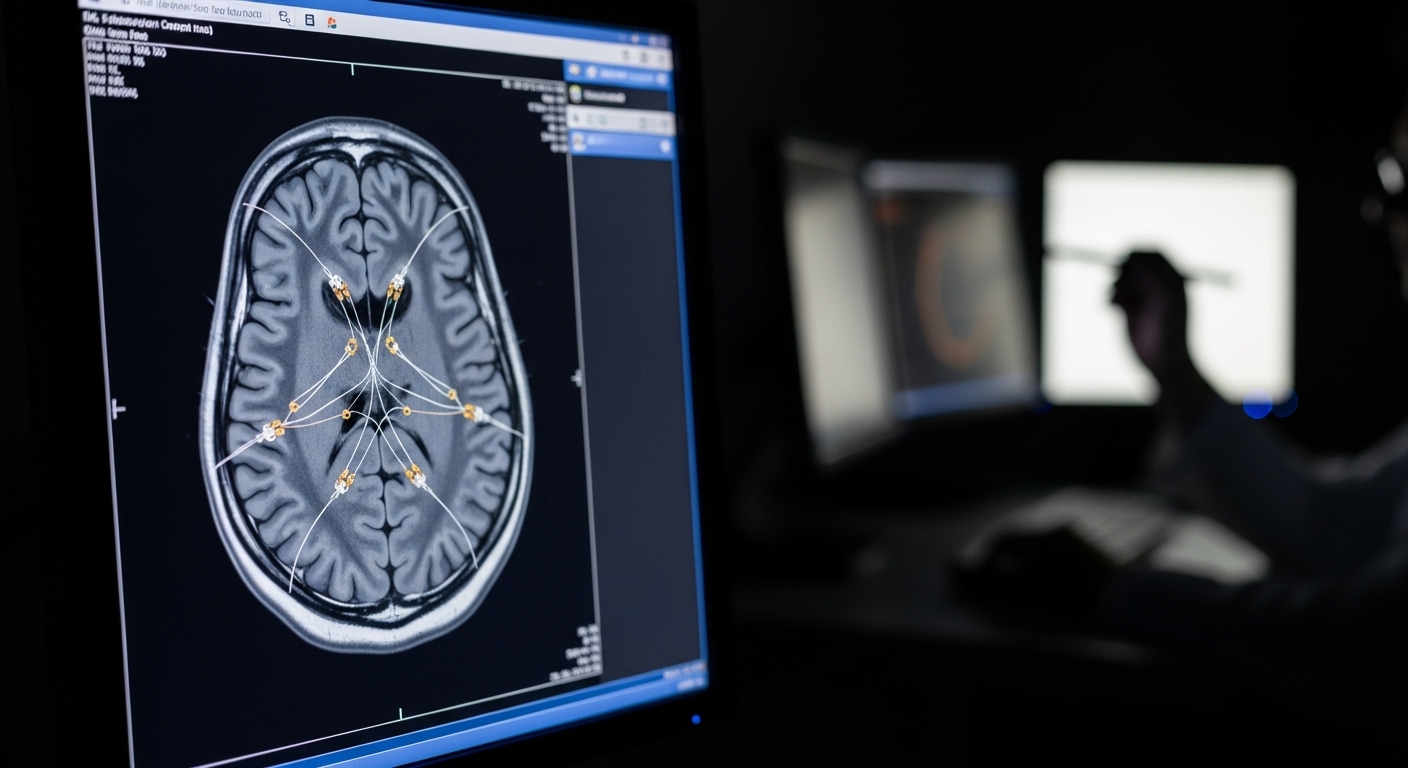
- The study addressed how to identify and prevent attentional lapses by understanding the neural basis of attentional control.
- Researchers used in vivo intracranial recordings in children with epilepsy performing an attentional set-shifting task.
- Machine learning classifiers predicted delays in attention shifting, and intracranial stimulation rescued attention shifts.
- The authors concluded these findings provide insight into the neural basis of attentional shifts.
- This work has implications for targeted neuromodulation and exogenous attentional control in pediatric populations.
Modulating Attentional Flexibility in Pediatric Populations
Attentional flexibility, the cognitive capacity to shift focus in response to changing environmental demands, is crucial for learning and development. Disruptions in this process are a core feature of pediatric attention deficit disorders, often leading to academic and social challenges [1]. While many neurological conditions involve complex brain changes [2, 3], precisely mapping the neural circuits governing attention has been difficult. Intracranial electroencephalography (iEEG), which records neural activity directly from the brain's surface, offers a high-resolution window into these processes [4], creating an opportunity to identify the specific neural signatures of cognitive functions. A recent study leverages this technique to isolate the brain activity underlying attentional control, testing whether this activity can be modulated in real time to prevent cognitive lapses.
Identifying Neural Signatures of Attentional Control
To pinpoint a consistent neural marker for attentional control, researchers analyzed in vivo intracranial recordings from children with epilepsy who were already undergoing monitoring. This patient population provides a unique opportunity for high-fidelity neural recording. The study's primary goal was to identify a reproducible electrical signature in the brain that precedes a lapse in attention. By finding such a pattern, the investigators aimed to develop a system that could not only predict an impending failure to shift attention but also intervene to prevent it, offering a potential blueprint for real-time therapeutic adjustment.
Real-Time Prediction and Intervention with Machine Learning
The study's methodology centered on training specialized algorithms to recognize brain activity patterns associated with attentional states. These algorithms, a form of machine learning known as classifiers, were fed intracranial signals while children performed an attentional set-shifting task, a cognitive test requiring them to flexibly switch between different rules. This process allowed the classifiers to learn the specific neural precursors of a delayed or failed attention shift. The models proved to be highly effective, as they successfully predicted delays in attention shifting over multiple days in the same child and, importantly, across several different pediatric populations. This suggests the identified neural signature is not an artifact of one individual or group but a more generalizable marker of attentional control. Based on these predictions, the system delivered a targeted intervention: when the classifier detected an impending lapse, intracranial electrical stimulation was applied in real time to the relevant brain region. This closed-loop neuromodulation rescued the impending attention shifts, an effect confirmed by objective improvements in eye tracking, faster reaction times, and greater accuracy on the cognitive task.
Translating to Noninvasive Modulation
A critical step toward broader clinical use involves moving from invasive to noninvasive techniques. To this end, the researchers conducted simultaneous electroencephalography (EEG) during the intracranial recordings. This allowed them to discover that the deep-brain signals predictive of attentional lapses had a corresponding, detectable pattern on the scalp. The study reports that these simultaneously recorded EEG signals identified corresponding scalp signatures of attentional control. This finding is significant because it provides a biomarker that can be measured noninvasively in a clinical setting. Building on this, the investigators demonstrated that these scalp-level patterns could be used to guide intervention. In a cohort of healthy participants, noninvasive modulation techniques successfully influenced attention shifting, confirming that the principle of real-time intervention is not limited to patients with implanted electrodes. This validation in a healthy population is a key step in developing accessible, non-surgical therapies for children with a range of attentional disorders.
Clinical Implications for Attentional Disorders
These findings provide a detailed neurophysiological account of attentional flexibility, offering a deeper insight into the neural basis of attention shifts. By isolating a predictive neural signature and demonstrating that it can be modulated to prevent cognitive errors, the study moves from correlational observation to causal intervention. For clinicians, this work points toward future therapeutic strategies based on targeted neuromodulation. Instead of systemic pharmacotherapy, it may become possible to develop devices that detect the neural state preceding an attentional lapse and deliver a precise, corrective stimulus only when needed. The successful translation of this principle to a noninvasive EEG-based system suggests a feasible pathway for such interventions in a broad pediatric population. Furthermore, the results have implications for what is known as exogenous attentional control, or the use of external tools to guide focus. The system developed in this study functions as a proof of concept for a neuroprosthetic that provides real-time cognitive support. Such a technology could one day help children with attention deficit disorders maintain focus and adapt to changing tasks by externally reinforcing the brain's own attentional control mechanisms at the very moment they begin to falter.
References
1. Warsi NM, Wong SM, Mithani K, et al. Closed-loop stimulation modulates attention shifting in children.. Nature neuroscience. 2026. doi:10.1038/s41593-026-02294-0
2. Verkhratsky A, Butt AM, Li B, et al. Astrocytes in human central nervous system diseases: a frontier for new therapies. Signal Transduction and Targeted Therapy. 2023. doi:10.1038/s41392-023-01628-9
3. Su J, Song Y, Zhu Z, et al. Cell–cell communication: new insights and clinical implications. Signal Transduction and Targeted Therapy. 2024. doi:10.1038/s41392-024-01888-z
4. Mercier M, Dubarry A, Tadel F, et al. Advances in human intracranial electroencephalography research, guidelines and good practices. NeuroImage. 2022. doi:10.1016/j.neuroimage.2022.119438