
Nature Neuroscience Animal Study

Macaque V1 Neuron Activity Links Internal States to Reaction Time, Perceptual Choice

New research in macaque monkeys reveals how primary visual cortex neuron membrane potential dynamically influences visual task performance.
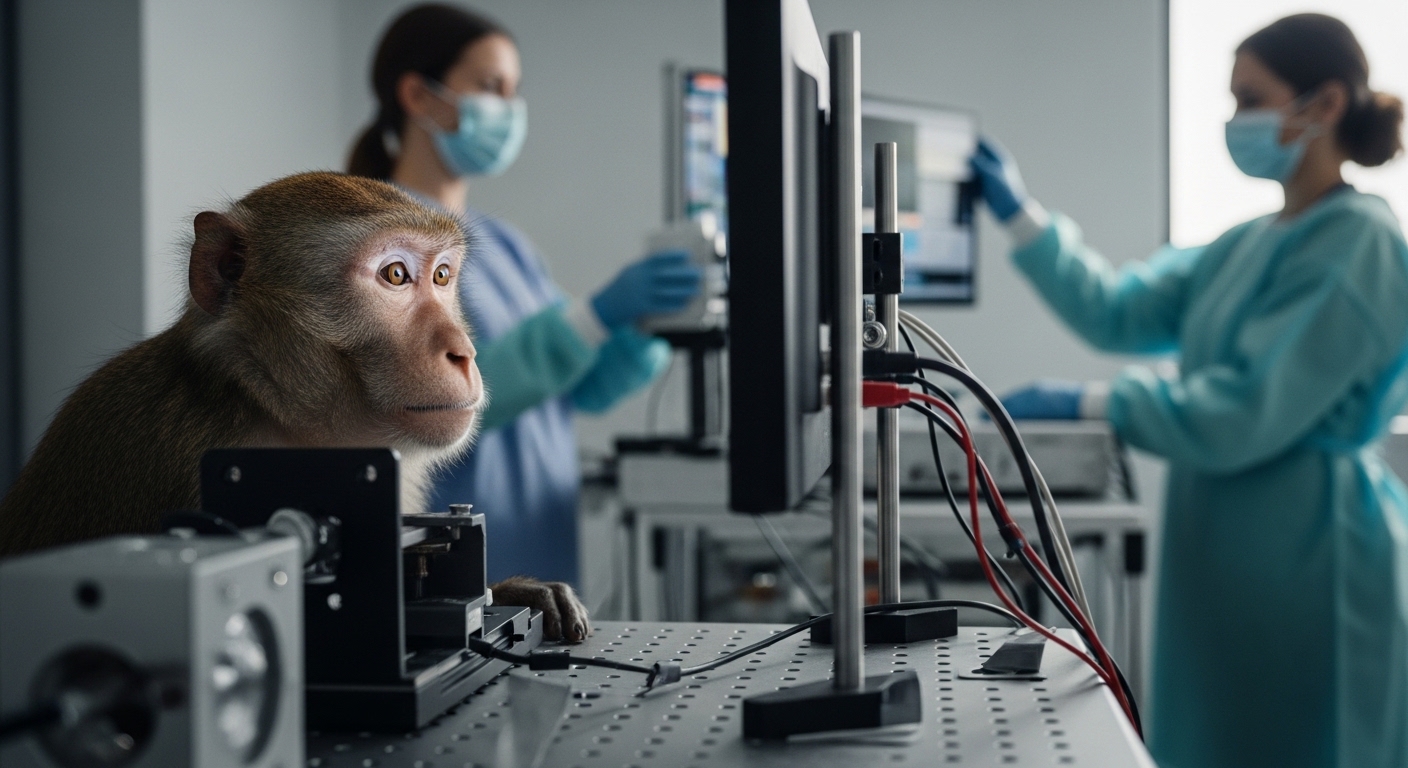
Macaque V1 Neuron Activity Links Internal States to Reaction Time, Perceptual Choice
For Doctors in a Hurry
  • The study addressed how brain regions integrate external sensory inputs with internal states to influence perception and behavior.
  • Researchers measured membrane potential of single V1 neurons in macaque monkeys during a visual detection task.
  • Most V1 neurons gradually depolarized before target onset, with variations correlating to the monkey's reaction times.
  • The authors concluded that internal-state-related nonlinear modulations in V1 or earlier regions implement these V<sub>m</sub>-behavior covariations.
  • These findings enhance understanding of how internal brain states modulate early visual processing and behavioral responses.

Internal States and Visual Perception: Beyond External Stimuli

The brain's capacity to process visual information is essential for everything from simple reaction times to complex decisions in demanding environments like sports or driving [1, 2, 3]. While perception is clearly driven by external sensory input, it is also profoundly shaped by an individual's internal state, such as alertness or expectation [4, 5]. However, the precise neural mechanisms by which these internal states modulate the earliest stages of sensory processing to influence behavior have remained largely undefined. A recent study in macaques provides new evidence on how these internal and external worlds interact within the primary visual cortex.

Unpacking the Neural Mechanisms in V1

To investigate where the brain integrates sensory input with internal state, researchers focused on the primary visual cortex (V1), a region often considered a foundational, feedforward processor of visual information. The study's central question was whether this early sensory area might play a more dynamic role than previously understood. To explore this, the investigators took direct electrophysiological measurements from macaque monkeys performing a reaction-time visual detection task. They specifically recorded the membrane potential (Vm) of single V1 neurons. This measure, representing the voltage difference across a neuron's membrane, offers a precise, real-time window into a cell's excitability and its response to incoming signals. By monitoring Vm during a behavioral task, the study could directly link fluctuations in neuronal readiness within V1 to perceptual outcomes.

V1 Activity Predicts Reaction Time and Perceptual Decisions

Direct measurement of V1 neurons revealed a dynamic interplay between internal readiness and visual processing. The study first established that most V1 neurons gradually depolarize in the moments leading up to the appearance of a visual target. This preparatory increase in membrane potential makes the neurons more excitable, suggesting V1 actively anticipates incoming stimuli rather than passively waiting for them. Critically, the researchers found that variations in this preparatory buildup were correlated with the monkey's reaction times. A greater degree of pre-stimulus depolarization in V1 neurons was associated with a faster response, providing a direct neural link between a state of readiness and behavioral performance. The influence of V1 extended beyond simple reaction speed. After the target appeared, fluctuations in membrane potential were correlated with the animal's perceptual choice. This finding indicates that V1 activity contributes not just to detecting a stimulus but also to the subsequent decision-making process. This relationship was highly context-dependent, as the strength of the correlation between Vm and choice was significantly modulated by both the location and the contrast of the visual target, highlighting the sophisticated and adaptive nature of V1's role in shaping perception.

Modeling Internal State Modulation in V1

To explain the underlying mechanism for these observations, the authors developed a computational framework. Their analysis showed that a simple model incorporating fluctuating multiplicative gain could account for the experimental results. In neural processing, multiplicative gain is a mechanism by which an internal signal, such as attention, amplifies or suppresses the strength of an incoming sensory signal, much like a volume control. This is distinct from an additive effect, which would simply shift the baseline activity. The model suggests that an animal's internal state dynamically scales the processing of visual information within V1. The study's overarching conclusion is that the observed links between V1 neuron activity and behavior are driven by these internal-state-related nonlinear modulations. Furthermore, the findings strongly suggest that these modulations operate at, or even before, the primary visual cortex. This places the influence of internal states at a remarkably early point in the visual processing stream, challenging the view of V1 as a simple feature detector and recasting it as a key site for integrating internal state with external sensory evidence.

Clinical Implications for Visual Processing and Cognition

These findings have direct relevance for clinicians, reinforcing that a patient's perception is a complex product of both external stimuli and their internal state. The research demonstrates that the primary visual cortex is a critical hub where this integration occurs. For physicians, this provides a potential neurobiological basis for how factors like fatigue, stress, or vigilance can directly alter a patient's performance on tasks requiring visual processing. For example, variability in a patient's internal state could directly influence the outcome of diagnostic assessments that depend on reaction time or visual acuity, from neurological exams to pediatric developmental screenings. This understanding underscores the importance of considering a patient's state during clinical evaluation. The discovery that these modulatory effects occur at or before V1 may also inform the understanding of disorders characterized by attentional or perceptual deficits, such as ADHD or age-related cognitive decline. The study suggests that the pathophysiology of these conditions could involve dysregulated modulation of early sensory processing. By identifying a specific mechanism, multiplicative gain, this work provides a framework for investigating how changes in internal state regulation contribute to clinical presentations, potentially guiding future strategies that target not just sensory deficits but the underlying modulation of sensory brain regions.

Study Info
Fluctuating internal states mediate neural–behavioral covariations in V1
Baowang Li, Jason M. Samonds, Y R Chen, Thibaud Taillefumier, et al.
Journal Nature Neuroscience
Published May 13, 2026

References

1. Yang M, Guo Y, Yang F, Zhao K. Exploring the association between visual skills and sport-specific performance in team athletes: a systematic review and meta-analysis.. Frontiers in physiology. 2026. doi:10.3389/fphys.2026.1797347

2. Oliveira SLND, Faria A, Tenório F, et al. PERCEPTUAL ANSWERS PRESENTED BY SOCCER ATHLETES DURING PRE AND POST­TRAINING PERIODS: A SYSTEMATIC REVIEW WITH METANALYSIS. 2020. doi:10.16887/90.A1.44

3. Burkhardt G, Goerigk S, Dechantsreiter E, et al. Driving-related cognitive skills during antidepressant transcranial direct current stimulation: results in a subsample from the DepressionDC trial.. Frontiers in psychiatry. 2023. doi:10.3389/fpsyt.2023.1255415

4. Paterson DH, Warburton DER. Physical activity and functional limitations in older adults: a systematic review related to Canada's Physical Activity Guidelines. International Journal of Behavioral Nutrition and Physical Activity. 2010. doi:10.1186/1479-5868-7-38

5. Clark A. Whatever next? Predictive brains, situated agents, and the future of cognitive science. Behavioral and Brain Sciences. 2013. doi:10.1017/s0140525x12000477