For Doctors in a Hurry
- Surgeons face increased technical difficulty during facelifts in patients with prior filler or thread treatments, necessitating improved intraoperative nerve protection methods.
- This prospective study analyzed 200 patients undergoing extended sub-muscular facelifts who had previously received fillers, thread lifts, or prior facial surgeries.
- The neurapraxia rate was 0 percent with monitoring versus 6 percent without (p = 0.029), while dissection time decreased significantly (p < 0.001).
- The researchers concluded that using a nerve integrity monitor effectively reduces both nerve injury risk and total operative duration.
- Incorporating nerve monitoring provides a standardized dissection algorithm to improve safety for patients with complex and scarred facial tissue planes.
Navigating the Distorted Anatomy of the Modern Facelift
The rising prevalence of minimally invasive treatments, such as biostimulatory injectables and thread lifts, has introduced significant anatomical challenges for surgeons performing subsequent facial rejuvenation procedures [1]. These prior interventions can lead to plane distortion, tissue fibrosis, and the thickening of facial ligaments, all of which complicate the identification of delicate neurovascular structures [2]. While facial nerve injury remains a rare but devastating complication of rhytidectomy, the risk of postoperative paresis (partial loss of voluntary movement) increases significantly with prolonged operative times and complex dissections [3]. Traditional anatomical landmarks may be unreliable in these cases, particularly given the high degree of variability in peripheral facial nerve branching [4]. Consequently, clinicians are increasingly exploring neuroguided techniques to enhance surgical precision and prevent functional or aesthetic impairments [5]. A recent prospective study now examines how real-time monitoring affects outcomes in this challenging patient population, offering a practical strategy for surgeons navigating distorted facial planes.
Prospective Evaluation of Intraoperative Monitoring
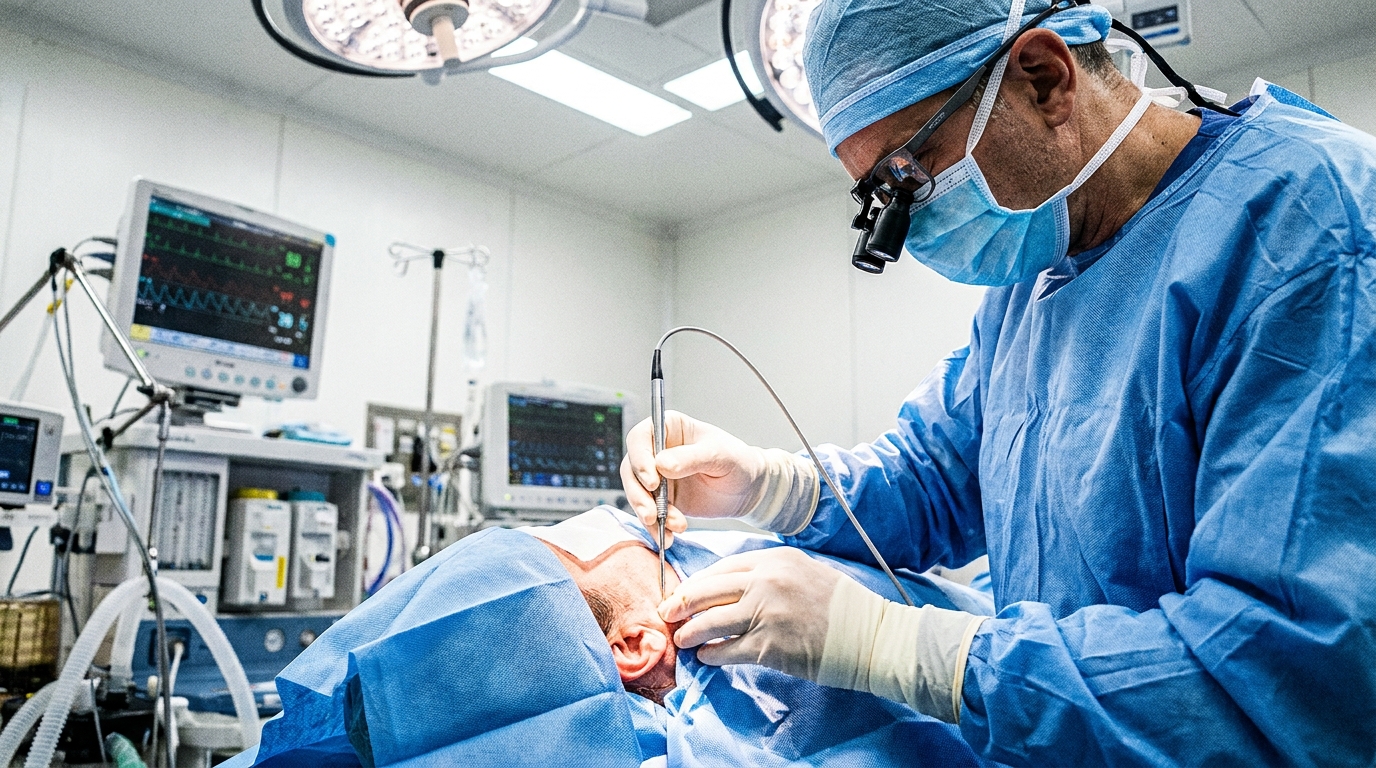
While the use of a nerve integrity monitor (a device that provides real-time electromyographic feedback to identify and map motor nerves during surgery) is common in otolaryngology and neurosurgery, data on its application in facelift procedures remains limited. To address this gap, researchers conducted a prospective study from January 2024 to August 2025 to describe the use of this technology in facial rejuvenation and to compare outcomes between procedures performed with and without its assistance. The final analysis included a total of 200 patients undergoing extended subSMAS facelifts, a technique involving dissection beneath the superficial musculoaponeurotic system to reposition deep facial tissues. To be eligible for inclusion, participants must have previously received filler injections, thread lifts, or prior facelifts, all of which can induce fibrosis and obscure natural surgical planes. These participants were divided into either the nerve integrity monitor group or the non-monitor group to evaluate the impact of the technology on surgical safety and efficiency. The findings demonstrated that the use of a nerve integrity monitor significantly improved clinical outcomes in these complex cases. The incidence of neurapraxia (a temporary loss of nerve function due to compression or stretching) was 0% in the monitored group compared to 6% in the non-monitored group (p = 0.029). Furthermore, the technology streamlined the surgical process by facilitating faster nerve identification. Dissection time was significantly reduced in the monitored group, with a median of 32.86 [26.25, 38.00] minutes, compared to 63.5 [55.0, 75.0] minutes in the group without monitoring (p < 0.001). These results suggest that intraoperative monitoring may mitigate the technical difficulties and increased risks associated with secondary facial surgery.
Standardizing the Neuroguided Dissection
The increasing prevalence of filler injections, thread lifts, and energy-based devices (technologies such as radiofrequency or ultrasound used for deep skin tightening) for facial rejuvenation has introduced new technical difficulties for surgeons performing deep plane or subSMAS facelifts. These prior interventions often result in significant fibrosis and scarring, which obscure the natural surgical planes and distort expected anatomical landmarks. To address the challenges associated with distorted anatomy, the researchers utilized the nerve integrity monitor to provide an objective method for locating nerve branches within scarred or altered tissue. This real-time feedback assists the surgeon in maintaining the correct dissection plane while avoiding accidental trauma to the facial nerve. To ensure the consistent application of this technology, the study presented a step-by-step dissection algorithm using a nerve integrity monitor during facelift surgery. This protocol standardizes the integration of real-time nerve feedback into the surgical workflow, allowing for a systematic approach to identifying nerve branches before they are encountered by the scalpel or scissors. By following this structured algorithm, surgeons can navigate the complex tissue environments created by previous aesthetic procedures with greater precision. The implementation of this standardized method contributed directly to the improved safety profile observed in the study cohort, suggesting that a formalized approach to neuroguided dissection can enhance both safety and efficiency in secondary facial rejuvenation.
Significant Reductions in Nerve Injury and Operative Time
The primary safety endpoint of the study focused on the incidence of neurapraxia (a temporary loss of motor or sensory function due to nerve compression or stretching). Among the 200 patients analyzed, the researchers observed that the incidence of neurapraxia was 0 (0%) in the nerve integrity monitor group, compared to 6 (6%) in the unmonitored group. This difference reached statistical significance with a p-value of 0.029, indicating that the use of a nerve integrity monitor in facelift surgery effectively reduces the rate of nerve injury. For the practicing clinician, these data suggest that real-time electromyographic feedback provides a measurable safety margin when navigating the fibrotic tissues often encountered in secondary or complex facial rejuvenation. Beyond safety, the study demonstrated substantial improvements in surgical efficiency. The dissection time in the monitored group was 32.86 [26.25, 38.00] minutes, whereas the dissection time in the unmonitored group was 63.5 [55.0, 75.0] minutes. This reduction in dissection time was highly significant, with a p-value of less than 0.001. By providing immediate confirmation of nerve location, the monitor allows the surgeon to proceed with greater confidence and speed through difficult anatomical planes. Consequently, the use of a nerve integrity monitor in facelift surgery reduces overall operative time, which directly benefits clinical practice by increasing surgical throughput and minimizing the duration of patient exposure to general anesthesia.
References
1. Shridharani SM, Palm MD, Jarmuz T, et al. Optimizing Aesthetic Facial Surgery Outcomes Following Minimally Invasive Treatments: Guidelines for Perioperative Management. Aesthetic Surgery Journal Open Forum. 2025. doi:10.1093/asjof/ojaf087
2. Yi K, Jitaree B, Yoon SE, et al. Facial Ligament Thickening Using Poly‐D,L‐Lactic Acid Injection. Journal of Cosmetic Dermatology. 2025. doi:10.1111/jocd.70300
3. Infante-Cossío P, Gonzalez-Cardero E, García AG, Montes-Latorre E, Pérez JLG, Prats-Golczer E. Complications after superficial parotidectomy for pleomorphic adenoma. Medicina oral, patología oral y cirugía bucal. 2018. doi:10.4317/medoral.22386
4. Raslan A, Volk GF, Möller MC, Stark V, Eckhardt N, Guntinas‐Lichius O. High variability of facial muscle innervation by facial nerve branches: A prospective electrostimulation study. The Laryngoscope. 2016. doi:10.1002/lary.26349
5. Silva MD, Liborio P, Marquezini RM. Neuroguided Surgery: A Safe Technique to Prevent Nerve Injuries in Facelift Surgery. Plastic & Reconstructive Surgery Global Open. 2025. doi:10.1097/gox.0000000000007232