
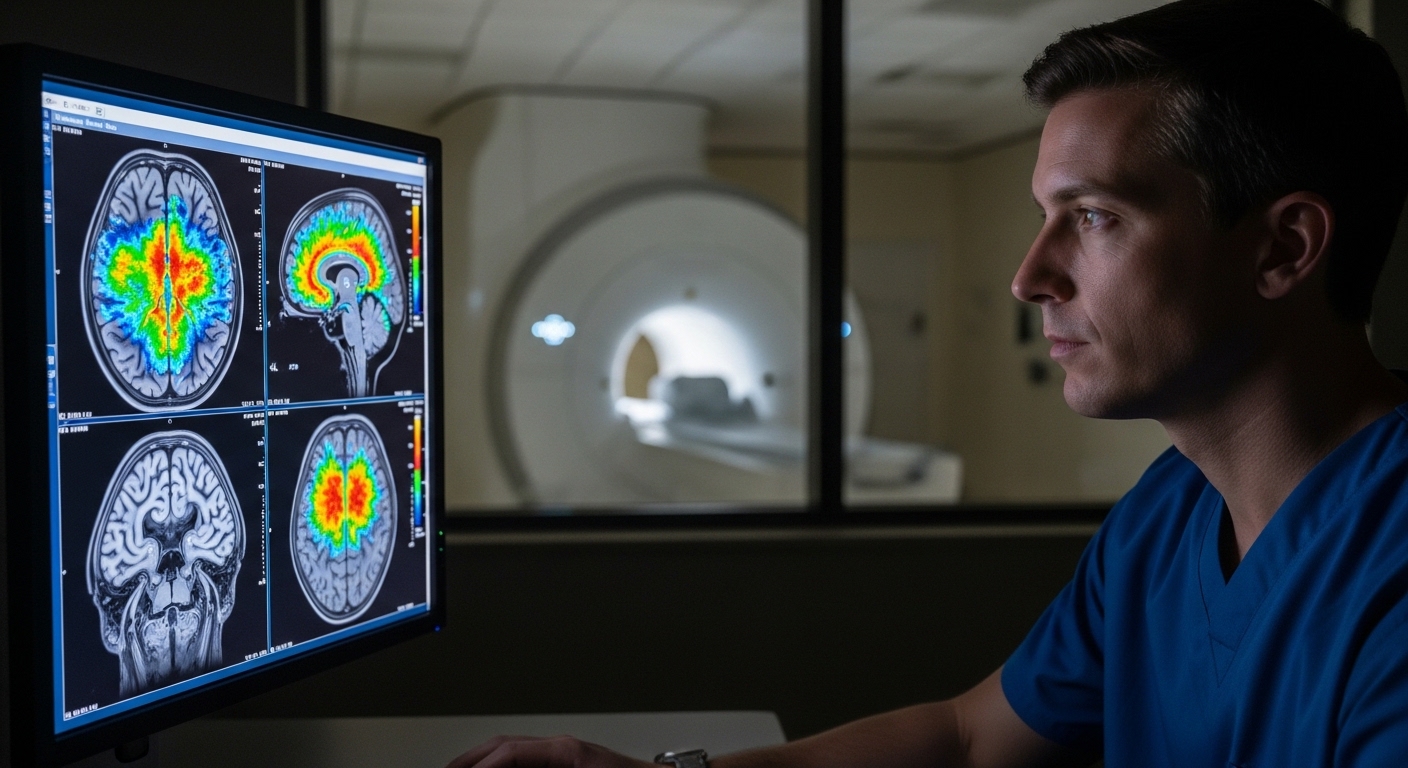
- Major depressive disorder (MDD) lacks biomarkers, leading to trial-and-error treatment where only 33% achieve remission initially.
- This critical review synthesizes studies on functional magnetic resonance imaging (fMRI) to predict treatment outcomes for MDD.
- Matching treatment to a patient's biotype, defined by personalized circuit scores, has the potential to double remission rates.
- The authors conclude that fMRI-based tools can parse MDD heterogeneity and guide personalized treatment selection.
- Future work must address challenges in translating these precision imaging approaches into routine clinical practice.
Navigating Treatment Heterogeneity in Major Depressive Disorder
Major depressive disorder (MDD) remains a leading cause of disability, yet its diagnosis relies on symptom checklists that group together patients with diverse underlying pathologies [1, 2, 3, 4]. This biological heterogeneity contributes to inconsistent treatment responses, forcing clinicians into a cycle of empirical prescribing where many patients try multiple therapies over years, facing an escalating risk of relapse with each failure [5, 6]. While functional magnetic resonance imaging (fMRI) has long been used in research to study brain function in MDD, its translation into a clinical tool for guiding personalized treatment has been limited, highlighting the urgent need for objective biomarkers to match patients to effective interventions [7, 8, 9].
The Clinical Imperative for Precision in MDD
The practical consequences of treating major depressive disorder as a uniform entity are stark, as the condition remains one of the leading causes of disability across medical conditions. Current diagnostic criteria group patients with highly heterogeneous presentations, analogous to diagnosing all chest pain without using imaging to identify the specific underlying cardiac pathology. In the absence of biological markers to guide therapy, clinicians must often resort to trial-and-error prescribing. This empirical process yields suboptimal outcomes, with only 33% of individuals with MDD achieving remission in response to initial treatments. For most patients, this initiates a protracted search for an effective therapy, cycling through multiple treatments over an average of 7 years. This journey is not benign; the risk of relapse increases substantially with each treatment failure, rising from 50% to 90%.
Functional MRI as a Predictor of Treatment Response
To address the limitations of a symptom-based approach, a recent critical review synthesizes studies on the clinical utility of functional magnetic resonance imaging. By measuring brain activity through changes in blood flow, fMRI provides a noninvasive window into the function of neural circuits. The review consolidates evidence showing how this technology can be used to predict treatment outcomes for major depressive disorder, offering a biological complement to clinical observation. More specifically, the findings indicate fMRI can help identify which treatment is most effective for an individual based on their unique brain circuit profile. This moves beyond simply predicting response to a single treatment and toward a more sophisticated application: guiding the initial choice between different therapeutic options, thereby reducing the need for prolonged and often discouraging trial-and-error sequences.
Developing Personalized Circuit Biotypes
A key strategy highlighted by the review involves a method to quantify dysfunction across 6 large-scale biotype circuits known to be involved in mood and cognitive regulation. This technique uses an individual's fMRI data and compares it to a large dataset of brain scans from healthy individuals. This process, which establishes a baseline of typical brain function in order to flag individual deviations, allows for the creation of personalized circuit scores. These scores are not a simple binary measure but a detailed profile of how a patient's brain activity differs from the healthy reference norm. The resulting profile constitutes a patient's neural "biotype."
These personalized circuit scores have direct clinical relevance. The authors report that the scores can serve as predictors of response or failure to a given therapy. More importantly, they also function as moderators of differential treatment outcomes. This means the scores can indicate not just if a patient will get better, but which of several available treatments is most likely to be effective for them. By matching a patient's specific biotype to a compatible therapy, the authors suggest it is possible to provide a data-driven alternative to empirical prescribing, with the potential to double remission rates compared with unmatched treatments.
Potential for Enhanced Remission Rates
The clinical implications of applying this fMRI-based biotyping are significant for the management of major depressive disorder. By shifting the basis of treatment selection from clinical impression to a biological signature, the authors project a substantial improvement in patient outcomes. The central finding is that matching treatment to a patient's biotype, defined by their personalized circuit scores, has the potential to double remission rates. This improvement is calculated in comparison to unmatched treatment, where the therapeutic choice is not guided by the patient's neurobiological profile. This finding suggests a direct, quantifiable benefit of integrating brain circuit information into the clinical decision-making process for MDD.
Translational Challenges and Future Directions
The specific fMRI method detailed in the review is situated within the broader field of precision imaging approaches to parsing major depressive disorder heterogeneity. These strategies share a common goal: to deconstruct the broad diagnosis of MDD into more discrete, biologically defined subgroups that may respond to different interventions. While the prospect of doubling remission rates is compelling, the review also addresses the key challenges, limitations, and future directions for translating fMRI-based tools into clinical practice. For these tools to become viable, logistical hurdles must be overcome. This includes establishing standardized fMRI protocols to ensure data is comparable across different clinics and developing user-friendly analytical software that can distill complex brain data into a clear, actionable report for the practicing physician. Successful validation in diverse, real-world patient populations will be the ultimate test before such techniques can move from specialized research centers into routine clinical care.
References
1. Chowdhury A, Boukezzi S, Costi S, et al. Effects of the KCNQ (Kv7) Channel Opener Ezogabine on Resting-State Functional Connectivity of Striatal Brain Reward Regions, Depression and Anhedonia in Major Depressive Disorder: Results from a Randomized Controlled Trial.. Biological Psychiatry. 2025. doi:10.1016/j.biopsych.2025.02.897
2. Pan Z, Qi H, Zhou J, Xu Y. Comparison of Brain Function and Structure in Patients with Major Depression: A Systematic Review and Meta-Analysis of MRI-Based Data. Actas espanolas de psiquiatria. 2024. doi:10.62641/aep.v52i4.1636
3. Wang Z, He D, Yang L, et al. Common and distinct patterns of task-related neural activation abnormalities in patients with remitted and current major depressive disorder: A systematic review and coordinate-based meta-analysis.. Neuroscience and biobehavioral reviews. 2023. doi:10.1016/j.neubiorev.2023.105284
4. Hack LM, Tozzi L, Zenteno S, et al. A Cognitive Biotype of Depression and Symptoms, Behavior Measures, Neural Circuits, and Differential Treatment Outcomes: A Prespecified Secondary Analysis of a Randomized Clinical Trial.. JAMA network open. 2023. doi:10.1001/jamanetworkopen.2023.18411
5. Miskowiak K, Damgaard V, Schandorff J, et al. Effects of cognitive training under hypoxia on cognitive proficiency and neuroplasticity in remitted patients with mood disorders and healthy individuals: ALTIBRAIN study protocol for a randomized controlled trial. Trials. 2024. doi:10.1186/s13063-024-08463-5
6. Qin P, Li A, Xia A, et al. TRANSCRANIAL PULSE STIMULATION FOR THE TREATMENT OF MAJOR DEPRESSIVE DISORDER: A RANDOMIZED, DOUBLE-BLIND, SHAM- CONTROLLED, PILOT TRIALS. International Journal of Neuropsychopharmacology*. 2025. doi:10.1093/ijnp/pyae059.241
7. Sabbah SG, Li S, Wong S, et al. Temporal dynamics in neuroimaging as correlates of therapeutic response to psilocybin in major depressive disorder: A systematic review and critical appraisal.. Journal of Affective Disorders. 2025. doi:10.1016/j.jad.2025.120335
8. Nguyen KP, Fatt CC, Treacher A, et al. Predictive Patterns of Antidepressant Response from Pre-Treatment Reward Processing using Functional MRI and Deep Learning: Key Results from the EMBARC Randomized Clinical Trial. bioRxiv. 2020. doi:10.1101/2020.01.28.923821
9. Zhang H, Mellor D, Peng D. Neuroimaging genomic studies in major depressive disorder: A systematic review.. CNS neuroscience & therapeutics. 2018. doi:10.1111/cns.12829