For Doctors in a Hurry
- Researchers investigated whether monitoring cerebral oxygenation during postnatal transition improves early motor development in preterm infants.
- This retrospective study analyzed 162 infants under 32 weeks gestation from the COSGOD III randomized multicenter trial.
- The intervention group showed higher Motor Optimality Scores (median 26 versus 24; p=0.003) and better motor repertoires (83% versus 66%).
- The authors concluded that targeted cerebral oxygenation during immediate transition is associated with improved early motor performance.
- These findings suggest that near-infrared spectroscopy may help clinicians mitigate hypoxia and support neurodevelopmental outcomes in preterm neonates.
Optimizing Cerebral Oxygenation in the Golden Hour
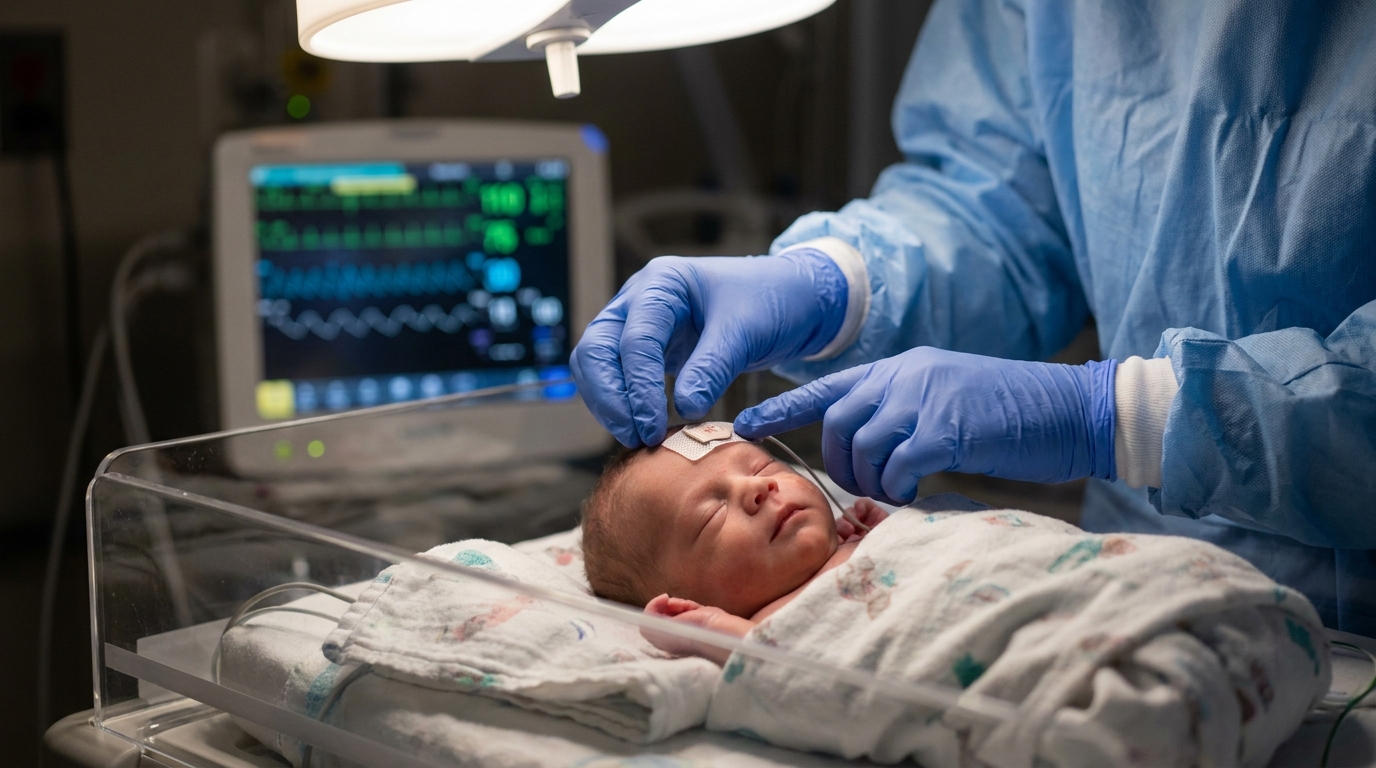
The immediate postnatal transition represents a period of profound physiological vulnerability for preterm infants, where fluctuations in cerebral blood flow can lead to irreversible neurological injury [1]. While clinicians traditionally rely on heart rate and pulse oximetry to guide resuscitation, these metrics often fail to capture the burden of cerebral hypoxia or hyperoxia that occurs within the first minutes of life [2, 3]. Integrating near-infrared spectroscopy (NIRS) allows for real-time monitoring of cerebral regional oxygen saturation, which measures the percentage of oxygenated hemoglobin in brain tissue, offering a potential window to stabilize brain oxygenation through targeted clinical guidelines [4, 5]. Recent meta-analyses involving 667 preterm infants indicate that NIRS-guided resuscitation is associated with a 4.5 percent increase in survival without cerebral injury and a 4.2 percent reduction in intraventricular hemorrhage, or bleeding within the brain's ventricular system [3, 6]. Furthermore, secondary analyses of the COSGOD III trial, a multicenter randomized controlled trial, demonstrated that infants receiving NIRS-guided care had a significantly larger median biparietal diameter (78.6 mm versus 76.7 mm) at near-term age, suggesting enhanced structural brain development [7, 8]. For practicing pediatricians and neonatologists, these findings indicate that early hemodynamic stabilization in the delivery room may correlate with improved neurodevelopmental markers in the months following discharge.
Evaluating the COSGOD III Cohort
To investigate the long-term neurodevelopmental impact of early hemodynamic monitoring, researchers conducted a retrospective ancillary observational study using data from the randomized multicenter COSGOD III trial. The analysis focused on a cohort of 162 preterm infants born at less than 32 weeks of gestation, all enrolled at two specialized Austrian centers in Graz and Innsbruck. The primary objective was to assess differences in early motor outcomes at 6 to 20 weeks corrected age, a metric that adjusts the infant's chronological age for their degree of prematurity, based on their original group allocation. By analyzing video recordings of these infants, the authors sought to determine if stabilizing brain oxygenation in the delivery room translated to measurable improvements in motor repertoire during the first months of life.
The study compared two distinct clinical approaches used during the first 15 minutes after birth. In the near-infrared spectroscopy group (n=76), clinicians utilized continuous monitoring of cerebral regional oxygen saturation to guide resuscitation efforts. In contrast, the control group (n=86) had their cerebral oxygenation levels measured, but these values were blinded to the clinical team, meaning resuscitation followed standard protocols without targeted oxygenation guidance. To ensure the groups were comparable at baseline, the researchers analyzed birth characteristics and found no significant difference in maturity between the cohorts. The monitored group had a median gestational age of 29.6 weeks, while the control group had a median gestational age of 28.8 weeks (p=0.357), establishing a balanced foundation for evaluating subsequent motor development.
Quantifying Early Motor Development
To evaluate the neurological impact of early oxygenation management, the researchers utilized the General Movement Assessment, a non-invasive diagnostic tool used to observe spontaneous movement patterns that serve as markers for the integrity of the young nervous system. These assessments were conducted using video recordings captured when the infants reached 6 to 20 weeks corrected age. Within this framework, the authors applied the Motor Optimality Score-Revised, a standardized metric ranging from 5 to 28. This scoring system allows clinicians to quantify the quality of an infant's motor repertoire, where higher scores indicate a more typical and diverse range of movements that are highly predictive of later motor and cognitive outcomes.
The retrospective analysis revealed that while the presence of normal fidgety movements, defined as the small and elegant movements of the neck, trunk, and limbs expected at this developmental stage, was nearly universal at 95 percent across the entire cohort, the overall quality of movement differed significantly between the two study arms. Infants in the near-infrared spectroscopy group achieved a median Motor Optimality Score-Revised of 26 (interquartile range 24 to 28), whereas the control group achieved a median score of 24 (interquartile range 22 to 26), a difference that reached statistical significance (p=0.003). Furthermore, 83 percent of infants in the monitored group demonstrated an age-adequate motor repertoire compared to only 66 percent in the control group (p=0.003). Although 96 percent of the monitored group and 94 percent of the control group exhibited normal fidgety movements, the higher optimality scores in the intervention arm suggest that targeted cerebral oxygenation during the first 15 minutes of life supports more refined neurological development.
Superior Motor Repertoire with Targeted Oxygenation
The findings highlight a critical clinical nuance regarding how physicians evaluate early motor development following premature birth. While basic markers of neurological health were present in the majority of infants, the overall quality of those movements varied based on the use of near-infrared spectroscopy. Normal fidgety movements were present in 95 percent of the total cohort, and when comparing the two study arms, the researchers found these movements in 96 percent of the monitored group and 94 percent of the control group. This high prevalence suggests that relying solely on the presence or absence of fidgety movements may not be sensitive enough to capture the subtle neuroprotective benefits of early oxygenation management.
However, a more granular assessment using the Motor Optimality Score-Revised demonstrated a clear advantage for infants who received guided resuscitation. Scores were significantly higher in the monitored group, with a median (interquartile range) of 26 (24 to 28) compared to 24 (22 to 26) in the control group (p=0.003). This higher score reflects a more diverse and age-appropriate movement profile, which is clinically relevant for predicting long-term functional independence. Specifically, an age-adequate motor repertoire was observed in 83 percent of infants in the monitored group, whereas only 66 percent of infants in the control group achieved this benchmark (p=0.003). Ultimately, the study concludes that targeted management during the immediate postnatal transition is associated with improved early motor performance, providing clinicians with compelling evidence that stabilizing cerebral oxygenation in the first minutes of life can positively influence long-term neurodevelopmental trajectories.
References
1. Pfurtscheller D, Baik-Schneditz N, Schwaberger B, Urlesberger B, Pichler G. Insights into Neonatal Cerebral Autoregulation by Blood Pressure Monitoring and Cerebral Tissue Oxygenation: A Qualitative Systematic Review. Children. 2023. doi:10.3390/children10081304
2. Hyttel-Sorensen S, Austin T, Bel FV, et al. A phase II randomized clinical trial on cerebral near-infrared spectroscopy plus a treatment guideline versus treatment as usual for extremely preterm infants during the first three days of life (SafeBoosC): study protocol for a randomized controlled trial. Trials. 2013. doi:10.1186/1745-6215-14-120
3. Bruckner M, Suppan T, Suppan E, et al. Brain oxygenation monitoring during neonatal stabilization and resuscitation and its potential for improving preterm infant outcomes: a systematic review and meta-analysis with Bayesian analysis. European Journal of Pediatrics. 2025. doi:10.1007/s00431-025-06138-0
4. Pellicer A, Greisen G, Benders M, et al. The SafeBoosC Phase II Randomised Clinical Trial: A Treatment Guideline for Targeted Near-Infrared-Derived Cerebral Tissue Oxygenation versus Standard Treatment in Extremely Preterm Infants. Neonatology. 2013. doi:10.1159/000351346
5. Hansen M, Pellicer A, Gluud C, et al. Cerebral near-infrared spectroscopy monitoring versus treatment as usual for extremely preterm infants: a protocol for the SafeBoosC randomised clinical phase III trial. Trials. 2019. doi:10.1186/s13063-019-3955-6
6. Monnelly V, Nakwa F, Josephsen J, et al. Near-infrared spectroscopy during respiratory support at birth: a systematic review. Archives of Disease in Childhood. 2025. doi:10.1136/archdischild-2025-328577
7. Hammerl M, Schreiner C, Griesmaier E, et al. Impact of cerebral oxygenation-guided resuscitation during immediate postnatal transition on brain injury and brain growth detected by MRI in very preterm neonates: a secondary outcome analysis of the multicenter randomized phase 3 clinical COSGOD III trial. Italian Journal of Pediatrics. 2026. doi:10.1186/s13052-026-02216-7
8. Wolfsberger CH, Schwaberger B, Urlesberger B, et al. Cerebral oxygenation during immediate fetal-to-neonatal transition and fidgety movements between six to 20 weeks of corrected age: An ancillary study to the COSGOD III trial. European Journal of Pediatrics. 2024. doi:10.1007/s00431-024-05711-3