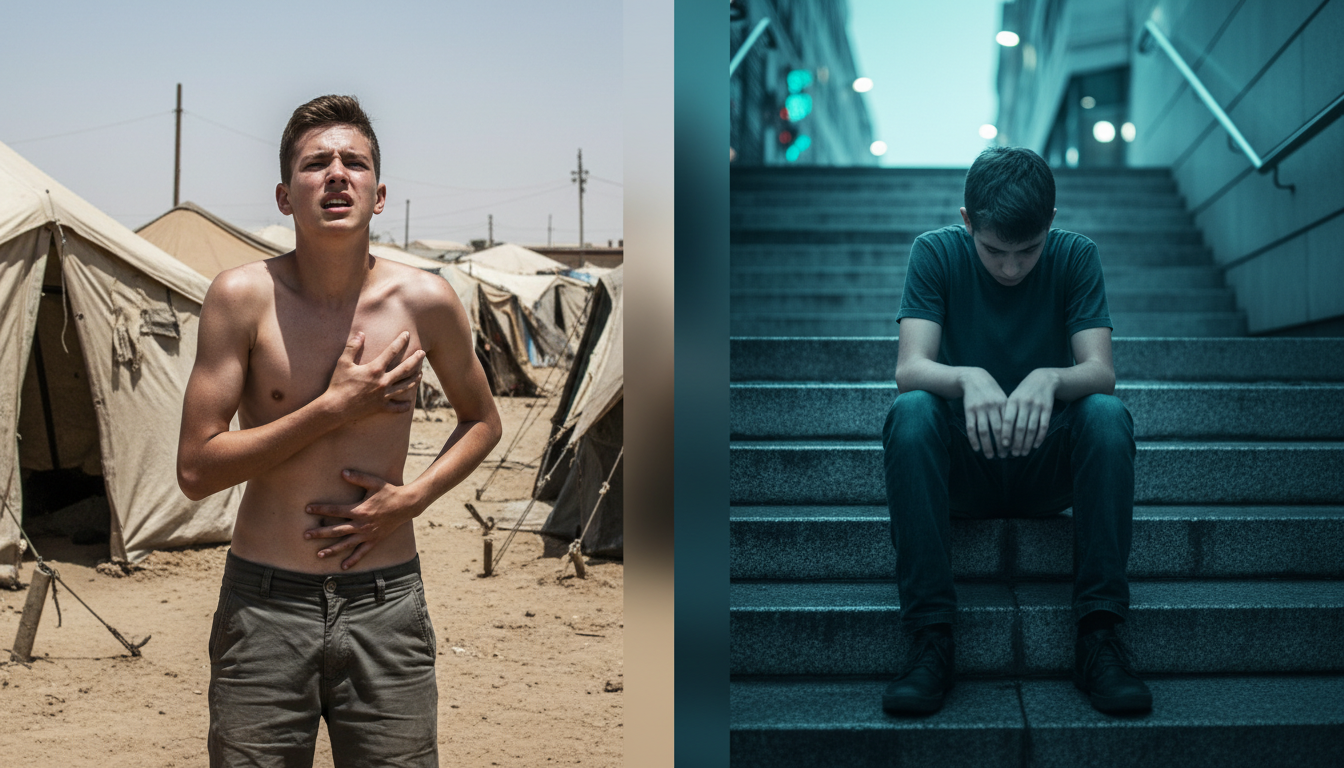
For Doctors in a Hurry
- Researchers investigated how different environmental contexts, specifically refugee camps versus urban resettlement, shape trauma and coping mechanisms among refugee youth.
- The researchers conducted a qualitative meta-synthesis of 24 peer-reviewed studies encompassing 984 refugees to evaluate multilevel environmental influences on mental health.
- Among 248 camp residents, acute distress prevailed, whereas 736 urban refugees, including 677 children, experienced higher chronic depression driven by discrimination.
- The authors concluded that environmental context fundamentally dictates psychological trajectories, with camps amplifying survival-based distress and resettlement causing persistent psychosocial strain.
- Clinicians must implement trauma-informed, culturally responsive interventions tailored to address the distinct stressors of either spatial confinement or social integration.
The Hidden Psychiatric Toll of Forced Displacement on Youth
Over half of the global refugee population consists of children and adolescents under age 18, a demographic highly vulnerable to the psychological fallout of armed conflict and forced displacement [1, 2]. Clinical evaluations consistently reveal high rates of psychiatric morbidity in this group, with post-traumatic stress disorder (PTSD) affecting 22.7% (95% confidence interval, 12.8 to 32.6), depression affecting 13.8% (95% confidence interval, 6.0 to 21.7), and anxiety disorders affecting 15.8% (95% confidence interval, 8.0 to 23.5) of displaced youth [1]. Among unaccompanied refugee minors, these rates can be even more severe, with PTSD prevalence reaching up to 43% and depression up to 61.6% in a review of 80,651 youths [3]. While the immediate focus of asylum is physical safety, this enduring mental health burden places these children at severe risk for long-term educational disadvantage and poor social integration in host communities [1]. Consequently, clinicians must prioritize evidence-based trauma-focused treatments, as eye movement desensitization and reprocessing (EMDR) therapy and cognitive behavioral therapy (CBT) yield large (effect size -1.63) and medium (effect size -0.55) reductions in post-traumatic stress symptoms, respectively [4].
Mapping Environmental Impact on Mental Health
To understand how different post-displacement environments shape psychiatric symptoms, researchers conducted a qualitative brief meta-synthesis (a systematic review method that pools non-numerical, narrative data from multiple studies to identify overarching clinical themes) involving 984 refugees. The analysis incorporated 24 peer-reviewed qualitative and mixed-methods studies published between 2017 and 2025. To ensure a comprehensive review of the clinical literature, the investigators retrieved these studies from five major academic databases: PsycINFO, PubMed/Medline, Scopus, CINAHL, and Web of Science. The research team structured their analysis following the five-stage approach proposed by Lachal et al., a standardized methodological framework designed to systematically synthesize qualitative data and identify recurring clinical themes across diverse patient narratives.
The synthesis was explicitly guided by Bronfenbrenner’s ecological model, a theoretical framework that examines how different layers of a child's environment interact to influence their development and well-being. By applying this model, the researchers aimed to capture multilevel environmental influences on mental health. For practicing physicians, this approach is highly relevant because it moves beyond individual pathology to highlight how external factors, such as spatial confinement in camps or social isolation in urban settings, directly exacerbate or mitigate psychiatric morbidity. Understanding these multilevel influences allows clinicians to better contextualize a patient's trauma and tailor interventions to the specific structural stressors present in their current living environment.
Acute Distress and Somatization in Refugee Camps
To better understand the psychiatric burden on displaced youth, the concept of severely deprived children has recently been integrated into the study of refugee populations. This framework helps clinicians navigate the paradox inherent in many displacement settings. While refugee camps are designed to ensure physical safety, they often expose young residents to chronic deprivation, limited mobility, and psychosocial isolation. The researchers found that across both camp and urban contexts, post-traumatic stress disorder (PTSD), depression, anxiety, and somatization were consistently prevalent. Despite this shared baseline of psychiatric illness, the clinical presentation of these conditions differed significantly depending on the environmental context. This divergence requires clinicians to look beyond standard diagnostic criteria and consider how a patient's immediate surroundings shape their symptom profile.
To isolate the effects of camp environments, the analysis included data from four refugee camps comprising 248 individuals. Within these specific settings, the researchers observed that cumulative trauma exposure, legal uncertainty, and spatial confinement intensified acute distress and collective grief. Clinically, this means that children living in camps are not merely experiencing standard trauma responses. Instead, distress often manifested through somatic symptoms and perceived helplessness. Physicians evaluating these patients should be highly attuned to unexplained physical complaints, such as chronic headaches or abdominal pain, as somatization frequently serves as the primary expression of acute psychological distress in confined, highly uncertain environments.
Chronic Depression and Isolation in Urban Resettlement
Moving away from the spatial confinement of camps, the researchers also evaluated the psychiatric profiles of displaced youth living in cities. The analysis included 19 urban resettlement cases comprising 736 individuals, of which 677 were children. The study noted that while urban resettlement may foster autonomy and integration, it simultaneously introduces new forms of structural and cultural stress. For clinicians, this means that relocating a child to a city does not eliminate their psychiatric risk; rather, it shifts the environmental pressures they face.
This shift in environmental stressors directly alters the clinical presentation of these patients. The researchers found that in urban resettlement, refugees displayed lower acute stress but higher chronic depression and adjustment difficulties. Unlike the acute, survival-based distress and somatization seen in camp environments, the psychiatric burden in cities is more insidious and prolonged. The data indicated that chronic depression and adjustment difficulties in urban resettlement were largely driven by discrimination, social isolation, and integration challenges. Physicians treating resettled youth must therefore screen proactively for persistent depressive symptoms and social withdrawal, recognizing that the cultural friction and isolation inherent in urban integration can be just as psychologically damaging as the trauma of initial displacement.
Tailoring Clinical Interventions to the Post-Displacement Context
The clinical data clearly demonstrate that environmental context fundamentally shapes refugee children’s psychological trajectories, with camps amplifying survival-based distress and resettlement introducing persistent psychosocial strain. For practicing physicians, recognizing this dichotomy is a critical diagnostic step. Understanding how environmental context shapes trauma and coping among refugee youth is essential to designing context-sensitive interventions. A uniform approach to psychiatric care will likely fail if it ignores the immediate structural realities of the patient. Clinicians must assess whether a child is reacting to the acute spatial confinement of a camp or the chronic social isolation of a new city, and adjust their therapeutic targets accordingly.
Despite the severe psychiatric burden observed across both settings, the clinical picture is not entirely defined by pathology. Refugee narratives emphasized hope, agency, and bicultural adaptation as key resilience mechanisms. Physicians can actively leverage these protective factors during treatment, encouraging patients to build a sense of personal control and navigate their dual cultural identities to buffer against ongoing stress. To support these clinical efforts on a broader scale, policies must integrate trauma-informed and culturally responsive interventions that address both confinement-related and integration-related stressors. By aligning public health strategies with the specific environmental drivers of psychiatric illness, healthcare systems can better mitigate the long-term mental health consequences of forced displacement.
References
1. Blackmore R, Gray KM, Boyle JA, et al. Systematic Review and Meta-analysis: The Prevalence of Mental Illness in Child and Adolescent Refugees and Asylum Seekers.. Journal of the American Academy of Child and Adolescent Psychiatry. 2020. doi:10.1016/j.jaac.2019.11.011
2. Kadir A, Shenoda S, Goldhagen J. Effects of armed conflict on child health and development: A systematic review. PLoS ONE. 2019. doi:10.1371/journal.pone.0210071
3. Daniel-Calveras A, Baldaquí N, Baeza I. Mental health of unaccompanied refugee minors in Europe: A systematic review.. International Journal of Child Abuse & Neglect. 2022. doi:10.1016/j.chiabu.2022.105865
4. Velu ME, Kuiper RM, Schok M, Sleijpen M, Roos CD, Mooren T. Effectiveness of trauma-focused treatments for refugee children: a systematic review and meta-analyses.. European journal of psychotraumatology. 2025. doi:10.1080/20008066.2025.2494362