For Doctors in a Hurry
- Researchers investigated whether prehospital whole-blood transfusion reduces death or massive transfusion (requiring 10 or more units) in severe hemorrhage.
- This phase 3 randomized trial analyzed 616 patients treated by air ambulance services for major traumatic hemorrhage.
- The primary outcome occurred in 48.7% of whole-blood and 47.7% of standard-care patients (relative risk, 1.02; 95% confidence interval, 0.80 to 1.31).
- The authors concluded that prehospital whole-blood transfusion is not superior to standard care for life-threatening traumatic hemorrhage.
- Clinicians can confidently continue using standard blood components for prehospital trauma, as whole blood provides no additional survival benefit.
The Resurgence of Whole Blood in Trauma Resuscitation
Uncontrolled hemorrhage remains the leading preventable cause of death among trauma patients, with up to half of these fatalities occurring before the patient ever reaches a hospital [1]. Resuscitation for hemorrhagic shock has increasingly shifted toward prehospital whole blood transfusion, driven by military experience and civilian meta-analyses showing that whole blood reduces 24-hour mortality by an absolute risk reduction of 4.6 percentage points compared to standard component therapy [2, 3, 4]. Despite this enthusiasm for early whole blood administration, high-quality randomized data comparing it directly to standard component therapy in the prehospital setting have remained scarce. A newly published randomized trial now offers fresh insights into whether administering whole blood before hospital arrival truly provides a survival advantage for patients with major traumatic hemorrhage [5].
Trial Design and Prehospital Interventions
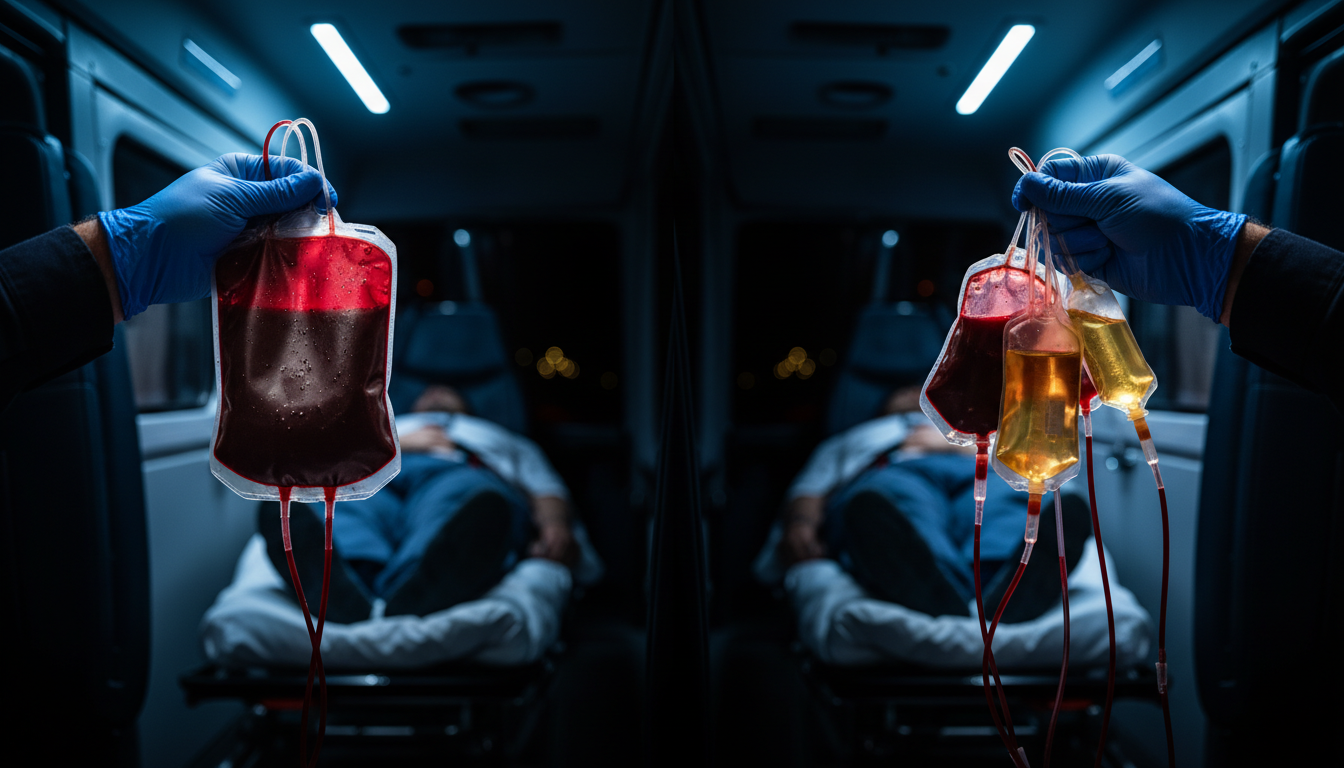
To evaluate the efficacy of prehospital whole blood, researchers conducted a pragmatic, phase 3, multicenter, unblinded, randomized, superiority trial across 10 air ambulance services in England. This specific trial design was chosen to determine if the experimental intervention is definitively better than standard practice under real-world clinical conditions. The trial enrolled patients with major traumatic hemorrhage who were attended by a participating air ambulance service. Initially, a total of 942 patients underwent randomization. To ensure the cohort strictly represented severe traumatic bleeding, the investigators excluded participants with nontraumatic hemorrhage or traumatic cardiac arrest from the final analysis. Following these exclusions, the final analysis included 616 patients, comprising 314 patients in the whole-blood group and 302 patients in the standard-care group. Upon enrollment, patients were randomly assigned to receive either prehospital whole-blood transfusion or standard care with blood components. In the experimental arm, the whole-blood transfusion group received up to 2 units of whole blood before arrival at the hospital. In contrast, the standard care group received up to 2 units each of red cells and plasma before arrival at the hospital. To measure clinical effectiveness, the researchers established a primary outcome defined as a composite of death from any cause or massive transfusion within 24 hours after randomization. The study defined massive transfusion as receiving 10 or more units of blood components or products. This composite endpoint, a statistical tool that combines multiple related clinical events into a single measurable outcome, allowed the investigators to capture both early mortality and the ongoing need for aggressive hemostatic resuscitation in the critical hours following injury.
Primary Outcomes Show No Superiority
The analysis revealed no statistical difference in the primary composite outcome between the two resuscitation strategies. A primary-outcome event occurred in 48.7% of the participants in the whole-blood group, compared to 47.7% of the participants in the standard-care group. The researchers calculated that the relative risk for the primary outcome between the whole-blood and standard-care groups was 1.02 (with a 95% confidence interval of 0.80 to 1.31 and a P = 0.84). This indicates that the use of whole blood did not confer a measurable advantage over component therapy for the combined endpoint of early mortality or severe bleeding requiring extensive resuscitation. Beyond the 24-hour composite endpoint, the secondary outcomes also failed to demonstrate a benefit for the experimental intervention. The incidence of death from any cause at all time points appeared to be similar in the two groups. Furthermore, the incidence of massive transfusion and other secondary outcomes appeared to be similar in the two groups. Based on these findings, the trial concluded that prehospital transfusion of 2 units of whole blood was not superior to standard care in reducing the risk of death or massive transfusion within 24 hours. For clinicians managing life-threatening hemorrhage in the field or receiving these patients in the trauma bay, these data suggest that standard component therapy remains equally effective for initial stabilization, allowing emergency departments to rely on established blood bank protocols without compromising patient survival.
Coagulation Profiles and Adverse Events
When evaluating laboratory markers of coagulation, the researchers noted differences in clotting metrics between the two cohorts. Specifically, prothrombin times were above the normal range in 40.7% of the participants in the whole-blood group, compared to 30.5% of the participants in the standard-care group. For clinicians managing trauma, an elevated prothrombin time indicates a prolonged clotting duration, which is a critical metric to monitor during the ongoing resuscitation of patients with severe hemorrhage. This finding suggests that patients receiving whole blood may require closer monitoring of their coagulation cascade upon hospital arrival. Regarding the safety profile of the interventions, the study tracked complications following prehospital transfusion. Serious adverse events occurred in 37 participants in the standard-care group and 31 participants in the whole-blood group. Despite theoretical concerns that administering unseparated whole blood might increase the risk of pathological clotting, the incidence of thrombotic events appeared to be similar in the whole-blood and standard-care groups. Finally, the authors disclosed that the trial was funded by NHS Blood and Transplant and others, providing transparency regarding the financial support for this large-scale prehospital investigation.
References
1. Risha M, Alotaibi AM, Smith SA, et al. Does early transfusion of cold-stored whole blood reduce the need for component therapy in civilian trauma patients? A systematic review. Journal of Trauma and Acute Care Surgery. 2024. doi:10.1097/TA.0000000000004429
2. Horst RAVD, Rijnhout TWH, Noorman F, et al. Whole blood transfusion in the treatment of acute hemorrhage, a systematic review and meta-analysis.. The journal of trauma and acute care surgery. 2023. doi:10.1097/TA.0000000000004000
3. Ibrahim W, Monge KM, Menzel J, et al. Whole-Blood vs Component Therapy in Adult Trauma: An Updated Systematic Review and Meta-Analysis.. JAMA surgery. 2026. doi:10.1001/jamasurg.2026.0197
4. Butler FK, Holcomb JB, Shackelford S, et al. Advanced Resuscitative Care in Tactical Combat Casualty Care: TCCC Guidelines Change 18-01:14 October 2018. Journal of Special Operations Medicine. 2018. doi:10.55460/yjb8-zc0y
5. Smith JE, Cardigan R, Sanderson E, et al. Prehospital Whole Blood in Traumatic Hemorrhage - a Randomized Controlled Trial.. The New England journal of medicine. 2026. doi:10.1056/NEJMoa2516043